हिंदी में पढ़ें —JantaScope हिंदी
Finance

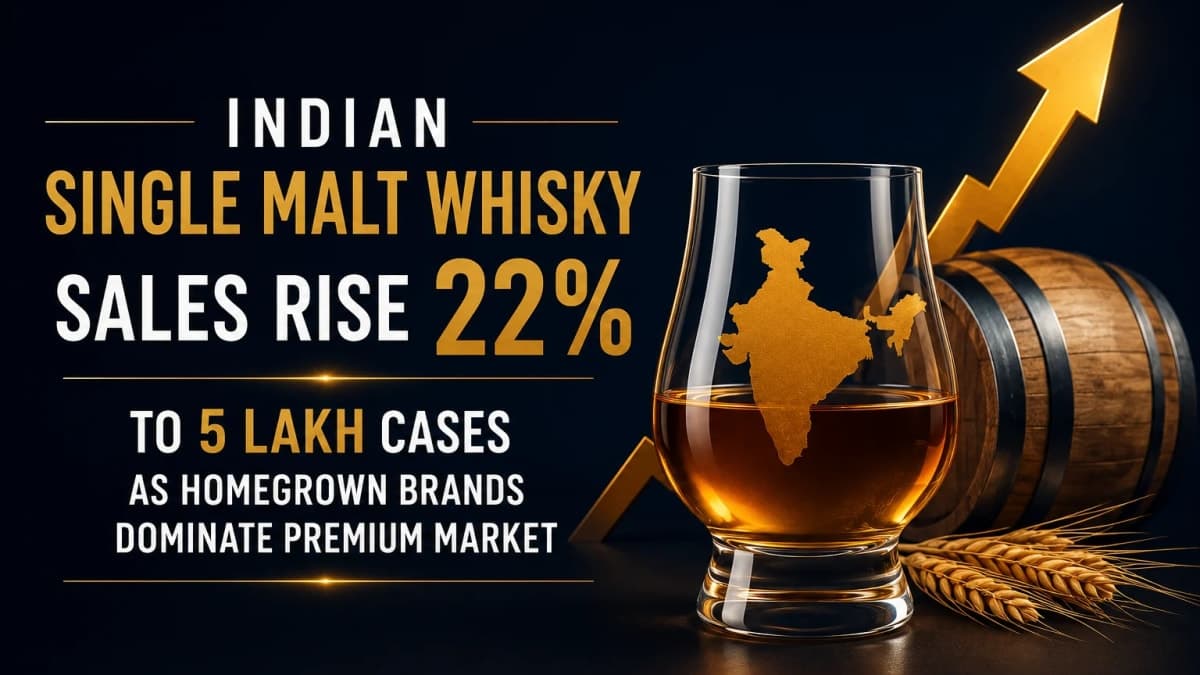
Indian Single Malt Whisky Sales Rise 22% to 5 Lakh Cases as Homegrown Brands Dominate Premium Market

India's single malt whisky industry continued its rapid expansion in 2025, with sales climbing around 22% to nearly 5 lakh nine-litre cases. Domestic manufacturers accounted for an estimated 92% of the Made-in-India single malt segment, highlighting the growing popularity of premium Indian whisky brands among consumers.

Indian Single Malt Whisky Sales Rise 22% to 5 Lakh Cases as Homegrown Brands Dominate Premium Market

By Jeet Nirmal

Source: Janta Scope

Indian Single Malt Whisky Sees Strong Growth, Homegrown Brands Cement Market Leadership

India's premium whisky segment recorded another year of impressive growth as sales of Made-in-India single malt whisky reached nearly 5 lakh nine-litre cases in 2025, according to estimates released by the Confederation of Indian Alcoholic Beverage Companies (CIABC). The category expanded by approximately 22% over the previous year, reflecting rising consumer demand for premium spirits and growing confidence in Indian-produced labels.

The latest figures also underline the dominance of domestic manufacturers, which accounted for an estimated 92% of total sales within the Made-in-India single malt category. Indian distillers have steadily strengthened their position by combining quality production, international recognition, and expanding product portfolios aimed at premium consumers.

Premiumisation Continues to Drive Growth

Industry experts attribute the category's expansion to India's ongoing premiumisation trend, where consumers are increasingly choosing higher-quality alcoholic beverages instead of focusing purely on volume.

Indian single malts have benefited from improved craftsmanship, climate-driven maturation characteristics, innovative cask finishes, and increasing international awards. These factors have helped transform the category from a niche offering into one of the fastest-growing premium segments in the Indian spirits industry.

Indian Brands Lead the Market

Established Indian whisky makers continue to dominate the segment, with brands such as Amrut, Rampur, Indri and Paul John among the leading names. Newer entrants including Solan Gold, GianChand, Doaab, Crazy Cock, Aaghaz and Gamber Valley have also contributed to expanding consumer choice and increasing competition in the premium category.

Multinational liquor companies remain present through Indian-produced brands, but together they account for only a small share of the Made-in-India single malt market compared with domestic producers.

Overall Single Malt Market Continues to Expand

When imported single malt whiskies are included alongside Indian-produced labels, India's overall single malt market is estimated to have reached around 8.5 lakh cases in 2025.

The continued expansion reflects changing consumer preferences, with more buyers willing to spend on premium spirits that offer distinctive production methods, regional identity and craft positioning.

Industry Pushes for Quality Standards

To strengthen consumer confidence and reinforce authenticity, the Indian Malt Whisky Association has introduced a certification hologram that will be awarded only to producers meeting defined production standards.

The initiative aims to establish clearer quality benchmarks for Indian malt whisky while supporting the industry's growing reputation in both domestic and international markets.

Why This Story Matters

The strong growth of Indian single malts reflects a broader transformation within India's alcoholic beverages industry. Consumers are increasingly embracing premium domestic products, while Indian distilleries are gaining recognition for producing globally competitive whiskies.

For the industry, rising demand creates opportunities for higher investment, exports, tourism and brand development. At the same time, the segment remains subject to regulatory challenges, taxation policies and growing competition from imported whiskies, making innovation and quality essential for sustaining future growth.

Related

More stories

India’s Q2 Economic Indicators Signal Strong Momentum Ahead of Festive Season

India ended the July-September quarter with encouraging signals across manufacturing, industrial production, tax collections, digital payments and parts of the automobile market. The data point to resilient economic activity ahead of the festive season, although inflation, energy costs and uneven rural-facing demand remain important risks.

Finance

India’s Q2 Economic Indicators Signal Strong Momentum Ahead of Festive Season

India-US Trade Deal Not Imminent, USTR Says as Negotiations Enter Final Stretch

India and the United States are continuing negotiations on a bilateral trade agreement, but an immediate breakthrough should not be expected, US Trade Representative Jamieson Greer said. His comments came after discussions with Indian Commerce and Industry Minister Piyush Goyal at the G20 Trade Ministers’ Meeting in Milwaukee. Both sides say negotiations are progressing, although unresolved issues remain.

Finance

India-US Trade Deal Not Imminent, USTR Says as Negotiations Enter Final Stretch

Finance Ministry Sees India’s Q2 FY27 GDP Growth at 7.3%, but Global Risks Cloud Outlook

India’s Finance Ministry expects real GDP to grow around 7.3% in the July–September quarter of FY27, extending the economy’s strong start to the fiscal year. The estimate is notably above the Reserve Bank of India’s 6.4% projection for the quarter, although the ministry has warned that oil prices, trade uncertainty and tighter global financial conditions remain important risks

Finance

Finance Ministry Sees India’s Q2 FY27 GDP Growth at 7.3%, but Global Risks Cloud Outlook

FPI Outflows Cross ₹1 Trillion in H1 FY27 as Global Pressures Weigh on Indian Markets

Foreign portfolio investors remained cautious toward Indian markets during the first half of FY27, with net selling reaching ₹1.29 trillion. Financial services, oil and gas, automobiles and telecom faced significant withdrawals, while selected consumer and services sectors continued to attract overseas capital.

Finance

FPI Outflows Cross ₹1 Trillion in H1 FY27 as Global Pressures Weigh on Indian Markets

RBI FX Swaps Open Cheaper Dollar Funding Route for Some Indian Companies

The Reserve Bank of India’s large-scale dollar-rupee swap operations are reshaping currency-market pricing and creating an unusual funding opportunity for some Indian companies. Higher forward premiums mean eligible corporates may be able to borrow in rupees and convert that liability into dollars through currency swaps at a lower effective cost than borrowing directly overseas.

Finance

RBI FX Swaps Open Cheaper Dollar Funding Route for Some Indian Companies

Finance Ministry Estimates India’s Q2 GDP Growth at 7.3% as Momentum Moderates

India’s Finance Ministry expects the economy to grow by 7.3% in the July–September quarter of FY2026-27, according to its nowcasting model. The estimate points to continued economic expansion after 7.8% real GDP growth in April–June, although the ministry has also highlighted risks from geopolitical tensions, trade uncertainty, rising oil prices and tighter global financial conditions.

Finance

Finance Ministry Estimates India’s Q2 GDP Growth at 7.3% as Momentum Moderates