India’s AI Infrastructure Push Enters a New Phase
India’s data-centre market is expanding rapidly as artificial intelligence changes the amount—and type—of computing infrastructure required by businesses, cloud providers and technology companies.
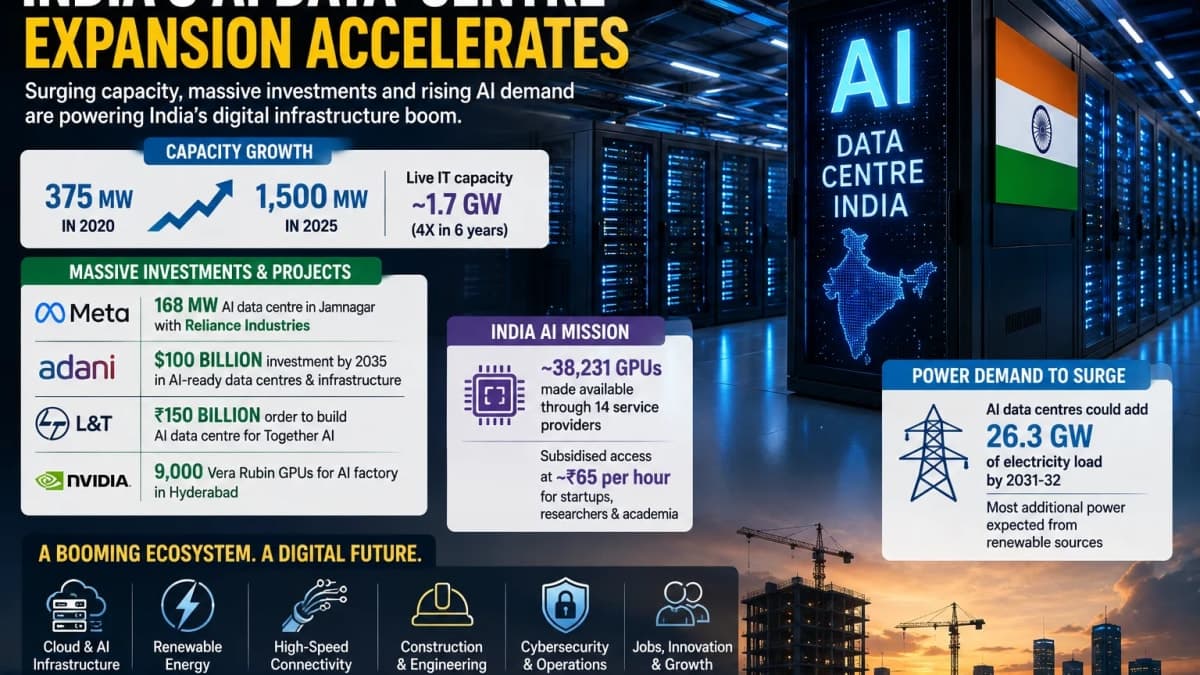
The country’s data-centre capacity increased from roughly 375 megawatts in 2020 to around 1,500 MW in 2025, according to the Ministry of Electronics and Information Technology. The government says AI and high-performance computing are now adding further demand for capacity.
More recent industry estimates point to another significant acceleration. BloombergNEF data cited in Indian media put live IT capacity at about 1.7 GW, roughly four times the level six years earlier, and described India as a leading growth market among major Asia-Pacific data-centre markets outside China.
The numbers demonstrate an important shift: data centres are no longer simply supporting India's internet economy. Increasingly, they are becoming part of the physical infrastructure required for the AI economy.
AI Is Changing What a Data Centre Needs to Be
Traditional data centres primarily supported websites, enterprise applications, databases, streaming services and cloud computing.
Artificial intelligence introduces a much more demanding category of workload.
Training large AI models can require thousands of high-performance accelerators operating simultaneously. Running those models at scale—known as inference—can also require substantial computing capacity close to users.
As a result, developers are increasingly designing facilities around high-density server racks, advanced networking and sophisticated cooling.
The shift can be dramatic. Equinix India managing director Manoj Paul recently described how rack densities are moving from conventional levels of around 6 kW toward AI configurations reaching as high as 150 kW. Such densities make power delivery and technologies such as liquid cooling increasingly important.
India Could Add Gigawatts of AI Computing Capacity
Expectations for future growth are substantial.
Brookfield Asset Management expects around 6.5 GW of AI-related data-centre capacity to come online across India over the next five years as demand for AI inference increases. The estimate refers to the broader Indian market rather than Brookfield's own projects.
Other projections use different definitions and therefore produce different totals. Wood Mackenzie, for example, forecasts India's overall operational data-centre capacity could increase from 2.2 GW in 2025 to 12 GW by 2030, while AI-dedicated capacity could expand almost 24-fold.
The variation between forecasts is worth noting. Estimates depend on how analysts define operational, planned, AI-dedicated and total capacity. Nevertheless, they point in the same direction: India's computing infrastructure is expected to expand dramatically.
Major AI Projects Are Beginning to Take Shape
The boom is becoming visible through individual projects.
In June, Meta announced an agreement with Reliance Industries to lease its first AI-enabled data centre in India. The Jamnagar facility is expected to begin with 168 MW of capacity, with options to expand. Meta said the project would be powered by renewable energy and cooled using desalinated seawater.
Infrastructure activity is spreading elsewhere as well. In August, Larsen & Toubro secured an order worth up to ₹150 billion to develop an AI data centre for U.S.-based Together AI using high-performance Nvidia chips.
Meanwhile, AM Intelligence has ordered 9,000 Nvidia Vera Rubin GPUs for an AI factory in Hyderabad, potentially making the facility one of Asia's early deployments of the new computing platform.
These projects illustrate how AI infrastructure is moving from forecasts and investment announcements toward physical deployment.
Adani Makes a Massive Long-Term AI Infrastructure Bet
Another major commitment has come from Adani Group.
In February, the group announced plans to invest $100 billion through 2035 in renewable-energy-powered, hyperscale AI-ready data centres and related sovereign AI infrastructure.
Adani estimates the investment could catalyse another $150 billion across areas including servers, electrical infrastructure and cloud platforms, although those figures represent company projections rather than guaranteed investment outcomes.
The scale of these announcements demonstrates how data centres are increasingly intersecting with India's energy, construction, semiconductor, cloud and telecommunications sectors.
IndiaAI Is Expanding Access to GPUs
Private investment is only one part of India's computing strategy.
Under the government's AI compute framework, approximately 38,231 GPUs had been onboarded through 14 empanelled service providers and data centres as of March.
The government said eligible startups, researchers and academic institutions could access computing resources at a subsidised average rate of around ₹65 per hour.
That matters because access to advanced GPUs has become a significant barrier for smaller AI companies.
Large technology companies can spend billions building dedicated infrastructure. Startups and researchers generally cannot.
Providing shared computing capacity could therefore allow Indian AI developers to experiment and build models without owning expensive GPU clusters themselves.
Mumbai Leads, but the Map Is Expanding
India's data-centre industry has historically been concentrated around major digital and commercial hubs.
As of January 2026, India had 271 data centres, with Mumbai, Hyderabad, Delhi-NCR, Bengaluru and Chennai collectively accounting for nearly 65% of facilities, according to a Rubix Data Sciences report.
The next phase could produce a more geographically diverse market.
Jamnagar is emerging through the Reliance-Meta development, Hyderabad continues to attract large AI projects, and states including Gujarat are actively seeking additional AI and data-centre investment.
Location decisions increasingly depend on more than proximity to internet users. Developers must consider electricity availability, renewable-energy access, fibre connectivity, land, water, skilled workers and long-term operating costs.
The Biggest Challenge Could Be Electricity
The same AI boom creating investment opportunities could also place enormous pressure on India's electricity infrastructure.
The Ministry of Power has projected that AI data centres could add approximately 26.3 GW of electricity load by 2031-32, with much of the additional requirement expected to be supported by renewable generation.
This is one of the most important issues surrounding the expansion.
AI servers consume considerably more electricity than conventional computing infrastructure. They also produce large quantities of heat, meaning additional energy may be required for cooling.
Consequently, building an AI data centre is increasingly tied to building—or securing access to—generation, transmission and cooling infrastructure.
Water and Cooling Create Another Sustainability Test
Electricity is not the only resource concern.
High-density computing equipment generates enormous amounts of heat. Keeping servers within safe operating temperatures can require sophisticated cooling systems, potentially creating significant water requirements depending on the technology used.
The Indian government says the industry is adopting advanced cooling technologies, including systems intended to reduce water consumption, while high-density rack designs are being deployed for AI and high-performance computing.
Still, the environmental impact will depend heavily on where projects are located and how they obtain electricity and water.
This makes sustainability a competitive issue rather than merely an environmental one.
Why the Data-Centre Boom Matters for India
The economic opportunity extends far beyond buildings filled with servers.
A large AI infrastructure ecosystem requires construction companies, electrical equipment, fibre networks, cooling technology, renewable-energy projects, engineers, cybersecurity specialists, cloud platforms and hardware maintenance.
KPMG estimates an approximately $90 billion opportunity could emerge across India's end-to-end data-centre value chain by FY2035.
The Indian government has also argued that expansion of the sector could generate significant engineering employment.
More strategically, domestic computing capacity could reduce dependence on overseas infrastructure for some AI workloads and help Indian companies process data closer to their users.
A Huge Opportunity With Equally Large Infrastructure Demands
India has several advantages in the race to build AI infrastructure: a vast digital consumer market, a major software industry, growing cloud adoption and expanding renewable-energy capacity.
But AI data centres are physical infrastructure on an enormous scale.
Their success depends on reliable electricity, transmission networks, water management, land availability, connectivity and access to advanced chips. Communities and governments will also increasingly scrutinise whether the economic benefits justify the resources required.
That means India's AI data-centre expansion should not be measured solely by gigawatts announced.
The more important measure will be whether the country can build computing infrastructure that is economically competitive, technically reliable and environmentally sustainable.
If it can, the current wave of investment could move India from being primarily one of the world's largest consumers and developers of digital technology toward becoming one of the major physical computing hubs powering the global AI economy.
This article is based on reporting published by ETDatacenters com.