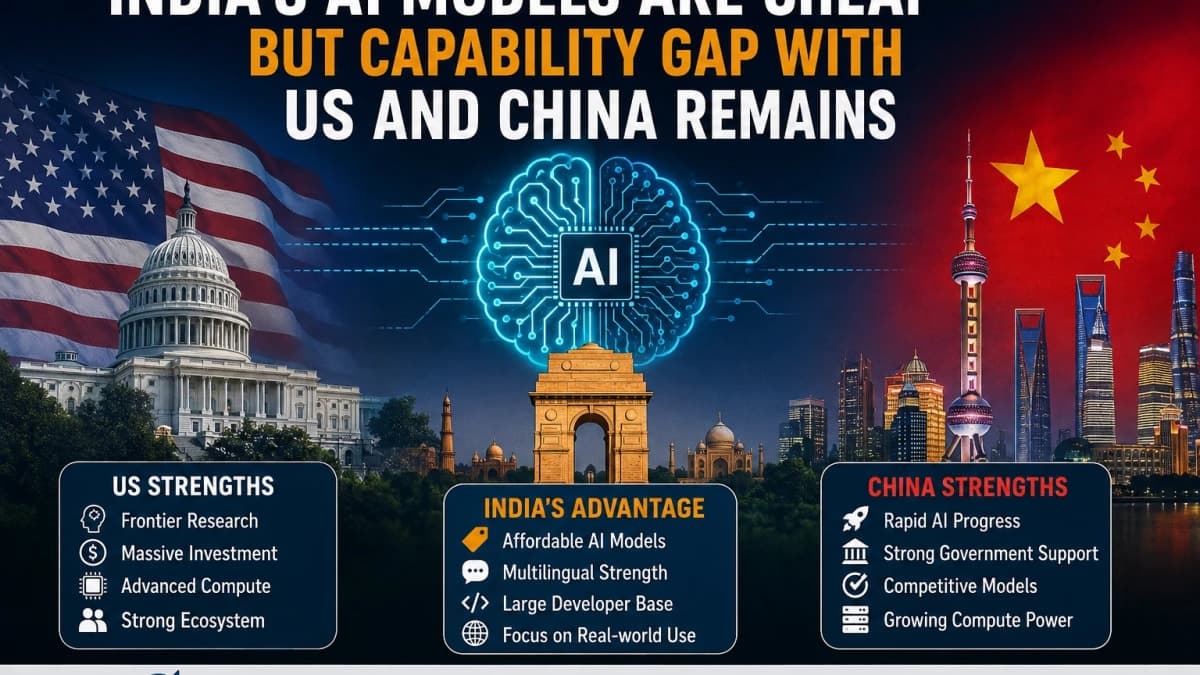
India Builds Its AI Strategy Around Affordability
India’s artificial intelligence ecosystem is beginning to develop an identity of its own: build AI that is affordable, scalable and designed for the realities of a vast multilingual market.
Rather than simply attempting to replicate the enormous frontier-model investments being made in the United States and China, Indian developers are increasingly focusing on efficient models, local-language capabilities and applications that can operate at comparatively lower costs.
That approach could become an important advantage for a country where AI adoption needs to reach businesses, government services and consumers across dramatically different income levels and technological environments.
However, lower cost alone does not mean India has caught up with the world's AI leaders.
The broader global AI landscape remains heavily influenced by the United States and China, which possess significantly deeper ecosystems for frontier-model development, advanced computing infrastructure, research and capital. Recent analysis of the global AI race continues to place India among the important emerging AI powers while identifying computing capacity and advanced technology as areas where it remains behind the two leaders.
US and China Remain the Frontier Competitors
The scale of competition at the top of the AI industry illustrates the challenge facing India.
The United States has built a powerful ecosystem around frontier AI laboratories, semiconductor technology, cloud infrastructure and enormous private investment. Stanford’s 2026 AI Index reported that US private AI investment reached $285.9 billion in 2025, demonstrating the extraordinary amount of capital flowing into the American ecosystem.
China, meanwhile, has made rapid progress in model development while pursuing its own domestic technology ecosystem.
Importantly, the old assumption that Chinese models remain substantially behind their American counterparts is becoming outdated. Stanford’s technical analysis found that the performance difference between leading US and Chinese models had effectively narrowed to a small margin by early 2026, with the top US model ahead by only 2.7% as of March.
Recent Chinese models have also combined increasingly competitive performance with aggressive pricing, making cost efficiency itself a major part of the global AI battle.
For India, therefore, the target is moving quickly.
India’s Advantage Could Be “Frugal AI”
Trying to win solely by producing the world's largest model may not be India’s strongest strategy.
Countries and companies with limited access to massive quantities of cutting-edge computing hardware are increasingly experimenting with smaller and more efficient models. This broader trend toward “frugal AI” attempts to reduce computing requirements while creating systems designed for specific populations and applications.
India is particularly well positioned to explore this approach because its domestic market creates challenges that frontier models developed elsewhere may not always address efficiently.
Indian AI systems can be optimized for regional languages, voice interactions, government services, agriculture, education, healthcare and small businesses rather than competing exclusively on general-purpose benchmark scores.
That creates two different definitions of AI success.
One is frontier capability—building the most powerful general-purpose models.
The other is deployment efficiency—delivering useful AI to hundreds of millions of people at sustainable costs.
India may have a stronger near-term opportunity in the second category.
Sovereign Models Are Expanding India’s AI Ecosystem
India has also accelerated efforts to develop domestic foundation models.
Companies and projects including Sarvam AI, Gnani.ai and BharatGen have been part of the broader push toward AI systems designed around Indian languages and requirements. Government initiatives have simultaneously sought to expand datasets, computing infrastructure, startup support and AI skills.
This matters beyond technological prestige.
Domestic models can reduce dependence on foreign AI platforms while giving Indian developers greater control over language coverage, data governance, deployment costs and customization.
For a country with hundreds of languages and dialects, linguistic capability could become one of the most strategically important areas of domestic AI development.
The Compute Challenge Cannot Be Ignored
Efficient models can reduce infrastructure requirements, but they cannot completely eliminate the importance of computing power.
Training frontier AI systems requires enormous clusters of advanced accelerators, sophisticated data infrastructure and substantial electricity and capital. Access to those resources influences how quickly researchers can experiment, train larger systems and improve their models.
The US remains particularly strong at the infrastructure and frontier-model layers, while China has invested heavily in domestic chips, research and large-scale AI adoption.
India is expanding sovereign compute infrastructure, but closing the gap will require sustained investment rather than a single generation of models.
Talent Is a Strength—but Retaining It Matters
India possesses another potentially powerful advantage: its large technology workforce.
The country already plays a major role in global software engineering and IT services, giving businesses a substantial base of developers who can transition toward AI engineering, deployment and enterprise integration.
Yet frontier AI requires more than conventional software talent.
Researchers specializing in model architecture, advanced mathematics, large-scale training, AI safety, semiconductor design and distributed computing remain highly valuable globally.
Building research institutions and companies capable of retaining such specialists will therefore be just as important as training larger numbers of AI developers.
Why the Capability Gap Matters
Dependence on foreign frontier models could eventually become a strategic issue.
Artificial intelligence is increasingly becoming infrastructure for software development, financial services, education, healthcare, defence, scientific research and government operations.
Countries that control powerful foundation models and computing infrastructure could therefore gain economic and technological advantages extending far beyond the AI industry itself.
For India, building domestic capability provides greater strategic flexibility while allowing AI products to be adapted to local languages, regulations and social conditions.
India Does Not Necessarily Need to Copy America or China
There is also a risk in measuring India's AI progress exclusively by whether its largest model beats an American or Chinese model on international benchmarks.
The US-China competition itself shows that different strategies are possible. The United States has benefited enormously from private capital and frontier AI companies, while China has increasingly combined domestic technological development with low-cost and open-model strategies.
India could build a third path centered on affordability, multilingual AI, open technology, specialized models and population-scale deployment.
Its experience with low-cost digital infrastructure provides a useful precedent: technological influence does not always require producing the most expensive system.
Balanced Analysis: Cost Advantage Is Valuable, but Not Enough
India’s emerging AI ecosystem should therefore be viewed with both optimism and caution.
Affordable models can dramatically expand AI adoption. Models trained specifically for Indian languages and use cases may also outperform much larger global systems in narrowly defined domestic applications.
But efficiency should not become an excuse for underinvestment in frontier research.
The US and China continue to advance rapidly, and the competition between them is becoming increasingly sophisticated. China in particular has demonstrated that relatively low-cost models and frontier-level capabilities are not necessarily mutually exclusive.
India ultimately needs both sides of the equation: frugal AI that can serve its enormous domestic market and deeper frontier capabilities that prevent long-term technological dependence.
What Comes Next
The next stage of India's AI journey will depend less on how many models are announced and more on how those models perform in real-world environments.
Success will require stronger computing infrastructure, high-quality Indian datasets, long-term research funding, advanced semiconductor capabilities, skilled researchers and sustainable AI businesses.
India may not yet match the United States and China at the frontier of artificial intelligence, but competing solely on model size would miss its biggest opportunity.
If India can combine its traditional strength in cost-efficient technology with serious investment in research and computing capability, it could transform affordability from a limitation into a competitive advantage—and establish itself as a significant third force in the global AI ecosystem.
This article is based on reporting published by India Today.