Data Centre Expansion Could Reshape India’s Housing Market
India’s growing data centre industry could become an important new driver of residential real estate demand as investment in digital infrastructure creates employment opportunities around major technology hubs.
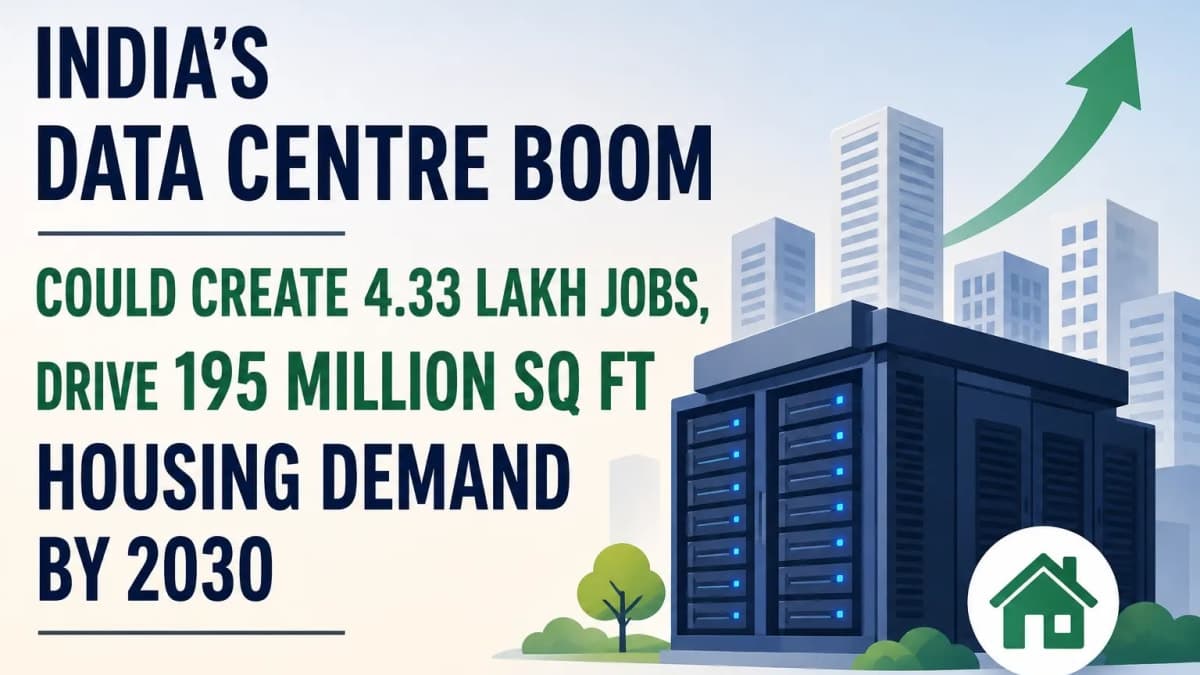
According to an analysis by proptech company Square Yards, India's proposed data centre pipeline of approximately 9,030 MW has the potential to support nearly 4.33 lakh jobs across the wider ecosystem.
The employment generated by this expansion could, in turn, create demand for an estimated 195 million square feet of residential space by 2030.
The projections underline how investment in digital infrastructure can extend beyond the technology sector, influencing housing, construction, services and the broader urban economy.
Nearly 4.33 Lakh Ecosystem Jobs Projected
The employment impact of data centres is not limited to people directly responsible for running servers and IT systems.
Large facilities depend on a broader network of professionals and service providers covering construction, engineering, electrical infrastructure, cooling systems, security, facility management, telecommunications and other support functions.
As India's data centre capacity increases, this ecosystem could expand alongside it.
Square Yards estimates that the proposed capacity pipeline could support approximately 4.33 lakh jobs by 2030.
The figure represents potential ecosystem employment associated with the expected expansion rather than a count of jobs that have already been created.
Housing Demand Could Reach 195 Million Sq Ft
The expected rise in employment could also affect residential markets surrounding major data centre clusters.
Square Yards estimates that employment linked with the proposed pipeline could translate into roughly 195 million square feet of housing demand by the end of the decade.
The relationship between infrastructure investment and residential demand is significant because major employment hubs frequently create secondary demand for housing, transportation, retail and other urban services.
Workers employed directly or indirectly by the data centre ecosystem may seek homes within commuting distance of major facilities, potentially creating opportunities for residential developers in surrounding locations.
Why India’s Data Centre Industry Is Expanding
Data centres have become a critical part of modern digital infrastructure.
They provide the computing and storage capacity needed for cloud platforms, artificial intelligence applications, digital payments, streaming services, enterprise technology and a growing range of internet-based services.
India’s large digital user base, increasing cloud adoption and growing demand for computing infrastructure have strengthened the case for additional domestic data centre capacity.
The rise of artificial intelligence is adding another dimension to this expansion. AI workloads can require substantial computing resources, increasing demand for specialised infrastructure capable of supporting high-performance processing.
As these trends continue, data centres are increasingly becoming part of India's broader infrastructure and real estate investment landscape.
Data Centres Could Create New Residential Micro-Markets
One of the more significant implications of the Square Yards projection is the potential development of residential demand around data centre locations.
Unlike traditional office districts, data centre campuses are often developed in areas offering large parcels of land, reliable power infrastructure and strong network connectivity.
When significant employment develops around such locations, nearby residential markets can benefit.
Developers could respond by building housing targeted at different categories of workers, ranging from technical specialists and engineers to facility-management and supporting service employees.
This could gradually turn some infrastructure-led locations into more diversified urban employment centres.
Benefits Could Extend Beyond Housing
The economic impact of a large data centre cluster can extend into several related sectors.
Construction activity is required to build facilities, while ongoing operations depend on power management, cooling, security, maintenance and telecommunications services.
Growing worker populations can subsequently support restaurants, retail businesses, transportation and other local services.
Residential construction generated by this employment could create another layer of economic activity.
This multiplier effect helps explain why the expansion of digital infrastructure is increasingly relevant not only to technology companies but also to real estate developers, urban planners and local governments.
Growth Will Depend on Projects Actually Being Delivered
The projections should nevertheless be interpreted as estimates based on the proposed data centre pipeline rather than guaranteed outcomes.
The eventual employment and housing impact will depend on how much of the planned capacity is completed, where facilities are developed and how labour-intensive the surrounding ecosystem becomes.
Technological changes could also influence employment requirements. Increasing automation, for example, could change the number and type of workers needed to operate future facilities.
Similarly, housing demand will depend on factors including property prices, transport connectivity, commuting patterns and the availability of residential development near data centre clusters.
Infrastructure and Sustainability Remain Important
Rapid data centre development also brings infrastructure challenges.
Large facilities require dependable electricity supplies and sophisticated cooling systems. Depending on their design and location, their environmental footprint can also raise questions involving power consumption and water use.
Cities and states seeking to attract data centre investment may therefore need to balance industrial development with electricity availability, environmental considerations and supporting urban infrastructure.
Residential development created around these employment centres will add another planning requirement, including roads, public transport and civic services.
Why the Projection Matters
The Square Yards analysis highlights an important shift in how India's data centre expansion could influence the economy.
Data centres are typically viewed as technology infrastructure, but their development could increasingly have consequences for employment patterns and real estate markets.
A proposed capacity pipeline of around 9,030 MW represents a substantial infrastructure buildout. If the projected expansion materialises, its impact could reach well beyond server facilities themselves.
The estimated 4.33 lakh ecosystem jobs and 195 million square feet of potential residential demand demonstrate how India's digital transformation could increasingly intersect with the country's physical urban development.
For the real estate industry, that creates an emerging opportunity: locations selected for large-scale digital infrastructure could become new employment and residential growth corridors over the remainder of the decade.
This article is based on reporting published by mint.