India’s Forex Reserves Reach Six-Month High as Inflows Strengthen External Position
India’s foreign exchange reserves have climbed sharply, providing the country with a stronger financial buffer at a time when global currency, energy and capital markets remain uncertain.
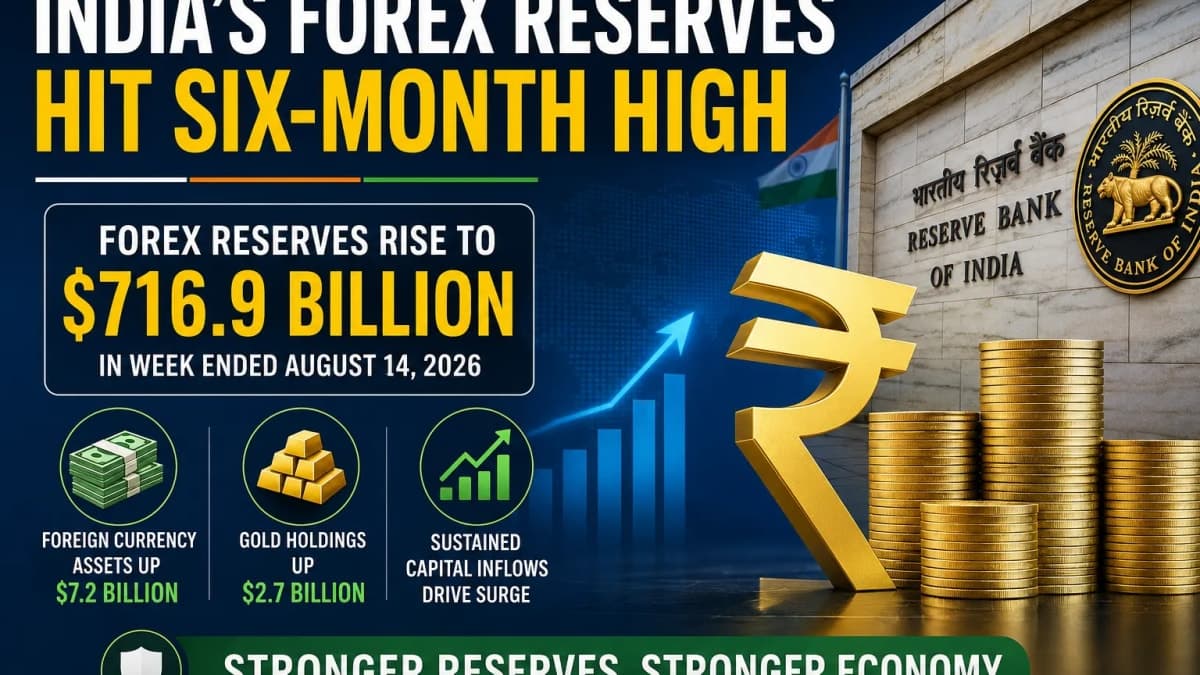
The country’s total foreign exchange reserves increased by about $9.9 billion to $716.9 billion in the week ended August 14, according to data released by the Reserve Bank of India. The latest level represents the highest reserve position in roughly six months.
The increase also brings India’s reserve stockpile closer to its record territory. Reserves had reached approximately $728.5 billion in February 2026, meaning the latest figure is only around $11.6 billion below that peak.
What Drove the Sharp Increase in India’s Forex Reserves?
The latest weekly rise was primarily supported by two major components of the reserve portfolio.
Foreign currency assets increased by approximately $7.2 billion, while the value of the RBI’s gold holdings rose by about $2.7 billion. Together, these movements accounted for most of the nearly $10 billion increase in overall reserves.
Foreign currency assets form the largest part of India’s reserve holdings. Although expressed in US dollars, their value can also change when currencies such as the euro, pound and yen move against the dollar.
India’s reserve portfolio additionally includes gold, Special Drawing Rights and the country’s reserve position with the International Monetary Fund.
Capital Inflows Help Rebuild India’s Reserve Cushion
The latest increase is part of a broader accumulation of reserves rather than an isolated weekly movement.
India’s forex reserves have risen by roughly $50 billion over the previous seven weeks, supported by sustained foreign-currency inflows.
Policy measures introduced by the RBI have played an important role in attracting these flows. Initiatives aimed at encouraging overseas borrowing and foreign-currency deposits included hedging-related incentives for banks and borrowers. By mid-August, these measures had attracted tens of billions of dollars in foreign-currency inflows.
The scale of the inflows became significant enough for the RBI to move toward ending one of its special deposit-related hedging programmes by August 31.
Why Higher Forex Reserves Matter for India
A large reserve stockpile acts as a financial safety net for an economy that remains closely connected to international trade and capital markets.
India needs foreign currency to pay for imports ranging from crude oil and natural gas to electronics and industrial equipment. A sizeable reserve buffer therefore improves the country’s ability to manage periods of external financial stress.
Reserves can also give the RBI greater flexibility in the foreign-exchange market. During periods of unusually sharp currency volatility, the central bank can sell dollars or undertake other market operations to reduce disorderly movements in the rupee.
That flexibility is particularly important for India because global oil prices, US monetary policy, geopolitical tensions and international investment flows can quickly affect demand for dollars.
What Does the Reserve Increase Mean for the Rupee?
Higher reserves do not automatically guarantee that the rupee will appreciate.
Exchange rates are influenced by several factors, including crude oil prices, trade flows, foreign portfolio investment, interest-rate expectations and global demand for the US dollar.
However, a larger reserve buffer strengthens the RBI’s capacity to respond when currency markets become volatile.
That remains relevant in the current environment. On August 25, traders reported likely RBI intervention as the rupee faced pressure from corporate dollar demand and elevated global oil prices.
The combination of strong reserves and continued capital inflows could therefore provide an important cushion, even when external factors put downward pressure on the currency.
India Moves Closer to Record Forex Reserve Levels
The speed of the recent reserve accumulation is notable.
India’s reserves stood at approximately $692.9 billion on July 31, increased to about $707 billion by August 7, and then reached $716.9 billion by August 14.
That progression suggests a rapid rebuilding of the country’s external buffer during a relatively short period.
With the latest level approaching the February record, future movements will depend heavily on capital flows, RBI foreign-exchange operations, gold valuations and changes in major global currencies.
Balanced Analysis: Strong Buffer, but External Risks Remain
The six-month high is broadly positive for India’s external financial stability. A reserve stockpile above $700 billion provides policymakers with substantial room to manage temporary shocks and periods of currency-market stress.
However, reserve levels should not be viewed in isolation.
A significant portion of weekly changes can reflect valuation movements rather than fresh dollar inflows. The RBI may also use part of its reserves when intervening in foreign-exchange markets, meaning the total can fluctuate substantially even when the broader economic picture remains stable.
India also remains a major importer of crude oil, making the economy sensitive to sustained increases in global energy prices. Strong dollar demand from importers or foreign investor withdrawals could similarly put pressure on both the rupee and reserve accumulation.
For that reason, the more important signal is not simply whether reserves reach another record, but whether India can maintain a sufficiently large external buffer relative to its import requirements and financial obligations.
Outlook
India’s rise to $716.9 billion in foreign exchange reserves gives the economy a substantial cushion as policymakers navigate volatile global markets.
Continued capital inflows could push reserves closer to—or potentially beyond—the record levels reached earlier in 2026. At the same time, oil prices, global interest rates, portfolio investment and RBI intervention will remain key variables determining the direction of the reserve stockpile.
For now, the six-month high represents a strengthening of India’s external financial position and gives the central bank additional capacity to manage currency volatility should global conditions become more challenging.
This article is based on reporting published by Reuters.