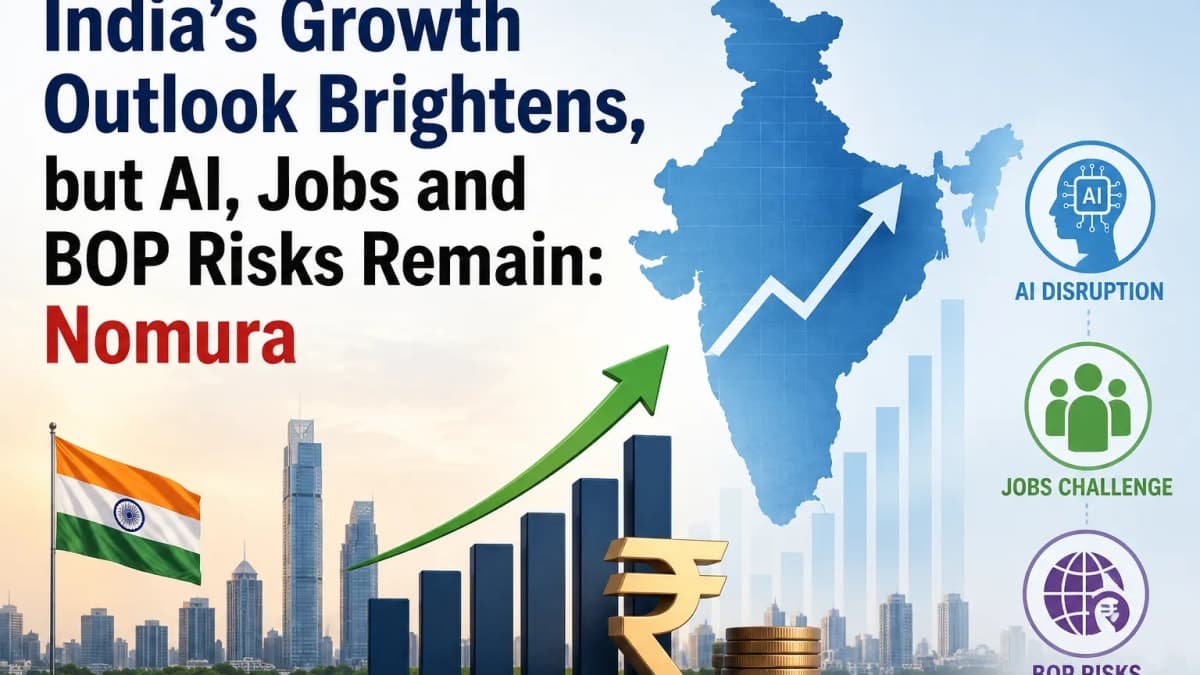
India’s Growth Prospects Turn More Positive
Sentiment around India’s economy has improved as expectations of stronger growth gain momentum. Despite uncertainties in the global economy, domestic demand and economic activity continue to provide support to the country’s growth prospects.
Nomura’s assessment suggests that market participants see the possibility of India’s GDP growth delivering a positive surprise. This improving sentiment is significant because India is navigating a global environment shaped by geopolitical uncertainty, changing trade conditions and rapid technological disruption.
The bigger question, however, is whether stronger headline growth can be accompanied by sufficient job creation and a stable external financial position.
Strong Start Could Improve the FY27 Growth Picture
A stronger-than-anticipated start to FY27 could improve expectations for the entire financial year. If economic activity remains resilient during subsequent quarters, India could maintain its position among the faster-growing major economies.
For businesses and investors, sustained economic expansion could support consumption, investment and credit demand. At the same time, the quality and composition of growth will matter as much as the headline GDP figure.
AI Emerges as Both an Opportunity and a Risk
Artificial intelligence represents one of the most important structural changes facing India’s economy.
For Indian companies, AI can improve productivity, automate routine processes and create opportunities in new technology-driven services. India’s large technology and services sector could benefit from growing global demand for AI-related capabilities.
The transition also presents employment challenges. Routine coding, back-office and other repetitive tasks could increasingly be automated. Entry-level workers may therefore face a changing employment landscape as companies place greater emphasis on advanced digital and AI-related skills.
India’s ability to reskill its workforce could determine how widely the economic benefits of AI are distributed.
Job Creation Remains a Crucial Test
Strong GDP growth alone does not guarantee broad improvements in household incomes and living standards. The economy must also generate enough productive employment for its expanding workforce.
This makes job creation one of the most important factors to watch alongside GDP growth.
AI could further change the nature of this challenge. Workers with specialised skills may benefit from greater demand, while roles involving repetitive tasks could face increasing pressure from automation.
Investment in education, vocational training and reskilling will therefore become increasingly important as technology changes the requirements of the labour market.
Why Balance of Payments Matters
India’s balance-of-payments position is another area receiving attention.
The BOP tracks the country’s economic transactions with the rest of the world and is influenced by factors including trade, services exports, foreign investment and capital flows.
A stable external position can support the rupee, foreign-exchange reserves and investor confidence. Conversely, weaker capital inflows or pressure on export earnings could make external financing conditions more challenging.
Changes in global investment patterns associated with AI and potential disruption to traditional IT services are therefore relevant not only to employment but also to India’s external accounts.
Inflation Remains Another Factor to Watch
The growth outlook must also be viewed alongside inflation. Food prices can significantly influence India’s headline inflation because of their importance in household expenditure.
A sustained rise in food inflation could complicate the policy environment by reducing household purchasing power and influencing expectations about interest rates.
If underlying inflation remains contained, however, policymakers would have greater flexibility to balance growth and price stability.
Why Nomura’s Assessment Matters
The assessment presents two sides of India’s economic story.
On one side is the possibility of resilient growth supported by domestic economic activity. On the other are structural challenges involving technology, employment and external financial stability.
This distinction matters because the sustainability of India’s growth will increasingly depend on more than simply maintaining a high GDP growth rate.
Balanced Analysis: The Next Phase of India’s Growth Story
India enters the next stage of its economic expansion with significant advantages, including a large domestic market, a sizeable services industry and growing adoption of digital technologies.
AI could strengthen productivity and create entirely new categories of businesses and employment. But the transition could also disrupt existing jobs faster than new opportunities emerge in some industries.
Similarly, healthy GDP growth could strengthen investor confidence, but maintaining stable foreign capital flows and a manageable external position will remain important.
The strongest outcome would be one in which productivity improvements from AI are accompanied by large-scale reskilling, investment and job creation. If that happens while external financial conditions remain stable, India could convert stronger near-term growth into a more durable economic expansion.
This article is based on reporting published by Moneycontrol.