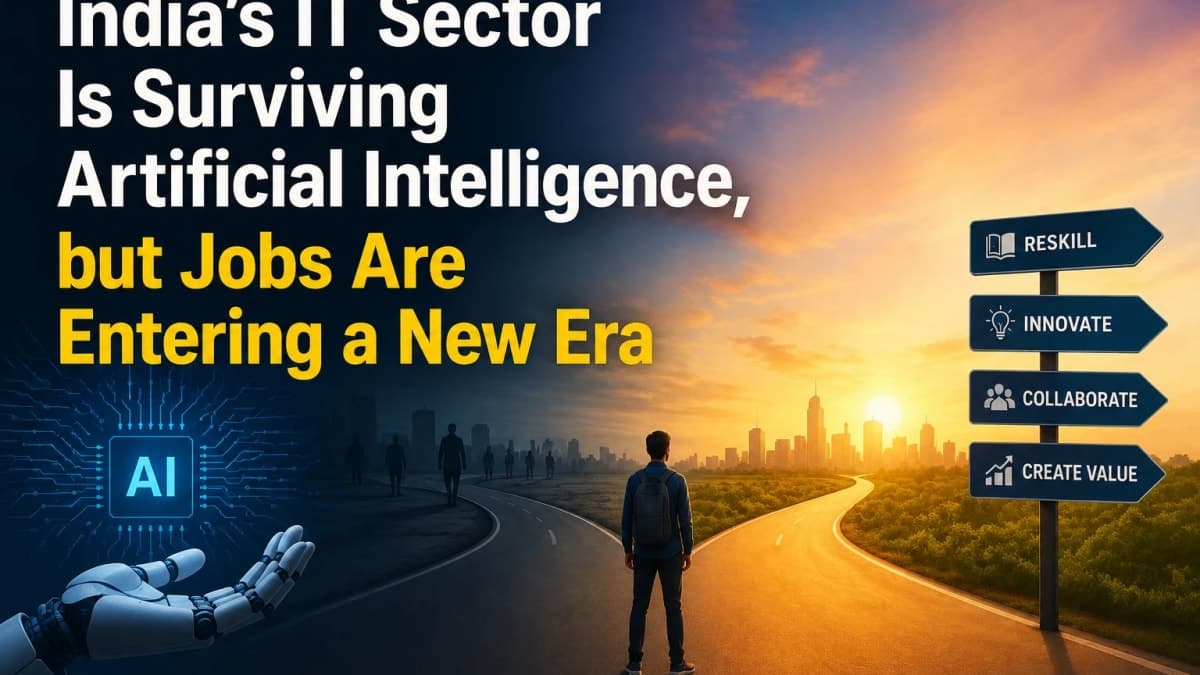
India’s IT Industry Faces the AI Test
Artificial intelligence has emerged as one of the biggest technological disruptions confronting the global IT services industry.
For India, where technology services have long been an important source of skilled employment, the rise of increasingly capable AI systems has created particular concern about the future of jobs.
Tasks that previously required substantial human effort can increasingly be assisted or automated by AI. This has intensified questions about whether companies will eventually require fewer employees for certain types of technology work.
Yet the emerging story is not simply one of AI replacing India's IT sector. Instead, the industry is being pushed toward a different operating model in which AI becomes part of how technology professionals perform their jobs.
AI Is Changing Jobs Rather Than Simply Eliminating Them
The employment impact of artificial intelligence is likely to vary significantly depending on the nature of the work.
Routine, repetitive and highly standardized digital tasks face greater exposure to automation. AI tools can help workers generate code, analyze information, prepare documentation and complete other technology-related assignments faster.
That productivity improvement presents a complicated equation for employment.
If an employee can accomplish substantially more work with AI assistance, companies may eventually need fewer people for some traditional assignments. At the same time, businesses adopting AI require employees capable of implementing, supervising, testing and integrating the technology.
The result could be a restructuring of technology employment rather than a straightforward collapse in jobs.
Entry-Level IT Roles Could Face Greater Pressure
One of the most important questions surrounding AI is what happens to entry-level employment.
India's IT industry has historically provided graduates with opportunities to enter the technology workforce, develop practical skills and gradually progress into more specialized positions.
AI could alter that pathway.
Some relatively basic assignments traditionally given to junior workers are among the tasks that can increasingly be accelerated through automation. If companies automate a larger portion of this work, expectations for new recruits could rise.
Fresh graduates may therefore need to demonstrate AI literacy alongside conventional programming, analytical and communication abilities.
The challenge is significant because entry-level positions do more than complete basic work. They also provide the experience through which future senior engineers, managers and technology specialists are developed.
Human Skills Still Matter
Despite rapid improvements in AI, technology projects involve considerably more than generating code or processing information.
Understanding a client's business requirements, designing appropriate systems, protecting sensitive information, managing complicated projects and taking responsibility for important decisions continue to require substantial human involvement.
AI-generated outputs can also require evaluation and verification.
This creates an important distinction between the automation of individual tasks and the replacement of entire occupations.
A technology professional whose job contains several automatable tasks may not necessarily become unnecessary. Instead, the composition of that person's work can change.
Reskilling Becomes Critical for India’s IT Workforce
The ability of workers to adapt could determine how disruptive the AI transition ultimately becomes.
Technology professionals who learn to use AI effectively may be able to improve their productivity while moving toward more sophisticated responsibilities. Skills involving AI integration, cybersecurity, data, cloud technologies, architecture, product development and business problem-solving could become increasingly valuable as routine work becomes easier to automate.
For employers, this means workforce development could become as important as technology investment.
Companies cannot benefit fully from sophisticated AI systems merely by purchasing tools. Employees need to understand where those systems are useful, where human oversight is necessary and how they can be incorporated into real business processes.
Why India’s IT Sector Can Adapt
India's IT industry has already experienced several major technology transitions.
The sector has evolved as computing shifted toward the internet, enterprise digitization, cloud services, mobile technologies and other new platforms. Artificial intelligence represents another transition, although its potential impact on knowledge work makes the current shift particularly significant.
The scale of India's technology workforce creates both an advantage and a challenge.
A large pool of engineers and technology professionals gives the industry significant human capability to build and deploy AI-based solutions. However, the same scale means that even gradual changes in hiring models could affect large numbers of workers and graduates.
The success of the transition will therefore depend partly on whether skills can evolve as quickly as companies adopt AI.
AI Could Change the Traditional IT Business Model
Artificial intelligence also raises a broader question about how IT services are priced and delivered.
Traditional technology outsourcing has often depended on large teams performing extensive development, maintenance and support work. If AI enables smaller teams to produce similar or better results, clients may increasingly expect higher productivity.
That could pressure companies to move away from models heavily dependent on workforce size.
Instead, businesses may have to compete more aggressively on specialized expertise, intellectual property, AI capabilities, consulting and measurable outcomes.
Such a transition would have important consequences for hiring. Companies could place greater emphasis on skills and productivity rather than simply expanding employee numbers alongside revenue.
The Job Impact Is Neither Entirely Positive nor Negative
The debate around AI and employment is often presented as a choice between two extremes: either artificial intelligence will destroy technology jobs or it will create enough new opportunities to make employment concerns irrelevant.
The reality is likely to be more complicated.
Some roles and tasks could shrink. Others could expand. Entirely new categories of work could emerge, while existing occupations may incorporate AI into everyday workflows.
Workers whose responsibilities are heavily repetitive could experience greater disruption, while professionals capable of combining technical expertise, business knowledge and AI tools may become more productive and valuable.
There is also a timing problem. New opportunities do not necessarily appear in the same locations, at the same salaries or for the same workers whose existing responsibilities are being automated.
That makes reskilling particularly important.
What AI Means for India’s Technology Graduates
For students preparing to enter India's IT industry, the AI transition does not necessarily mean technology careers are disappearing.
It does mean the definition of being employable in technology is changing.
Knowing how to write code may remain useful, but understanding how to work alongside AI, evaluate its output and solve larger business problems could become increasingly important.
Educational institutions and employers may consequently face pressure to update training programs so that graduates are prepared for an AI-enabled workplace rather than a technology market built around older working methods.
The Bigger Picture
India's IT sector surviving artificial intelligence does not mean the industry will remain unchanged.
Survival itself may require substantial transformation.
Companies will have to determine which processes should be automated, where human expertise creates the greatest value and how existing employees can be moved toward higher-value responsibilities.
Workers, meanwhile, will face growing pressure to continuously update their skills.
The most important employment question may therefore not be whether AI can perform technology work. It increasingly can.
The question is whether India's IT ecosystem can create new skills, roles and business models quickly enough to absorb the disruption.
For now, AI appears less like the end of India's technology industry and more like a force accelerating its next major transformation.
This article is based on reporting published by The Economist.