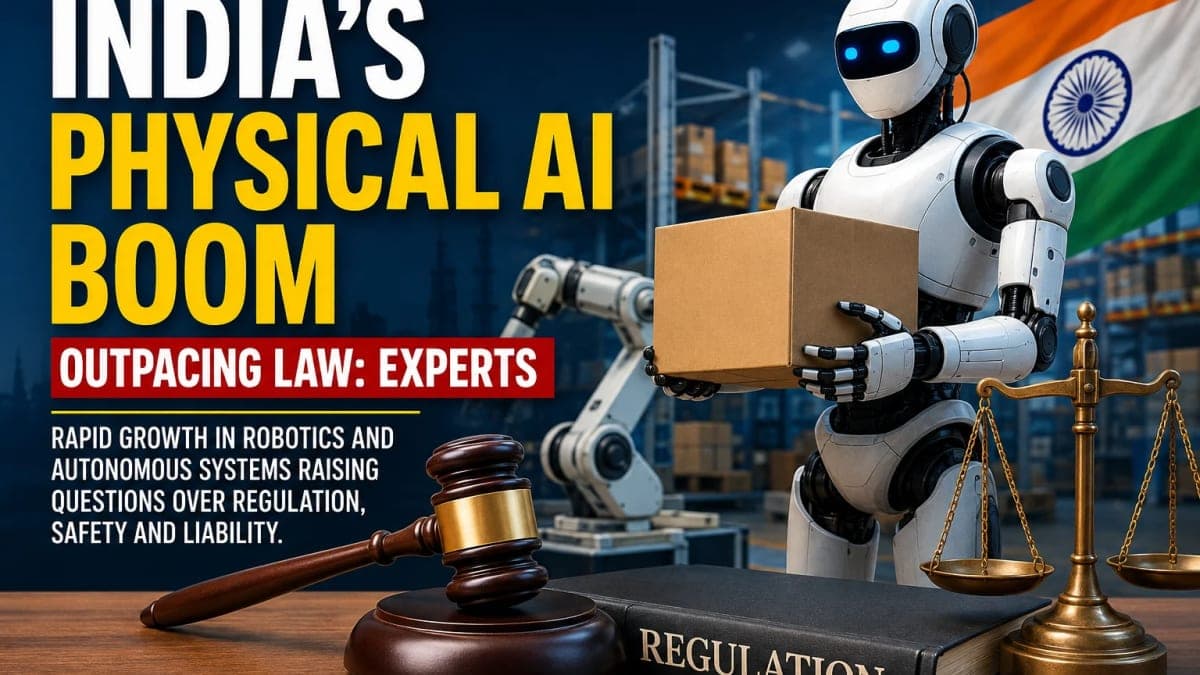
India’s Physical AI Push Enters a New Phase
India’s artificial intelligence journey is beginning to move beyond software, chatbots and digital assistants. A new wave of physical AI is bringing artificial intelligence into machines that can sense their surroundings, make decisions and perform actions in the real world.
The technology can include advanced robots, autonomous systems and other AI-powered machines designed to interact directly with physical environments. India’s growing interest in such technologies is creating new opportunities for manufacturing, logistics and other industries, but it is also exposing gaps in the country’s regulatory architecture.
Legal and policy experts have warned that India currently lacks a dedicated framework specifically designed to govern physical AI, even as development and hiring around robotics and autonomous technologies expand.
Why Physical AI Creates Different Legal Challenges
Traditional software generally produces information, recommendations or digital outputs. Physical AI can go further by translating machine-generated decisions into real-world actions.
That difference raises the stakes.
If an autonomous machine causes property damage, injures somebody or makes an unsafe decision, determining responsibility may be more complicated than in conventional technology systems. Potential responsibility could involve a manufacturer, software developer, AI model provider, system operator, employer or another participant in the technology chain.
Research into physical-AI governance similarly highlights that embodied AI systems face real-time safety requirements and must operate in changing environments alongside humans, creating governance challenges that conventional AI frameworks may not fully address.
Existing Indian Laws Offer Some Protection — But Were Built for a Different Era
India is not starting from a complete legal vacuum. Existing rules covering areas such as product liability, consumer protection, workplace safety and data protection, along with sector-specific regulations, can apply to physical-AI deployments.
The difficulty is that many of these frameworks were developed when human control and responsibility were easier to identify. Increasingly autonomous systems could blur those traditional lines of accountability.
This means regulators may eventually need clearer standards addressing how autonomous machines should be tested, how safety should be demonstrated and who bears responsibility when AI-driven physical systems fail.
India Has a Major Opportunity in Robotics
The regulatory debate comes as India looks to strengthen its position in advanced robotics and AI-enabled manufacturing.
The country has several potential advantages, including its expanding electronics and automotive manufacturing ecosystem, digital infrastructure and government-backed AI initiatives. Building a competitive physical-AI industry, however, would also require progress in components such as sensors, actuators, robotics electronics, specialised software and testing infrastructure.
Physical AI could eventually become particularly significant for factories, warehouses, transportation, infrastructure and other environments where intelligent machines can perform or assist with physical tasks.
Regulation Must Balance Safety With Innovation
The challenge for policymakers will be avoiding two extremes.
Rules that are introduced too slowly could leave businesses and consumers uncertain about safety standards, liability and legal responsibility. But excessively restrictive regulation introduced before technologies mature could raise compliance costs and discourage experimentation.
A balanced approach could therefore focus on risk-based regulation, placing stronger safeguards on systems capable of causing significant physical harm while allowing lower-risk technologies more room for development.
Regulatory sandboxes, industry standards, mandatory testing for high-risk applications and clearer liability principles could potentially help policymakers address risks without treating every physical-AI application in the same way.
Why the Issue Matters
The debate surrounding physical AI is ultimately larger than robotics alone. Artificial intelligence is moving from systems that primarily generate information toward machines capable of independently influencing the physical environment.
That transition changes the consequences of an AI error. A mistake made by a digital assistant may produce incorrect information; a mistake made by an autonomous physical system can potentially have immediate real-world safety consequences.
For India, the opportunity is significant. Physical AI could strengthen industrial automation, improve productivity and create new deep-tech businesses. At the same time, its growth will increase pressure on policymakers to establish clearer rules around safety, accountability and liability.
India’s ability to develop regulation alongside — rather than long after — technological adoption could therefore become an important factor in determining how successfully the country builds a trusted physical-AI ecosystem.
Balanced Analysis
India does not necessarily need to regulate every emerging physical-AI technology through an entirely new legal system. Existing consumer, product-safety, workplace and data laws provide a foundation that can continue to play an important role.
However, greater machine autonomy creates situations in which traditional assumptions about human control may become inadequate. The strongest regulatory approach may therefore involve updating existing frameworks while introducing specialised rules only where physical AI creates genuinely new risks.
The objective will be to give innovators enough flexibility to build globally competitive technologies while ensuring that businesses deploying autonomous machines remain accountable for their safety and real-world consequences.