Japan’s Latest Food Craze Breaks the First Rule of Instant Noodles
There are few food instructions more familiar than the ones printed on a cup of instant noodles: add boiling water, close the lid and wait.
Nissin Foods has spent five years figuring out how to remove the first step.
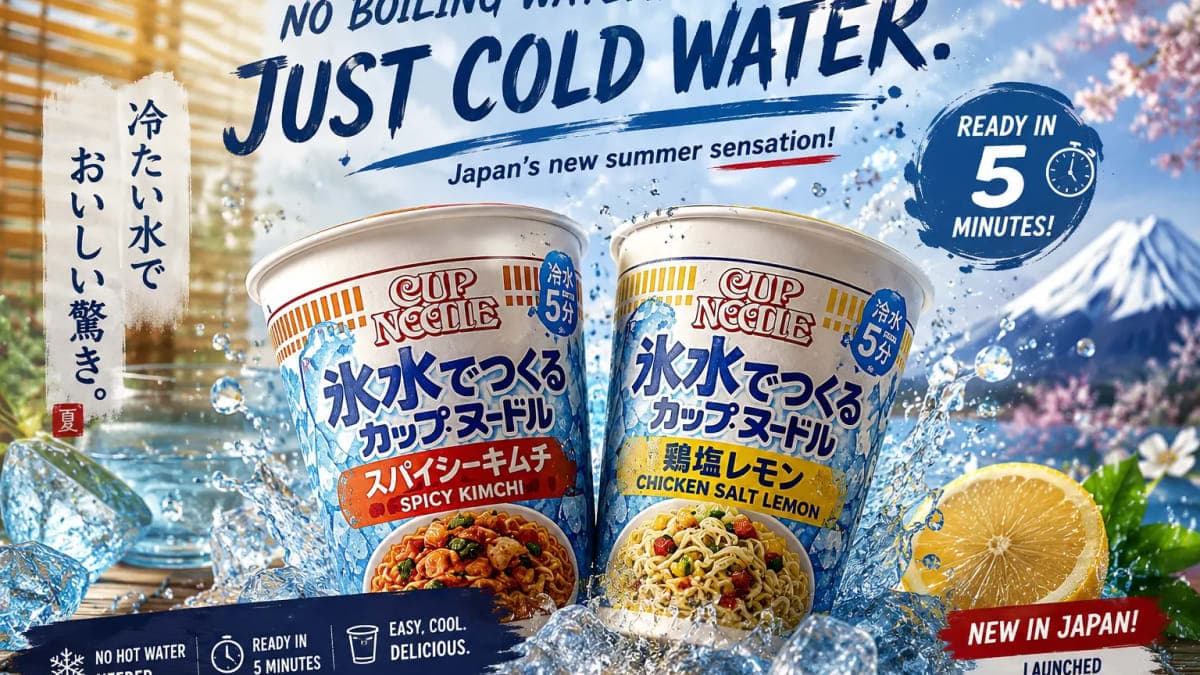
Its latest Cup Noodles need no boiling water at all. Pour in cold water, wait about five minutes, and they are ready to eat.
It is a small change to a product people have known for decades, but in Japan this summer, it has been enough to create a rush.
Nissin launched the cold-water noodles nationwide on July 20, 2026. The company expected its initial supply to last somewhere between one and two months.
It was gone in roughly a week.
That unexpectedly fast sellout, combined with an unusual preparation method that practically invites people to try it on camera, helped turn the noodles into a social-media curiosity.
A Simple Idea That Took Five Years to Get Right
Cold instant noodles may sound like the kind of product somebody could invent in an afternoon. The reality was more complicated.
Traditional instant noodles are designed around heat. Boiling water quickly rehydrates the dried noodles and prepares the ingredients inside the cup.
Take away that heat and the familiar formula no longer works in quite the same way.
Nissin spent about five years developing its answer, using a patented manufacturing process that allows the noodles to rehydrate in cold water while retaining their texture.
Preparation takes around five minutes, slightly longer than the three-minute wait associated with many conventional Cup Noodle varieties.
For a brand that introduced Cup Noodles in 1971, it represents an unusual rethink of a ritual that has barely needed explaining for more than half a century.
Two Flavors Designed for Summer
The company did not simply take its regular noodles and tell customers to pour cold water over them.
The new range was designed specifically to be eaten chilled and launched in two flavors: Spicy Kimchi and Chicken Salt Lemon.
That makes it different from eating conventional noodles after allowing them to cool.
Cold noodle dishes are already well established in Japanese and other Asian cuisines. The novelty here is convenience: these noodles require no hot-water preparation in the first place.
On a sweltering summer day, that difference can feel surprisingly useful.
Social Media Asked the Obvious Question: Does It Actually Work?
There is an irresistible experiment built into the product.
Can you really pour cold water over instant noodles and end up with something worth eating?
Consumers began answering that question themselves on social media, filming taste tests and showing the noodles before and after their five-minute wait.
Some did not stop at water.
Reports described users trying soy milk and tea, turning a straightforward food product into a platform for increasingly unconventional experiments.
The shortage added to the excitement. As the first supply disappeared, simply finding a cup became part of the experience.
Nissin has not disclosed exactly how many units were sold, so the scale of the launch cannot be measured from the sellout alone. What is clear is that demand arrived much faster than the company had planned for.
The Timing Could Hardly Have Been Better
Launching cold instant noodles in July also gave Nissin something no advertising campaign can manufacture: the right weather.
Japan has been experiencing severe summer heat, making the thought of boiling a kettle and then eating a steaming bowl of noodles less appealing for some consumers.
The cold version avoids both.
That places the product alongside a growing range of goods aimed at making Japan’s increasingly difficult summers more manageable. Cooling accessories, summer clothing and other heat-focused products have become familiar sights.
Cold Cup Noodles offer the same idea in food form: take something people already use and adapt it to hotter conditions.
In that sense, the product’s appeal is not entirely driven by novelty. There is a practical reason to reach for it when the temperature climbs.
Curiosity Is Spreading Beyond Japan
The fascination has already crossed Japan’s borders.
A limited one-day sale in Hong Kong attracted shoppers eager to try the noodles, with more than 30 people reportedly queuing at one point despite temperatures of around 32 degrees Celsius.
That does not necessarily mean a major international rollout is coming. Nissin has yet to establish what the product’s broader future will look like.
But it does show how easily the idea travels.
You do not need to know much about Japanese food culture to understand the appeal of the question: instant noodles without boiling water—do they really work?
An Unexpected Use Beyond Hot Summer Days
Amid the viral taste tests, consumers have also spotted a more practical possibility.
Cold-water instant noodles could be useful during an emergency.
That idea carries particular weight in Japan, where earthquakes, typhoons and other natural disasters have made household preparedness an everyday concern.
Ordinary instant noodles store easily, but they become less convenient during a power or gas outage if there is no way to boil water. A version that can be prepared cold removes that problem.
Nissin has acknowledged receiving comments from consumers suggesting the noodles could serve as emergency food.
The product was not primarily introduced as a disaster ration, and its usefulness in that role should not be overstated. Still, it is an intriguing second life for something designed as a summer meal.
What Happens When the Novelty Wears Off?
The bigger question now is whether cold-water Cup Noodles remain a summer curiosity or become a lasting part of Nissin’s lineup.
The company has not confirmed whether production will be expanded, whether the product will become permanent or whether more flavors will follow. Future decisions are expected to depend in part on sales performance.
Selling out in a week is certainly an eye-catching beginning. Whether consumers return once the novelty fades will be the more meaningful test.
Nissin has reinvented the instant-noodle experience before.
Its founder, Momofuku Ando, introduced Chicken Ramen in 1958, widely recognized as the world’s first instant ramen. Cup Noodles followed in 1971 and eventually became one of the most recognizable convenience foods in the world.
More than half a century later, the company has found a remarkably simple way to make that familiar cup interesting again.
It did not add an elaborate gadget or radically reinvent the meal.
It just took away the boiling water.
And in the heat of Japan’s summer, that was apparently enough to make people start hunting for noodles all over again.