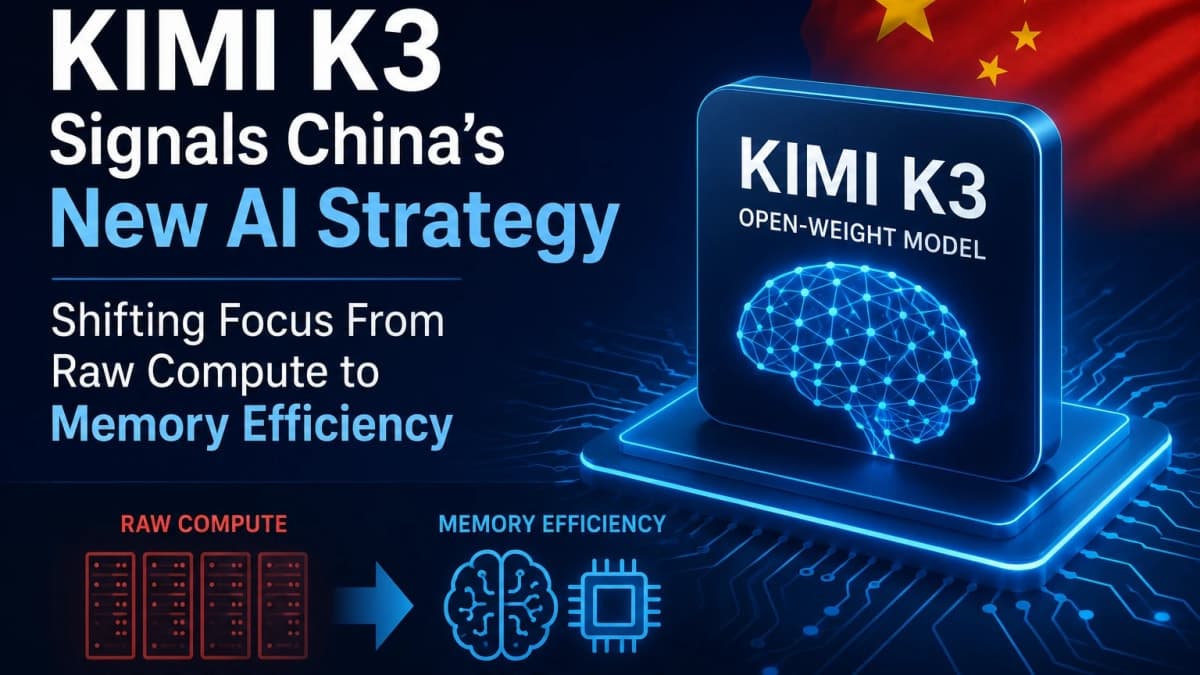
Moonshot AI Unveils Kimi K3 With a Different Vision for AI Scaling
Moonshot AI has launched Kimi K3, describing it as one of the world's largest open-weight AI models with approximately 2.8 trillion parameters. The release has drawn global attention because it combines massive model capacity with an architecture designed to improve inference efficiency rather than simply increasing hardware requirements.
Unlike proprietary AI systems that restrict access to their underlying models, Kimi K3 is part of China's broader push toward open-weight AI, allowing developers and organizations greater flexibility to deploy and customize the technology once the model weights are fully released.
Why Memory Is Becoming the New Battleground
For years, AI development has largely focused on expanding computing power by deploying increasingly powerful GPUs and larger training clusters.
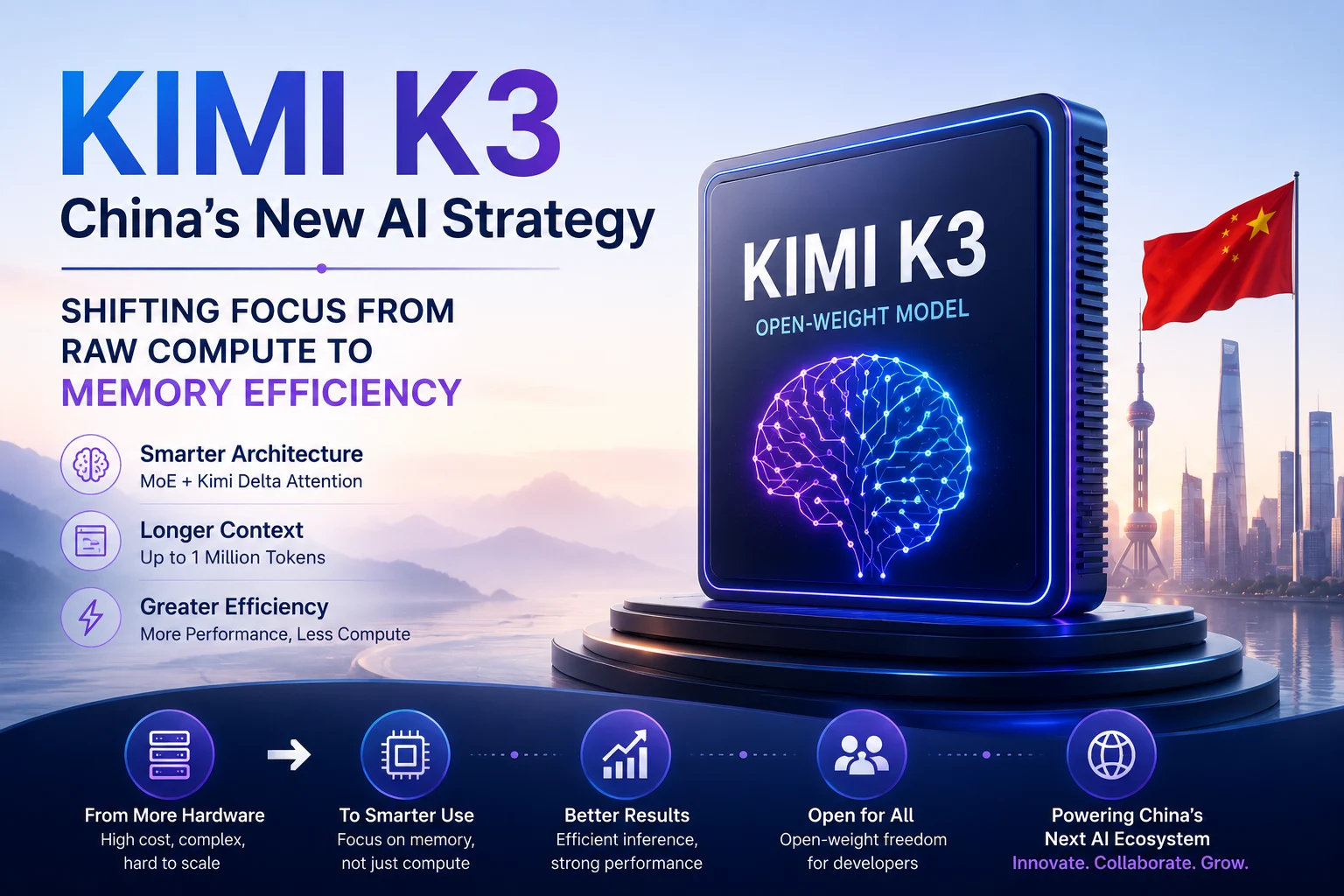
Kimi K3 represents a shift in emphasis. The model uses a Mixture-of-Experts (MoE) architecture, activating only a subset of its parameters during each request. It also incorporates Moonshot AI's Kimi Delta Attention, which is designed to improve memory utilization and efficiently support an exceptionally large one-million-token context window.
This approach suggests that future AI progress may increasingly depend on how efficiently models use memory and context rather than relying exclusively on additional compute resources.
Open-Weight Strategy Expands China's AI Ecosystem
Kimi K3 is part of a growing trend among Chinese AI developers to release advanced open-weight models.
Rather than keeping frontier AI exclusively behind commercial APIs, companies are increasingly building ecosystems that enable researchers, developers, and enterprises to experiment with powerful models on their own infrastructure.
Industry observers believe this strategy could accelerate AI adoption by encouraging innovation throughout the developer community while lowering barriers to entry for businesses.
Performance Targets Leading AI Models
Moonshot AI says Kimi K3 has been designed for demanding applications including software development, advanced reasoning, multimodal tasks, and knowledge-intensive workloads.
Benchmark results released by the company indicate competitive performance against several leading international AI systems, particularly in coding-related tasks. Independent observers note that while such benchmarks are useful indicators, real-world performance will ultimately determine the model's long-term impact after broader deployment.
Why This Matters for the Global AI Industry
Kimi K3 arrives as competition between Chinese and U.S. AI companies becomes increasingly intense.
Recent model launches from Chinese firms have demonstrated rapid improvements in capability while emphasizing lower deployment costs and broader accessibility through open-weight releases. This changing competitive landscape is encouraging AI companies worldwide to rethink how future models should be designed and distributed.
The growing focus on memory optimization may also influence future semiconductor demand, with analysts suggesting that advanced memory technologies could become just as strategically important as raw processing power.
Balanced Analysis
Kimi K3 highlights an important shift in AI development philosophy. Instead of viewing larger GPU clusters as the only path toward better AI, developers are increasingly investing in architectural innovations that improve efficiency, memory utilization, and long-context reasoning.
However, benchmark leadership alone does not guarantee widespread adoption. Developer tools, software ecosystems, safety testing, infrastructure compatibility, and enterprise support remain critical factors in determining whether an AI model succeeds commercially. Open-weight models also introduce additional responsibilities around responsible deployment and security.
Conclusion
The launch of Kimi K3 demonstrates how China's AI industry is evolving beyond simply matching international competitors on model size. By emphasizing memory-efficient architecture, long-context capabilities, and open-weight accessibility, Moonshot AI is showcasing an alternative direction for frontier AI development. As the global AI race continues, innovation may increasingly be measured not only by computational scale but also by how intelligently that computing power is used.