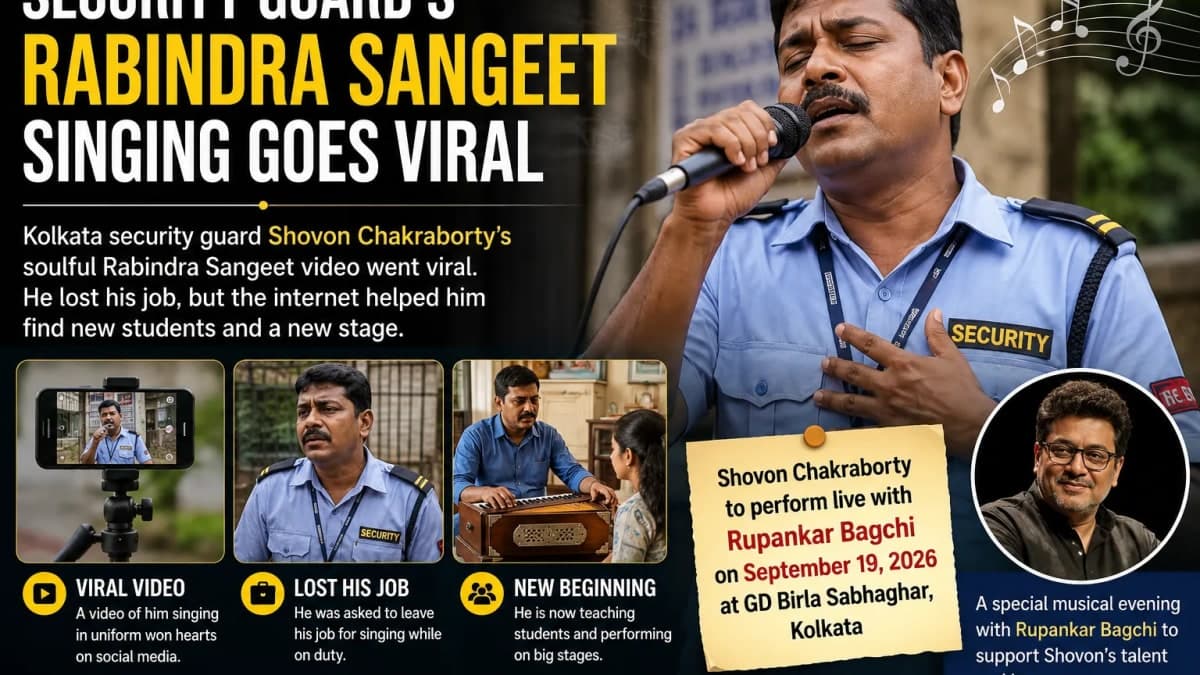
A security guard singing Rabindra Sangeet while wearing his work uniform has captured widespread attention online, but the man behind the viral voice is far from an amateur singer.
Shovon Chakraborty, a Kolkata-based security guard and trained Rabindra Sangeet singer, became a social-media sensation after a video showing him singing while on duty circulated widely.
The clip earned praise for Chakraborty's voice, but the attention also had an unexpected consequence: he subsequently lost his security job.
What initially appeared to be another fleeting viral moment has since developed into a larger story about artistic talent, financial circumstances and a musician attempting to return to the profession he once pursued.
Who Is Shovon Chakraborty?
Chakraborty's connection with music began long before he put on a security guard's uniform.
According to reports about his background, he began learning music as a young child and later trained in Rabindra Sangeet. He studied at Sangeet Bhavana in Santiniketan, part of Visva-Bharati's renowned tradition of music and performing arts.
Chakraborty also taught music to students.
That background provides crucial context to the viral video. Viewers were not simply hearing a security employee with an unexpectedly good voice; they were hearing someone who had spent years studying and teaching music.
Pandemic Disrupted His Music Teaching
Chakraborty's move into security work was driven by financial circumstances rather than a decision to abandon music.
Reports say that the COVID-19 pandemic severely affected his ability to earn through teaching as his number of music students declined.
Eventually, financial pressure pushed him towards security work to support himself and his family.
Even after changing professions, however, music remained part of his life.
That combination — a trained Rabindra Sangeet singer working security shifts to make ends meet — became central to why his story resonated so strongly once the video reached social media.
Viral Rabindra Sangeet Video Changes Everything
The video showed Chakraborty dressed in his security uniform and singing Rabindra Sangeet while at work.
His performance quickly attracted attention online, with viewers praising the quality of his voice and sharing his story.
But viral recognition did not initially translate into good news professionally.
Chakraborty said he was called by his employer after the video gained attention and was told that singing while performing his security duties was unacceptable.
“About 15 days ago, I lost my security guard job. It happened because the video of me singing had gone viral,” Chakraborty told Ei Samay Online, according to media reports.
He said the company told him that he could not continue working while going around singing and suggested that he pursue singing instead.
The circumstances of his dismissal triggered criticism on social media, where users questioned whether singing during his shift justified losing his livelihood.
He Doesn't Want Charity — He Wants Students
One of the most striking parts of Chakraborty's response has been his emphasis on returning to work as a music teacher rather than seeking financial assistance.
Reports quoting those who helped publicise his story said that Chakraborty wanted students so he could once again earn through teaching music.
His goal therefore appears less about capitalising on temporary internet fame and more about rebuilding the career that circumstances had interrupted.
That distinction has helped turn the story from a viral-video curiosity into a broader conversation about overlooked talent and economic opportunity.
Viral Attention Brings New Music Students
The online attention has already begun producing opportunities.
Chakraborty has said that people contacted him after discovering his story and that he has started receiving new students.
He has reportedly resumed teaching, including classes from home and online.
For someone whose loss of students during the pandemic contributed to his decision to take security work, renewed demand for his teaching represents a potentially significant reversal.
The viral clip may therefore accomplish something social-media popularity often fails to do: connect a skilled professional with people genuinely interested in his work.
Rupankar Bagchi Steps In
The story has also attracted support from established figures in Bengal's music community.
Singer Rupankar Bagchi became involved in an initiative offering Chakraborty an opportunity to perform publicly.
A currently listed special musical programme, “Bondhu Dekha Hobe – Rupankar, Guitar Aar Apnara,” is scheduled at GD Birla Sabhaghar in Kolkata on September 19, 2026, and includes a special appearance by Shovon Chakraborty.
The event description says the initiative is intended to celebrate his talent and support him following the loss of his security job.
After event-organising expenses are deducted, proceeds from the programme are expected to be given to Chakraborty.
For a musician who had moved away from teaching because of financial pressure, performing before a live audience alongside an established Bengali singer marks a dramatic change from the circumstances seen in the original viral clip.
Why Rabindra Sangeet Makes the Story Particularly Resonant
Chakraborty's choice of music adds another dimension to the attention surrounding his story.
Rabindra Sangeet refers to the body of songs composed by Rabindranath Tagore, whose music remains deeply embedded in Bengali cultural life.
The songs span themes including love, nature, spirituality, patriotism and human experience, and continue to be taught and performed across generations.
Santiniketan, where Chakraborty studied, is particularly significant to that tradition because of its close association with Tagore and Visva-Bharati.
That background helps explain why footage of a trained Santiniketan singer performing Rabindra Sangeet while working as a security guard generated such an emotional response among viewers.
More Than Just Another Viral Video
Social media regularly produces unexpected celebrities, but Chakraborty's case stands apart because the viral moment exposed an existing talent rather than creating one overnight.
Before millions of online viewers encountered his performance, he had already spent years learning and teaching music.
The pandemic and economic pressures altered his professional path. The internet merely revealed that history to a much larger audience.
There is also an important distinction between online sympathy and sustainable opportunity.
A viral video can generate attention for days or weeks. A renewed base of music students, teaching opportunities and professional performances could have a much longer impact.
From Security Shift to the Stage
Shovon Chakraborty's story has taken an unusual path.
He went from teaching music to working as a security guard after his student base declined, then became widely recognised after someone recorded him doing what he had continued to love — singing.
The viral video was followed by the loss of his security job, but it also introduced his music to an audience far beyond his workplace.
Now, new students and a public performance opportunity could allow Chakraborty to rebuild the musical career that economic circumstances had pushed aside.
Whether that develops into a lasting professional comeback remains to be seen.
What is already clear is that the security uniform in the viral video told only part of his story. Behind it was a trained musician whose voice had been waiting for a wider audience.