‘Mahila Sangeet’ Celebration Inside Train Divides Social Media
A seemingly cheerful moment during a train journey has turned into a wider conversation about where personal celebration ends and responsibility toward fellow passengers begins.
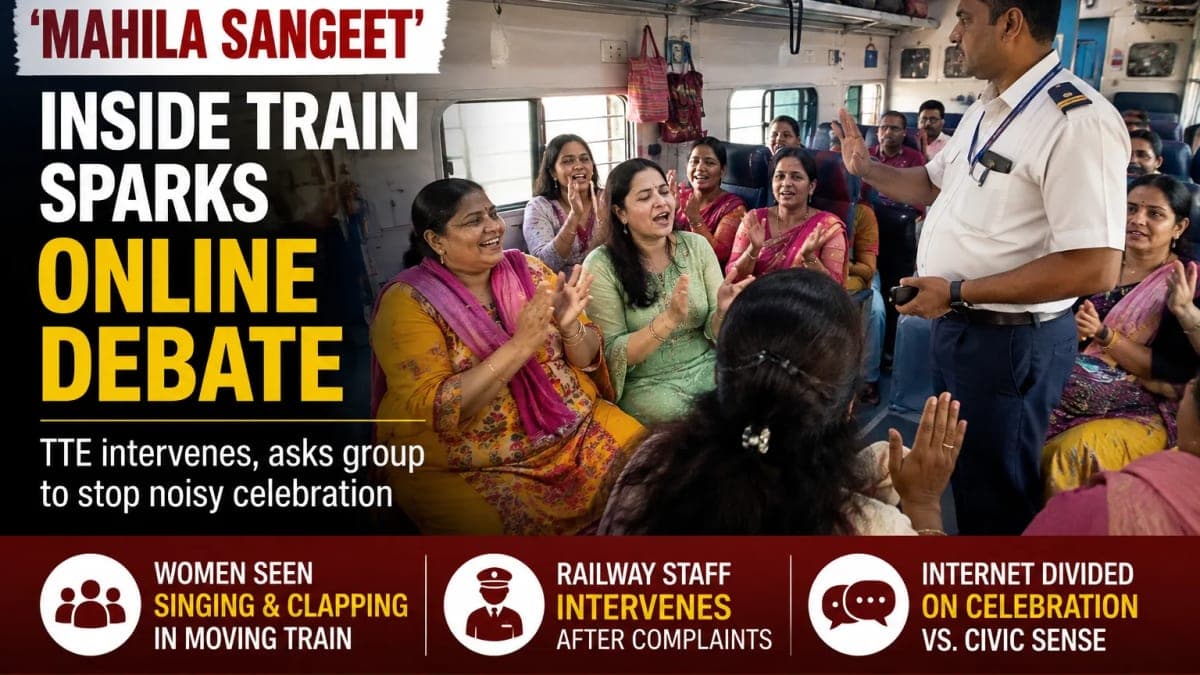
A video circulating on social media shows a group of women gathered inside a moving train coach, singing together, clapping and enjoying what appeared to be a spontaneous “Mahila Sangeet”-style celebration.
The atmosphere appears festive, with the group enthusiastically participating in the singing.
But the celebration also attracts the attention of other passengers — and eventually railway staff.
A Train Ticket Examiner (TTE) approaches the group and asks them to stop the noisy celebration, bringing the incident to the centre of an online discussion about acceptable behaviour aboard public transport.
What Does the Viral Train Video Show?
The video was shared on social media platform X and began gaining widespread attention after users started debating the passengers’ behaviour.
In the footage, several women can be seen sitting together and singing while repeatedly clapping along.
Other passengers remain seated around them as the celebration continues.
A railway staff member eventually approaches the group and communicates that the noise is disturbing other passengers.
The intervention appears calm rather than confrontational.
The women subsequently acknowledge the request, although parts of the exchange are light-hearted, with some members of the group joking during their conversation with the railway employee.
Why Did the Video Become Controversial?
The singing itself is only one reason the video gained attention.
The larger issue emerging from the clip concerns expectations of behaviour in shared public spaces.
Train coaches bring together passengers with very different needs. Some may be travelling for leisure, while others could be working, resting, reading, travelling with children or simply expecting a relatively peaceful journey.
A celebration that feels enjoyable to one group can therefore be disruptive to another.
That tension quickly became the central subject of the online discussion surrounding the video.
One Side Says: Public Transport Requires Consideration
Many social media users argued that purchasing a train ticket gives someone the right to travel — but not unrestricted control over the environment inside a shared coach.
From this perspective, prolonged loud singing, music or group celebrations can interfere with the comfort of passengers who have paid for the same journey.
Critics consequently viewed the railway employee’s intervention as reasonable.
For them, the controversy is less about whether people should enjoy themselves and more about whether that enjoyment affects others.
The debate also reflects a broader discussion frequently seen online about civic behaviour in public transportation, restaurants, airports, cinemas and other communal spaces.
Others Ask: Is Singing on a Train Really Such a Serious Problem?
Not everyone viewed the incident negatively.
Some users argued that passengers singing together during a journey can create memorable moments and that spontaneous celebrations have long been part of group travel.
From that perspective, the reaction to the video may appear disproportionate to what was essentially a group of passengers enjoying themselves.
Supporters of this interpretation questioned whether every instance of singing or laughter in public transport should automatically be treated as misconduct.
Their responses highlight another side of the debate: public spaces do not necessarily have to be completely silent.
Mahila Sangeet Has Deep Cultural Roots
The term “Mahila Sangeet” generally refers to a traditional pre-wedding gathering involving women singing songs, performing music and celebrating together.
Over time, sangeet celebrations have evolved considerably and can now include organised performances, dancing and elaborate events involving entire families.
In the viral train incident, however, “Mahila Sangeet” has largely been used online to describe the style and atmosphere of the women’s group celebration.
The controversy is therefore not fundamentally about the tradition itself.
Instead, it concerns whether a shared train coach is an appropriate setting for a loud group celebration.
Railway Staff’s Calm Intervention Draws Attention
Another notable part of the viral clip is the manner in which railway staff handled the situation.
Rather than escalating the exchange, the employee appears to communicate the concern directly to the passengers and asks them to stop or keep the disturbance under control.
That approach attracted appreciation from several people commenting on the video.
The interaction demonstrates how relatively ordinary disagreements in public spaces can sometimes be resolved through communication instead of confrontation.
The Bigger Question: Who Defines Acceptable Noise?
The viral video exposes an interesting challenge surrounding public etiquette.
There is rarely universal agreement about what constitutes “too loud.”
A conversation that seems normal to one passenger could be distracting to another. Children playing, people talking on phones, watching videos without headphones or groups singing can all produce similar disagreements.
Cultural expectations also influence perceptions of acceptable behaviour.
India’s train journeys have historically been highly social environments. Families share food, strangers strike up conversations and groups travelling together often interact throughout long journeys.
At the same time, expectations surrounding comfort and personal space are evolving.
More passengers now travel while working remotely, consuming entertainment through headphones or expecting quieter journeys.
Those two expectations can occasionally collide.
Celebration vs Civic Sense: Both Arguments Have Merit
Reducing the controversy to a simple question of who was “right” risks missing the more important issue.
Passengers should reasonably be allowed to talk, laugh and enjoy their journey.
Public transportation does not need to function like a silent library.
However, shared spaces also require compromise.
When a celebration becomes loud or prolonged enough to affect passengers outside the participating group, reducing the volume is a reasonable expectation.
Similarly, complaints about noise can be addressed without insulting or stereotyping the people involved.
The most practical standard may therefore be simple: enjoyment is acceptable until it significantly interferes with someone else’s ability to comfortably use the same shared space.
Social Media Adds Another Layer to the Controversy
There is also an important difference between what happened inside the coach and what happened after the footage reached social media.
A relatively small disagreement during a train journey can become a national conversation once a short video is uploaded online.
Viewers usually see only a limited portion of the original situation.
They may not know how long the singing continued, exactly what happened before recording began, how many passengers were affected or what conversations occurred outside the captured footage.
That makes caution important when assigning motives or making sweeping judgments about individuals appearing in viral clips.
Why This Viral Video Matters
The popularity of the video demonstrates how everyday incidents increasingly become discussions about broader social behaviour.
The issue is bigger than one group singing aboard one train.
India’s trains, metros, buses and airports serve enormous numbers of people every day. As public transportation becomes busier, maintaining a balance between individual freedom and collective comfort becomes increasingly important.
Technology adds another dimension.
Smartphones mean disagreements that once disappeared when a journey ended can now be recorded, uploaded and debated by millions of strangers.
That visibility can encourage conversations about civic responsibility, but it can also turn minor incidents into disproportionately large controversies.
A Simple Lesson From the Viral Train Debate
There is room for celebration in public life.
There is also room for people who simply want a peaceful journey.
The two do not necessarily have to conflict.
The viral “Mahila Sangeet” train video ultimately highlights a basic principle of shared spaces: individual enjoyment works best when accompanied by awareness of the people around us.
And perhaps that — rather than deciding whether singing itself was right or wrong — is the more useful takeaway from the debate.
This article is based on reporting published by TOI.