A set of screenshots carrying serious workplace allegations against McDonald’s India travelled quickly across social media over the weekend. Within hours, what appeared to be an employee grievance had developed into a wider online story involving claims of unpaid wages, questions over the authenticity of corporate posts and, eventually, cryptocurrency references.
McDonald’s India says the premise behind the controversy is false.
The company has denied any association with the post at the centre of the episode, saying it was fabricated and had never been published through its official social media account. That denial leaves an important distinction between what users saw in widely shared screenshots and what can actually be established about their origin.
How the ‘Unpaid Intern’ Claim Spread
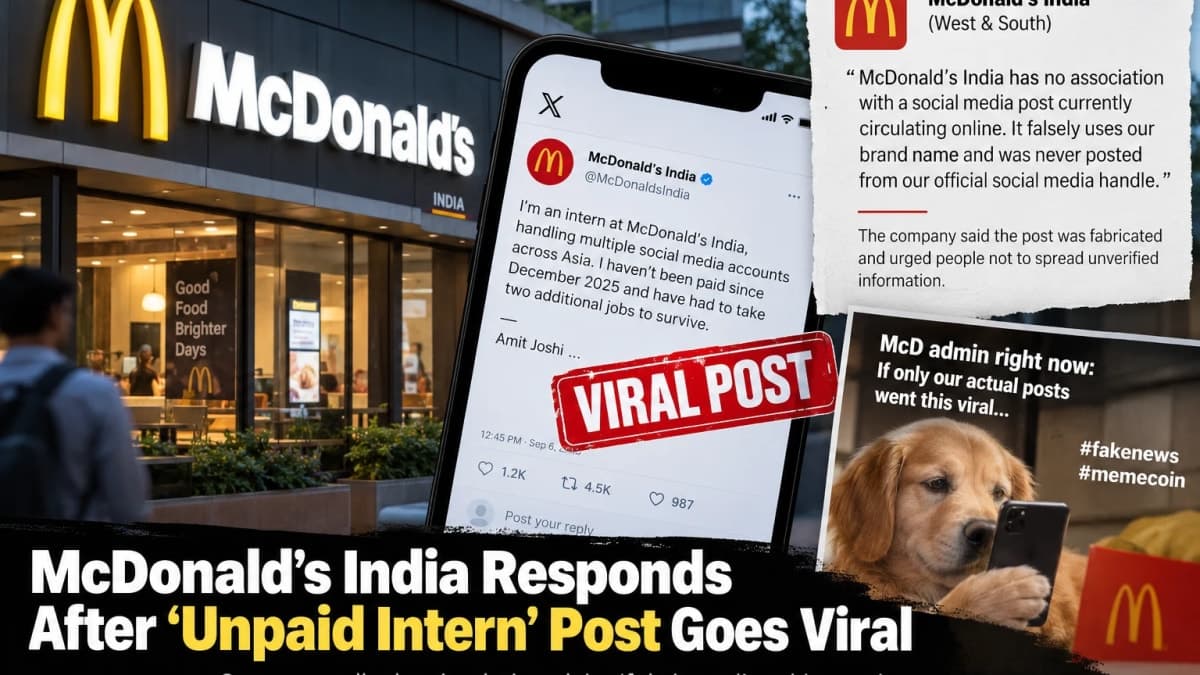
The controversy surfaced on September 6 after screenshots began circulating of a message presented as though it had appeared on McDonald’s India’s X account.
The person behind the message claimed to be an intern managing several of the company's social media accounts in Asia. The post alleged that the intern had not received payment since December 2025 and had been forced to take two additional jobs because of the financial strain.
It also named a person identified as Amit Joshi in connection with the alleged payment dispute.
Those claims have not been independently verified. The identity of the purported intern has also not been established, meaning the allegations about employment, salary and the individual named in the screenshots should not be treated as confirmed facts.
The story became more unusual as additional posts and screenshots circulated. Some contained references to financial difficulties, cryptocurrency, memecoins and wallet addresses, further complicating early assumptions that the episode was simply an employee airing a workplace grievance.
McDonald’s India Rejects the Viral Post
As the screenshots gained attention, McDonald’s India (West & South) issued a denial distancing itself from the content.
“McDonald's India has no association with a social media post currently circulating online. It falsely uses our brand name and was never posted from our official social media handle,” the company said in a statement reported by India Today.
It also pointed to what it described as “clear discrepancies” in the material and said the post was fabricated, urging people not to circulate unverified information.
That response is particularly relevant because some of the earliest discussion around the episode assumed the message had genuinely appeared on an official McDonald’s account before being removed.
The company's version is different: it says the viral material did not originate from its official handle.
Conflicting Accounts Complicate the Story
Coverage of the incident has not been entirely consistent.
Some reports described the episode as an apparent compromise of McDonald’s India’s X account, while the company has explicitly said the post was never published from its official social media handle.
Those are materially different explanations.
There is also no independently established evidence confirming that the person described in the post worked as an intern for McDonald’s India, was owed wages by the company or had responsibility for its social media accounts.
Similarly, the allegations involving the individual named in the screenshots remain unverified.
The available evidence therefore supports describing these as claims contained in viral online material, rather than as an established employment dispute.
McDonald’s Joins the Conversation With a Meme
After issuing its denial, McDonald’s India took a less formal approach to the attention surrounding the story.
The company posted an image of a dog looking at a phone alongside the line:
“McD admin right now: If only our actual posts went this viral…”
It accompanied the response with the hashtags #fakenews and #memecoin.
The joke allowed the company to acknowledge how far the story had travelled without giving additional weight to the allegations themselves.
It also reflected the unusual direction the episode had taken. What began online as an apparent salary complaint had, by then, expanded into speculation about account security, fabricated screenshots and cryptocurrency promotion.
Why the Source of the Screenshots Matters
The central issue is no longer simply what the viral message alleged, but whether the material was authentic in the first place.
Screenshots can preserve genuine posts after deletion, but they can also be edited or fabricated. Once detached from the original account and shared repeatedly across platforms, establishing where an image came from becomes considerably harder.
That makes the distinction in McDonald’s response important. The company is not merely disputing the salary allegations; it says the post itself did not originate from its official handle.
Unless independent evidence establishes otherwise, the unpaid-intern narrative remains an unverified social media claim rather than a confirmed account of working conditions at McDonald’s India.
The episode also shows how quickly the first version of an online story can become established before its underlying evidence has been tested. In this case, the viral screenshots generated a substantial conversation before questions about their authenticity became central to the coverage.