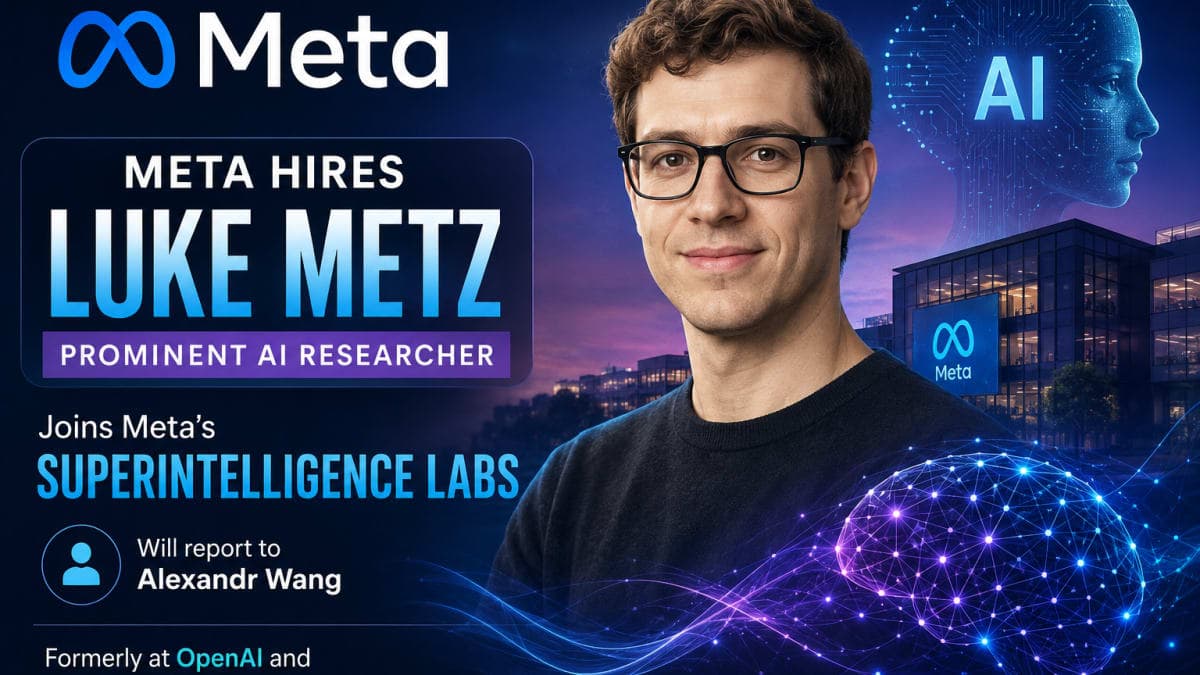
Meta Hires Prominent AI Researcher Luke Metz for Superintelligence Labs
Meta has added another prominent researcher to its artificial intelligence operation, hiring Luke Metz as competition among the world's leading technology companies for experienced AI scientists continues to intensify.
Metz has joined Meta’s Superintelligence Labs and is set to begin working at the company this week. He will report to Alexandr Wang, who leads Meta’s artificial intelligence efforts, according to reporting confirmed by a source familiar with the move.
The appointment is significant not simply because of Metz’s research background, but also because of the companies he has worked with. His career has placed him inside several organizations involved in developing cutting-edge artificial intelligence systems.
Luke Metz Moves From OpenAI to Meta
Before his latest move, Metz had returned to OpenAI earlier in 2026.
His return followed a period at Thinking Machines Lab, the AI startup founded by former OpenAI chief technology officer Mira Murati. Metz and Barret Zoph returned to OpenAI from Thinking Machines in January 2026.
Metz had originally left OpenAI in 2024 to join Thinking Machines before making his way back to the ChatGPT developer. His subsequent decision to join Meta illustrates how rapidly senior researchers are moving between competing frontier-AI organizations.
That movement has become an increasingly important part of the technology industry's AI competition.
Why Luke Metz Is an Important Hire for Meta
For Meta, recruiting experienced researchers can provide something that additional computing infrastructure alone cannot easily deliver: expertise developed through years of experimenting with large-scale machine-learning systems.
The most advanced AI models require enormous computing resources, high-quality datasets and sophisticated training techniques. But the researchers who understand how to combine those elements effectively have also become strategically important.
Metz's experience across major AI research organizations therefore makes his appointment particularly noteworthy.
His move also adds another experienced researcher to an organization that Meta is positioning at the center of its long-term AI ambitions.
Metz to Work Under Alexandr Wang
Metz will report to Alexandr Wang, who now heads Meta's artificial intelligence efforts.
Wang joined Meta following the company's multibillion-dollar transaction involving Scale AI, the AI data company he co-founded.
Since then, Meta has continued recruiting researchers and reorganizing its AI operations around its ambitions in advanced models and superintelligence.
Metz's arrival indicates that the company is continuing that strategy rather than relying exclusively on its existing research organization.
Meta's Superintelligence Ambitions
Meta has spent years investing heavily in artificial intelligence, with AI technology already supporting recommendation systems, advertising, content discovery and consumer products across its platforms.
The company's ambitions now extend much further.
Meta's AI research operation is working across areas including natural-language processing, reinforcement learning, computer vision, multimodal systems and generative AI. Its research organization continued publishing work across several of these fields during 2026.
The formation and expansion of Superintelligence Labs represents an effort to compete directly at the frontier of model development.
Hiring researchers with experience inside rival laboratories can accelerate that effort by bringing different approaches to model training, experimentation and research.
The AI Industry's Battle for Researchers
Metz's move also highlights a broader transformation taking place across the artificial intelligence industry.
Companies are competing not only over GPUs, data centers and model performance but also over a comparatively limited pool of researchers who have experience developing frontier-scale AI systems.
Researchers have consequently become highly valuable strategic assets.
The movement of Metz between OpenAI, Thinking Machines Lab, OpenAI again and now Meta illustrates how fluid the market for experienced AI researchers has become.
The situation resembles competition for elite engineering talent during earlier technology booms, but the stakes surrounding AI research are unusually high because relatively small teams can potentially influence the capabilities of systems used by hundreds of millions of people.
What the Hiring Means for OpenAI
The departure also represents another example of talent moving between OpenAI and its competitors.
However, the significance of any individual departure should be treated carefully.
Major AI laboratories employ large research and engineering teams, meaning one researcher changing companies does not necessarily translate into an immediate shift in model performance or competitive standing.
OpenAI has itself recruited researchers from competing organizations. Metz's return to OpenAI earlier this year came alongside Barret Zoph amid personnel movements involving Thinking Machines Lab.
The larger story, therefore, is less about a single company gaining or losing one employee and more about how aggressively the entire frontier-AI industry is competing for experienced researchers.
Why This Matters for the AI Race
The current AI competition increasingly has three major dimensions: computing power, research talent and product distribution.
Meta already possesses substantial distribution through its global consumer platforms. It is also investing heavily in computing infrastructure.
Building a research organization capable of producing leading AI systems is another part of that equation.
Recruiting researchers such as Metz could help Meta strengthen that third pillar, particularly as companies attempt to push models toward more sophisticated reasoning, multimodal capabilities and autonomous task execution.
At the same time, hiring well-known researchers does not guarantee technological leadership.
AI breakthroughs depend on research direction, organizational execution, infrastructure, data, model architecture and the ability to turn experiments into reliable products.
Balanced Analysis: A Significant Hire, but Results Will Matter More
Luke Metz's appointment strengthens Meta's roster and demonstrates the company's willingness to compete aggressively for experienced AI researchers.
It also reinforces the growing influence of Alexandr Wang within Meta's reorganized AI operation.
Yet the ultimate impact of the hiring will be determined by what Meta's expanded team produces.
Technology companies can assemble exceptional researchers and spend billions of dollars on infrastructure, but successful frontier models still require coordination between research, engineering, safety and product teams.
There is also a broader industry question surrounding increasingly rapid researcher movement. While competition can spread ideas and accelerate innovation, frequent personnel changes can make it harder for research organizations to maintain continuity on projects that may take months or years to mature.
What Comes Next for Meta AI?
Attention will now turn toward how Metz fits into Meta's broader superintelligence program and what projects emerge from the company's increasingly high-profile research organization.
Meta has introduced multiple AI models and research projects in recent months, while continuing to expand its work across generative AI and other machine-learning fields.
For the wider technology industry, Metz's latest career move sends another clear signal: the battle for AI leadership is increasingly becoming a battle for the people capable of building the next generation of models.
Infrastructure spending may dominate financial headlines, but the competition to recruit researchers with direct experience building frontier systems could prove just as consequential.
This article is based on reporting published by Axiox.