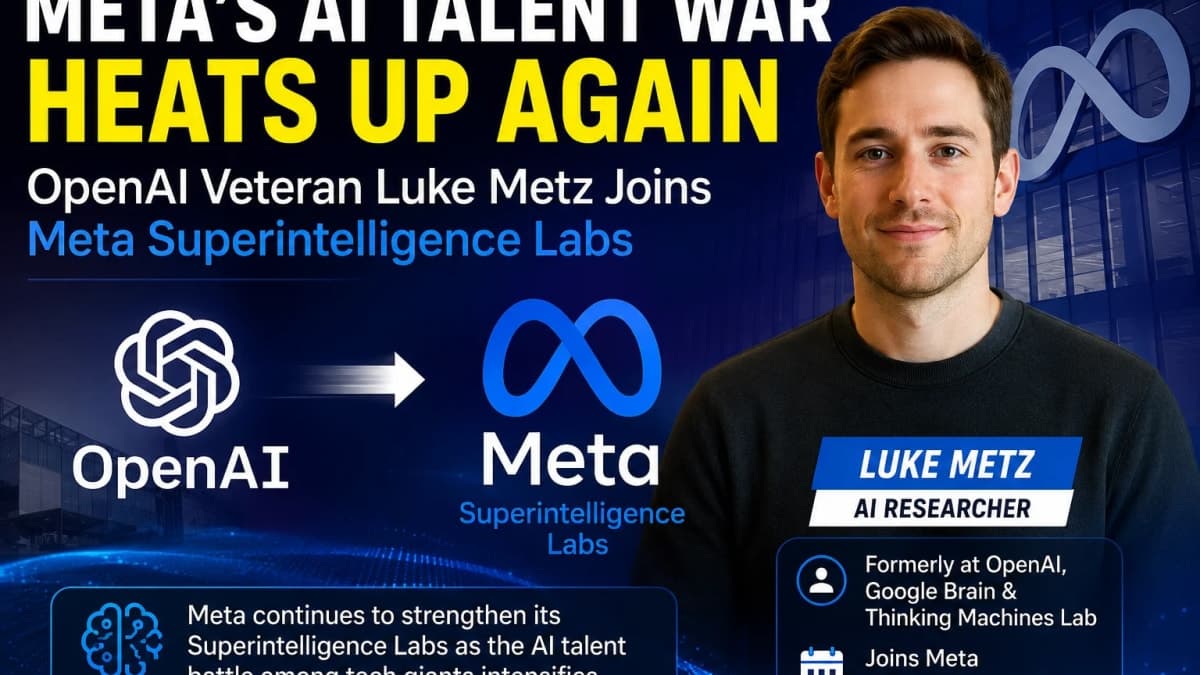
Meta Adds Another OpenAI Veteran
Meta has strengthened its artificial intelligence research ranks with the hiring of Luke Metz, an experienced researcher whose career has included work at OpenAI, Google Brain and Thinking Machines Lab.
According to reporting on the move, Metz is joining Meta Superintelligence Labs and is expected to report to Alexandr Wang, who leads Meta’s AI efforts. Metz is set to begin his new role this week.
His arrival is notable because Metz has spent significant time inside some of the organizations shaping modern generative AI. He previously worked at OpenAI and briefly moved to Thinking Machines Lab, the AI startup founded by former OpenAI CTO Mira Murati, before returning to OpenAI earlier in 2026.
Now, his move to Meta puts him at the center of one of Silicon Valley’s most ambitious AI expansion efforts.
Why Luke Metz’s Hiring Matters
Individual technology hires rarely attract widespread attention. In the current AI race, however, experienced researchers can have an unusually large strategic impact.
Building frontier AI models requires far more than access to powerful chips and large datasets. Companies also need researchers who understand model training, experimentation, scaling techniques and the difficult process of turning research breakthroughs into reliable products.
That makes people with direct experience at leading AI laboratories particularly valuable.
Metz's move therefore represents more than another addition to Meta's employee roster. It gives the company another researcher familiar with the environment and technical challenges involved in developing advanced AI systems.
Meta Is Building Its AI Strategy Around Superintelligence
Meta has been investing heavily in its ambition to develop increasingly capable AI systems.
The company’s Superintelligence Labs has become an important part of that strategy, with Alexandr Wang playing a central leadership role. Meta has simultaneously expanded its models, infrastructure and AI products as it attempts to compete with OpenAI, Google and other major laboratories.
The company has already demonstrated the results of this broader push through products developed by its AI organization. In 2026, Meta introduced Muse Spark, describing it as its most powerful model at launch, and later released Muse Image through Meta Superintelligence Labs.
Meta is also expanding the role of AI across its enormous consumer ecosystem, including Facebook, Instagram, WhatsApp, Messenger and its AI products.
That distribution gives Meta an important advantage: improvements made inside its AI laboratories can potentially reach billions of interactions across products the company already controls.
The AI Race Is Becoming a Battle for People
For years, the technology industry competed aggressively for software engineers. Generative AI has pushed that competition into a much narrower and more expensive category.
Only a limited number of researchers have extensive experience training and improving models at the frontier of AI development. As companies race toward more capable systems, those specialists have become strategically important assets.
Meta has emerged as one of the industry's most aggressive recruiters.
The company has recruited talent from organizations including OpenAI and Thinking Machines Lab, while movement has also occurred in the opposite direction. Thinking Machines, for example, has hired researchers from Meta and other major AI companies, illustrating that the talent battle is not entirely one-sided.
The result is an increasingly fluid AI employment market where leading researchers can move between companies that were previously direct rivals.
Why Companies Are Spending So Much on AI Talent
The economics of frontier AI help explain the intensity.
Training advanced models can require enormous spending on computing infrastructure, data centers, specialized chips and electricity. Yet all that infrastructure still depends on teams capable of designing the models and running effective training programs.
A relatively small improvement in model architecture, training efficiency or reasoning capability could potentially create substantial commercial advantages when deployed across products used by millions—or billions—of people.
From that perspective, paying heavily for a small number of proven researchers can make strategic sense for companies already committing billions of dollars to AI infrastructure.
But it also creates risks.
The Risks Behind the AI Hiring War
Aggressive recruiting does not automatically translate into better AI products.
Bringing together highly accomplished researchers from competing organizations can create management challenges, overlapping responsibilities and disagreements over research priorities. Extremely large compensation differences between newly recruited specialists and existing employees can also potentially create internal tensions.
There is another challenge: retention.
When several well-funded AI companies are competing for the same people, hiring a researcher is only part of the battle. Companies must also create an environment compelling enough to keep them.
The continuing movement of researchers between Meta, OpenAI, Thinking Machines Lab and other AI organizations demonstrates how quickly the competitive landscape can change.
What Metz’s Move Means for OpenAI
For OpenAI, Metz's departure represents another example of the intense competition surrounding experienced AI researchers.
It would be premature, however, to interpret a single departure as evidence of a major shift in technological leadership.
OpenAI continues to possess substantial research expertise, computing resources and an established AI product ecosystem. At the same time, competitors are clearly trying to reduce any talent advantage by recruiting researchers with direct experience inside the company.
This dynamic could force leading AI laboratories to devote increasing attention not only to recruiting new researchers but also to retaining existing teams.
Bigger Picture: AI’s Next Breakthrough Could Depend on Talent
The AI industry often focuses on model benchmarks, GPU clusters and investment figures. Meta's latest hire highlights another resource that may be equally important: experienced people.
Meta can purchase more computing capacity and build larger data centers, but assembling teams capable of converting those resources into major AI advances remains considerably harder.
Luke Metz joining Meta Superintelligence Labs therefore matters less as an isolated personnel announcement and more as another signal of where the industry is heading.
The companies attempting to build the next generation of AI are simultaneously racing for compute, models, distribution and human expertise.
And as the pool of researchers with frontier-model experience remains limited, the competition for those people could become one of the defining battles of the AI industry.
Balanced Analysis
Meta's aggressive recruitment strategy could accelerate its progress by concentrating experienced researchers inside its Superintelligence Labs. Combined with its massive infrastructure investment and global product distribution, that talent could strengthen Meta's position against OpenAI and other frontier AI developers.
However, hiring star researchers is not a guarantee of technological leadership. Successful AI development also depends on organizational stability, research culture, computing resources, long-term strategy and the ability to turn experimental breakthroughs into dependable products.
The real measure of Meta's talent strategy will therefore not be the number of prominent researchers it recruits, but whether those teams produce AI systems capable of meaningfully advancing the company's technology and products.
This article is based on reporting published by Axios.