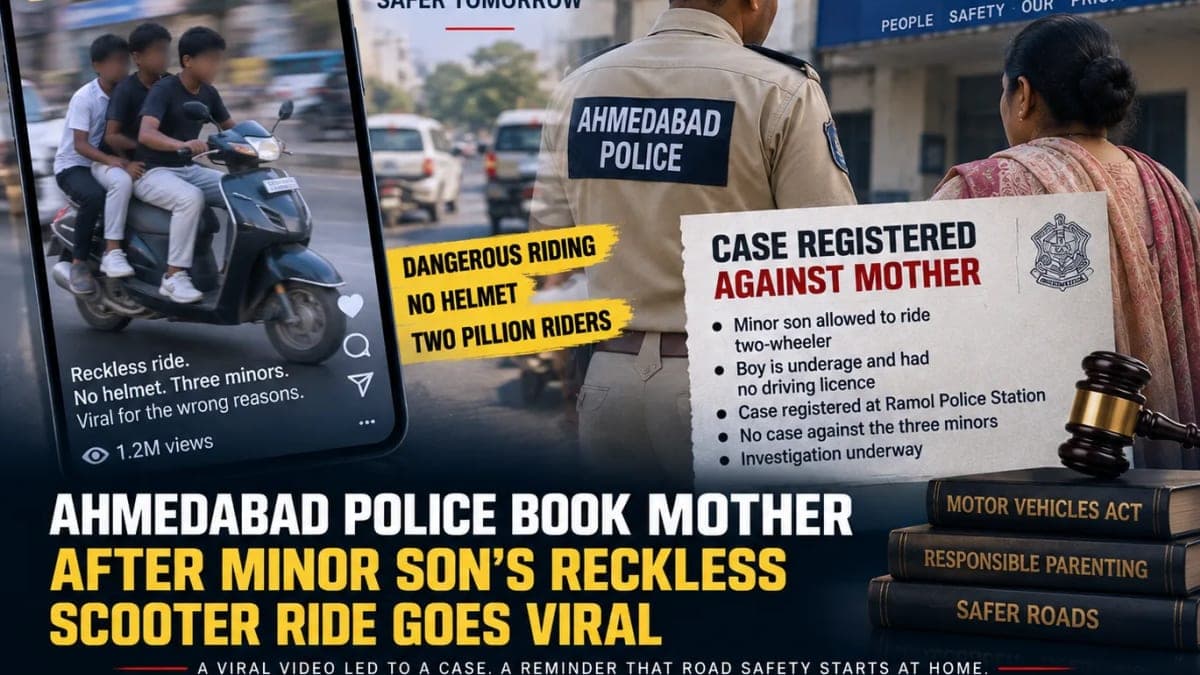
A short Instagram video showing three youngsters on a scooter has turned into a police case in Ahmedabad, but the person facing action is not the boy seen at the handlebars.
Ramol Police traced the underage rider after footage circulating online allegedly showed him manoeuvring dangerously through traffic with two pillion passengers. Police said he was not wearing a helmet and did not possess a driving licence.
Once officers established that the rider was a minor, their inquiry moved to a different question: how had he been allowed to take the scooter onto the road?
Police say the investigation found that his mother had permitted him to use the two-wheeler. A case was subsequently registered against her.
Inspector V.D. Mori said no case had been registered against the three minors seen on the scooter.
The episode shows how an online stunt can develop into something more consequential once police establish who controlled the vehicle and whether an adult knowingly allowed an underage person to drive it.
Instagram Clip Prompts Police Inquiry
The case began with footage posted on Instagram.
According to police, the video showed the minor riding through traffic in a manner officers considered dangerous. Two other minors were travelling behind him, taking the number of people on the scooter to three.
The rider was also allegedly without a helmet.
Police began working to identify him after the footage came to their attention.
A separate local report said officers identified the scooter as an Activa and used its registration details and technical surveillance as part of the process of tracing the rider. The report described the boy as making high-speed zigzag movements, sometimes referred to colloquially as “Nagin”-style riding.
Once located, police checked his eligibility to drive and found that he was underage and did not have a valid driving licence.
That changed the direction of the case.
Investigation Shifts From Rider to Parent
For police, identifying the boy did not settle the issue.
Because the rider was a minor, officers examined how he obtained access to the scooter and whether an adult had knowingly permitted him to use it.
Their inquiry led to his mother.
Inspector Mori said the investigation found that she had allowed her underage son to ride the vehicle despite his not having a licence. Police then registered a case against her.
The three minors shown in the video were not booked, according to Mori.
That distinction is central to the case. Indian motor vehicle law allows responsibility for offences involving juvenile drivers to extend beyond the child to the guardian or owner of the vehicle, depending on the circumstances.
What Indian Law Says About Juvenile Driving
India's Motor Vehicles Act contains specific provisions dealing with offences committed by juveniles.
Under Section 199A, when a motor vehicle offence is committed by a juvenile, the guardian of the juvenile or owner of the vehicle can be deemed responsible, subject to conditions and defences provided by law.
A guardian or owner can seek to establish that the offence occurred without their knowledge or that they had exercised due diligence to prevent it.
The law therefore does not automatically make every parent criminally responsible simply because a child takes a vehicle.
What matters is the evidence surrounding access to the vehicle and whether the adult knew about or permitted its use.
In the Ahmedabad case, police say their inquiry established that the mother had allowed her son to ride. That allegation, rather than the family relationship alone, forms the basis of the action against her.
One Video Potentially Records Several Road-Safety Problems
The footage drew attention because of the riding itself, but police were dealing with several separate safety concerns.
The person operating the scooter was allegedly below the legal age for driving and had no licence. He was reportedly riding without a helmet and carrying two pillion passengers.
The alleged zigzag manoeuvring added another element to the police assessment of the ride.
Taken together, those details explain why the footage moved beyond the usual cycle of social-media sharing and attracted official attention.
The fact that the video was available online also gave officers something that many fleeting traffic violations do not leave behind: a visual record that could be examined after the ride had ended.
Viral Road Videos Can Become Investigative Leads
Dangerous driving filmed for social media has increasingly created a straightforward problem for the people appearing in such videos.
The recording may become an investigative lead.
A clip can potentially reveal a vehicle registration number, road, landmark, rider or passenger. Police can then use those details to conduct a separate inquiry and determine whether an offence occurred.
That distinction matters legally. A viral video can prompt an investigation, but the popularity of a clip does not itself prove an offence.
In this case, police did not rely solely on what appeared online. They said they traced the rider and established separately that he was a minor without a driving licence.
Their investigation then turned to the person they allege gave him permission to use the scooter.
The Case Is About Access as Much as Riding
The most important element of the Ahmedabad case may ultimately be what happened before the scooter entered the road.
Underage driving depends on access to a vehicle. Where that access is knowingly provided by an adult, traffic law gives police a route to examine the responsibility of the guardian or vehicle owner rather than treating the incident solely as misconduct by a child.
That is why the police response did not end when they identified the rider in the Instagram video.
The online footage provided the lead. The boy's age and licence status established the underage-driving issue. The subsequent inquiry into who permitted him to use the vehicle determined where police directed the case.
For the mother who has been booked, the allegations remain subject to the legal process. Registration of a case records the police accusation; it is not a finding of guilt.