Nana Patekar Gave Up ₹1.5 Crore Luxury-Car Plan After Farmer Suicides—Here’s the Verified Story
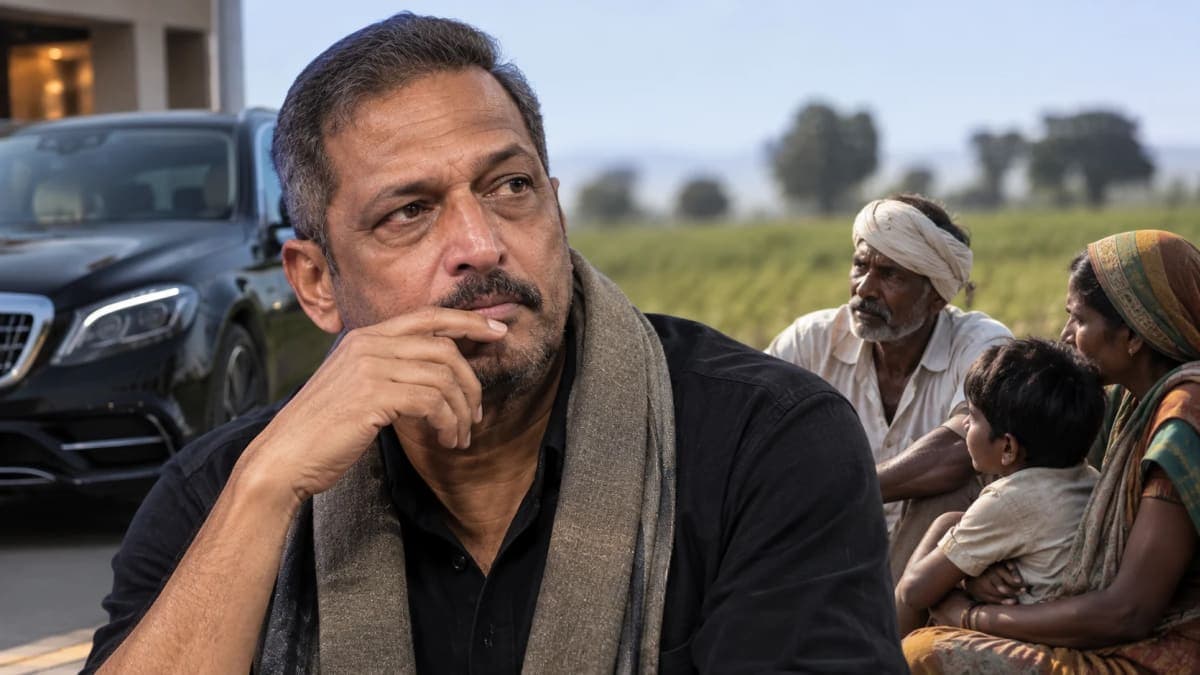
A new anecdote about Nana Patekar has attracted attention after screenwriter Ranbir Pushp recalled that the veteran actor abandoned plans to buy an expensive car and instead decided to help families devastated by farmer suicides.
The broad story is not merely a recent recollection. Importantly, Patekar himself told a substantially similar story more than a decade ago, giving unusually strong independent support to the central claim. However, one detail in the latest version—how much individual families received—does not align cleanly with the older record.
What Ranbir Pushp said
Pushp, who wrote the 1996 film Agni Sakshi starring Patekar, Manisha Koirala and Jackie Shroff, discussed the actor during a recent interview with Siddharth Kannan.
According to Pushp, Patekar had planned to purchase a car costing approximately ₹1.5 crore, but after learning about families affected by farmer suicides, he decided against the purchase and directed the money towards helping them.
Pushp used the story while challenging the public perception of Patekar as simply an angry or difficult personality.
“The one who wipes the farmers’ tears can’t cause harm to anyone,” Pushp said in the interview, according to the published transcript.
But the most interesting part of this story comes from looking back at what Patekar himself said years earlier.
Nana Patekar told the story himself in 2015
A December 2015 interview with The Telegraph reported that Patekar had put aside ₹1.5 crore to purchase a luxury car.
After becoming troubled by reports of farmer deaths, however, he changed his plans.
Patekar told the publication that he had become concerned that he was no longer reacting strongly enough to reports of farmers dying. That realization prompted him to think about helping affected families instead.
He then travelled to Beed in Maharashtra, where he met young widows and children from affected farming families.
That experience appears to have transformed what began as personal financial assistance into a much larger initiative.
Another interview independently supports the ₹1–1.5 crore figure
In March 2016, Patekar discussed the origins of his farmer-relief work with Governance Now.
He recalled seeing a television interview with the family of a farmer who had died by suicide and wondering how he could help.
Patekar said:
“I had Rs 1-1.5 crore with me and I asked Makarand to distribute the money to the families of farmers who had lost their breadwinners.”
The Makarand he referred to was Marathi actor Makarand Anaspure, with whom Patekar subsequently established the NAAM Foundation in September 2015 to support drought-affected farmers and their families in Maharashtra.
That older first-person account is significant because it means the central story does not depend solely on Pushp's 2026 recollection.
But there's an important discrepancy in the new version
This is where the latest viral version requires caution.
Recent coverage of Pushp's interview says Patekar arranged for ₹15 lakh to be given to each affected family.
However, Patekar's older first-person account and contemporary reporting present a different picture.
The Telegraph reported in 2015 that although Patekar had saved ₹1.5 crore for the luxury car and initially considered distributing the money, he ultimately personally donated ₹25 lakh to affected families. The publicity surrounding the initiative then generated additional donations, with the newly established foundation receiving ₹9.5 crore in less than a month, according to that contemporary report.
Therefore, the claim that ₹15 lakh was actually distributed to each family should not be presented by JantaScope as an independently established fact.
The better-supported conclusion is that Patekar had roughly ₹1–1.5 crore available, had contemplated using around ₹1.5 crore for a luxury car, and decided to redirect his attention and money toward distressed farming families.
The decision eventually became bigger than one donation
What makes the episode particularly relevant today isn't simply the abandoned car purchase.
Patekar's initial response developed into an organised effort.
In his 2016 interview, he explained that he and Anaspure started NAAM Foundation in September 2015 to assist farming families affected by drought in Maharashtra.
Contemporary reporting also shows that their ambition extended beyond handing out money. Plans included creating alternative employment opportunities for farming families and addressing some of the longer-term economic pressures affecting rural households.
That context changes the story considerably.
Instead of being merely a celebrity anecdote about sacrificing a luxury purchase, the car decision appears to have occurred during the formative period of a broader farmer-support initiative.
Why the original account matters
Celebrity anecdotes often resurface years later with increasingly dramatic details. This case provides a useful example of why checking contemporary sources matters.
Pushp's recollection broadly matches what Patekar himself said in 2015–16 about having roughly ₹1–1.5 crore and deciding to help families affected by farmer deaths rather than spending the money on himself.
But the specific distribution figures in the new telling are harder to reconcile with contemporary reporting.
So the strongest version of the story is also the simplest: Nana Patekar had saved a substantial amount of money, reportedly including plans for a ₹1.5-crore luxury car, but the plight of farming families prompted him to redirect his priorities toward helping them. That effort subsequently developed into organised work through NAAM Foundation.
That is remarkable enough without embellishment.