Headline
Indonesia’s Free School Meal Programme Under Pressure After Nearly 800 Fall Ill
Indonesia’s vast free meal programme is facing another test of its food-safety system after nearly 800 people became ill in separate incidents across East Java and West Sumatra.
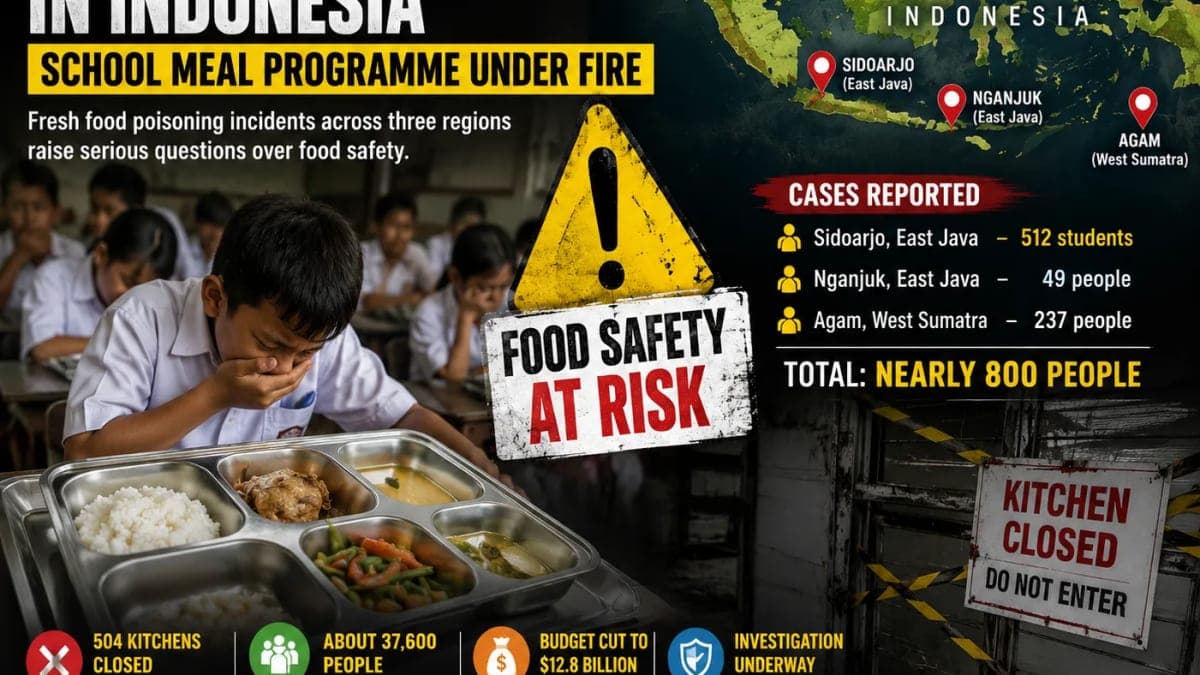
The largest cluster was recorded in Sidoarjo, where 512 students fell sick after eating lunch on Tuesday. Dozens remained under medical care the following day. Other cases were reported in Nganjuk and Agam, extending a pattern of food poisoning incidents that has followed the government programme during its rapid expansion.
Authorities have suspended a kitchen connected to the Sidoarjo cases while investigators examine food samples and try to establish what caused the illnesses.
More Than 500 Students Sick in Sidoarjo
National Nutrition Agency official Ketut Sumedana said 512 students in Sidoarjo became ill after Tuesday’s lunch. A regional official had earlier reported 516 cases.
Around 80 children were still receiving treatment on Wednesday, according to Ketut.
Investigators have yet to determine exactly what made the students sick. The kitchen suspected of supplying the affected meals has been suspended, and police have collected food samples for testing.
Ketut said the findings would be made public once the investigation was complete.
That leaves an important distinction at this stage: the illnesses have been associated with meals distributed through the government programme, but the specific source of contamination has not yet been confirmed.
Cases Stretch Beyond One District
Sidoarjo accounts for most of the latest illnesses, but similar cases have emerged elsewhere.
Lawmaker Charles Honoris, citing figures from local health departments, said 49 people were affected in Nganjuk, another part of East Java. A further 237 cases were recorded in Agam, West Sumatra.
Together, the three incidents account for 798 reported illnesses.
Honoris called the repeated cases a “failure of the system,” shifting attention from individual kitchens to the safeguards governing a programme that prepares and distributes meals on an enormous scale.
A Programme Built to Tackle Malnutrition
President Prabowo Subianto launched the Free Nutritious Meal programme in January 2025. It is one of his administration’s signature policies and was designed to improve access to nutritious food, particularly for children.
Its reach has grown quickly.
Before a government budget review, the National Nutrition Agency said roughly 62.5 million people were receiving meals through the programme.
Operating at that scale creates a complicated food-safety chain. Meals have to be prepared in large quantities, kept under appropriate conditions and delivered within safe time limits across thousands of locations.
Previous investigations have identified problems including improper storage and delays between cooking and delivery.
The latest illnesses therefore arrive against a much larger backdrop.
Network for Education Watch, a non-governmental education watchdog, said about 37,600 people had suffered food poisoning linked to the programme as of August 8, 2026.
That is the organisation’s count rather than an official government total, but it gives a sense of the concerns that have accumulated around the programme.
Hundreds of Kitchens Have Already Been Closed
The government has been tightening controls.
Indonesia’s National Nutrition Agency said in August that 504 kitchens had been permanently shut after local health authorities found they did not meet sanitation requirements.
Those decisions were based on assessments submitted by local health departments through the Health Ministry.
Closing hundreds of kitchens is a significant intervention, but the new cases show the difficulty of maintaining consistent standards across a nationwide operation serving tens of millions of people.
The challenge is no longer simply expanding the programme. Authorities also have to make sure growth does not move faster than inspection, training, sanitation and food-distribution systems can handle.
Government Shifts Attention Towards Quality
The programme’s scale has also forced changes in spending plans.
In July, the government cut its provisional 2026 budget for the initiative to 229 trillion rupiah, or about $12.8 billion, from an earlier allocation of 335 trillion rupiah.
Officials said the revised approach would put greater emphasis on quality rather than pursuing a fixed target for the number of recipients.
The programme has faced other pressures as well, including corruption allegations and leadership changes. Food poisoning, however, poses a particularly immediate problem because it touches the basic promise at the centre of the scheme: providing meals that improve children's nutrition without putting their health at risk.
Public Confidence Has Taken a Hit
There are signs that repeated safety problems are affecting how Indonesians view the programme.
A July survey by Saiful Mujani Research and Consulting found that only about one-third of respondents were satisfied with the initiative. Reports of food poisoning were among the reasons given for dissatisfaction.
That creates a difficult situation for a programme addressing a genuine nutritional need.
Its size means isolated failures can affect large numbers of people quickly. At the same time, slowing or restricting the programme carries consequences for families that rely on the meals.
The immediate task in Sidoarjo is narrower. Investigators must determine what caused hundreds of students to become sick and whether failures occurred during preparation, storage or distribution.
The broader task is harder: ensuring that kitchens across the country can meet the same safety standards as the programme continues to operate on a massive scale.
For an initiative built around children's nutrition, that standard is fundamental.