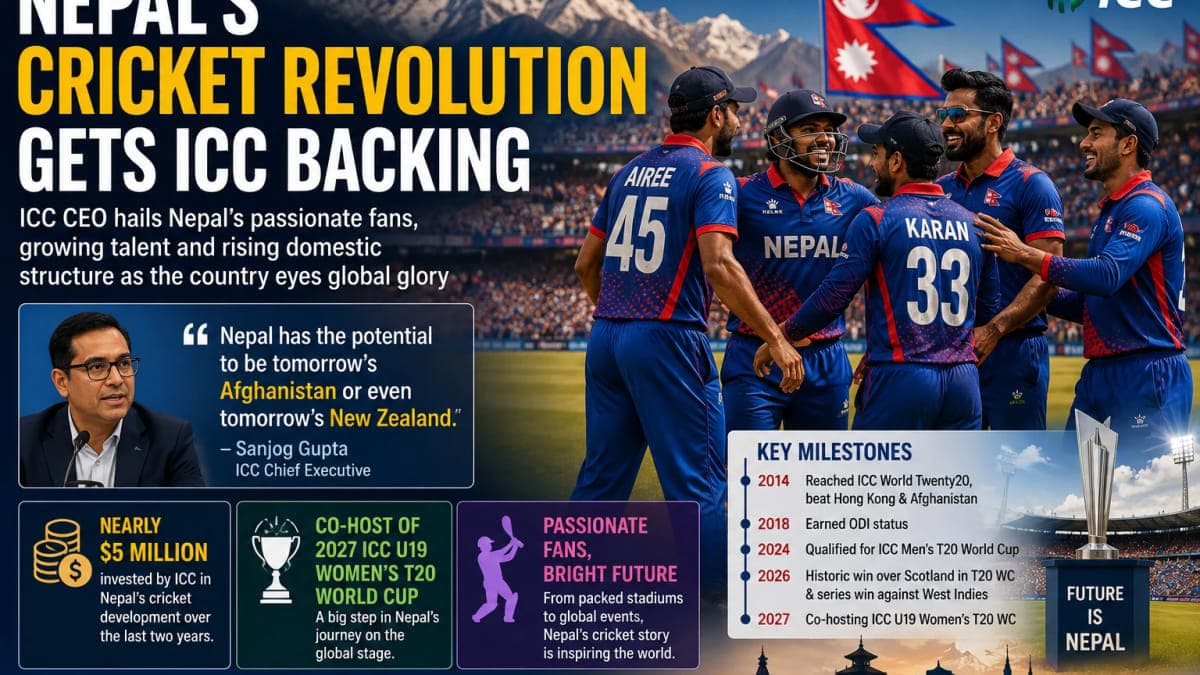
Nepal’s Cricket Revolution Gets ICC Backing as Global Ambitions Grow
Nepal's transformation from an emerging cricket nation into one of the sport's most compelling growth stories has received a significant vote of confidence from the International Cricket Council (ICC).
ICC chief executive Sanjog Gupta believes Nepal has the potential to follow a trajectory comparable to Afghanistan — or potentially develop into a cricket nation with the sustained stature of New Zealand.
The endorsement comes as Nepal combines an intensely passionate fan base with improving international performances, expanding infrastructure and a rapidly developing domestic cricket economy.
The ICC has invested nearly $5 million in Nepal's cricket development over the past two years, while Nepal has also been awarded co-hosting rights for the 2027 ICC Under-19 Women's T20 World Cup.
For a country that spent years fighting simply to establish itself on cricket's international map, the conversation has changed dramatically.
The question is increasingly becoming not whether Nepal belongs in international cricket, but how far the Himalayan nation can climb.
ICC Sees Enormous Potential in Nepal
The ICC's enthusiasm is based on more than Nepal's popularity.
Gupta pointed to the development of an increasingly competitive group of players capable of progressing through ICC pathways and performing at major tournaments.
Nepal's enormous supporter base provides another important advantage.
At the 2026 Men's T20 World Cup, thousands of Nepali supporters transformed matches into vibrant displays of red and blue, including at Mumbai's Wankhede Stadium.
That enthusiasm is particularly valuable for cricket's governing body because Nepal represents an opportunity to deepen the sport in a market where public interest has developed organically rather than being driven primarily by commercial investment.
Nearly $5 Million in ICC Investment
The ICC has backed its positive assessment with financial support.
Nearly $5 million has been invested in Nepal's cricket development during the last two years, according to Gupta.
Evidence of that support is already visible.
The Cricket Association of Nepal (CAN) recently announced plans to purchase cricket-ground equipment using ICC funding, with an international tender process launched in August.
For Nepal, infrastructure represents one of the most important challenges separating extraordinary fan enthusiasm from a sustainable professional cricket system.
Better grounds, training facilities and development programmes can increase the number of players entering the system while giving elite cricketers conditions closer to those available in established cricket nations.
The T20 World Cup Showed Nepal Can Compete
Nepal's performances have also helped change international perceptions.
At the 2026 T20 World Cup, Nepal narrowly lost to England by only four runs before later defeating Scotland by seven wickets.
The victory over Scotland was Nepal's first T20 World Cup win since 2014.
Nepal has also demonstrated its potential against stronger opposition outside global tournaments.
In September 2025, the team defeated the West Indies 2-1 in a three-match T20I series in Sharjah, although the Caribbean side did not field all of its first-choice players.
Those results do not yet make Nepal a leading international team.
But they demonstrate something equally important for an emerging cricket nation: the ability to make established opponents take them seriously.
From 2014 Breakthrough to ODI Status
Nepal's modern cricket revolution did not happen overnight.
Its appearance at the 2014 ICC World Twenty20 proved to be a defining moment.
Nepal recorded victories over Hong Kong and Afghanistan during that tournament and suddenly gained a national platform for the sport.
A decade later, Nepal returned to the T20 World Cup in 2024 before qualifying again in 2026 — the first time the country had reached consecutive editions.
Another major milestone came in 2018, when Nepal secured One-Day International status.
The combination of global-event qualification and ODI status helped cricket establish an increasingly dominant position within Nepal's sporting culture.
Nepal Premier League Could Become the Financial Engine
Perhaps the most important development away from international cricket has been the emergence of the Nepal Premier League (NPL).
The domestic T20 competition has quickly developed into an important commercial and entertainment platform.
Former Nepal captain and current Cricket Association of Nepal secretary Paras Khadka views the NPL as central to the country's future cricket development.
Revenue generated through the competition can be reinvested into cricket, potentially helping finance infrastructure, player development and domestic programmes.
That creates an important cycle:
popular national team → larger audience → stronger domestic league → higher revenue → better development → stronger national team.
If Nepal can maintain that cycle, the NPL could become considerably more important than simply another franchise tournament.
Why Afghanistan Is the Obvious Comparison
The ICC's comparison with Afghanistan carries particular significance.
Afghanistan moved rapidly through international cricket's hierarchy after developing a highly competitive limited-overs team.
The country became an ICC Full Member in 2017, gaining Test status alongside Ireland.
Its rise demonstrated that an emerging cricket nation can challenge the traditional hierarchy when talented players, strong public interest and consistent international performances come together.
Nepal sees elements of that journey as a possible blueprint.
However, copying Afghanistan's trajectory will not be straightforward.
Full Membership requires more than enthusiasm or occasional victories. Nepal will need sustainable domestic structures, strong governance, infrastructure and consistently competitive international performances.
More Matches Against Test Nations Are Crucial
One of Nepal's biggest challenges is access to high-quality international opposition.
Teams improve by repeatedly competing against stronger teams.
Khadka has stressed that Nepal needs more opportunities against Test-playing nations, and CAN has been working on potential bilateral cricket with Full Members.
Such matches would provide Nepal's players with experience that cannot be fully replicated through Associate competition.
They would also make Nepal more commercially attractive.
A regular schedule involving established cricket nations could attract broadcasters, sponsors and larger audiences while accelerating player development.
Nepal Is Building Beyond the Men's National Team
Sustainable cricket development cannot depend entirely on one senior men's team.
Nepal has therefore begun strengthening other parts of its cricket structure.
Player contracts have been introduced for both men and women, red-ball cricket is being developed, and infrastructure expansion is underway.
The decision to give Nepal co-hosting rights for the 2027 Under-19 Women's T20 World Cup is particularly important.
Hosting an ICC event can provide organisational experience while raising the profile of women's cricket among young players and supporters.
It also demonstrates that the ICC increasingly sees Nepal as more than simply a competitive Associate team.
Why Nepal Matters to World Cricket
Nepal represents something international cricket needs: organic growth in a new market.
Cricket remains heavily concentrated in a relatively small group of countries.
Expanding the number of genuinely competitive nations could make international tournaments less predictable while increasing the sport's global audience.
Nepal already possesses one ingredient that sporting organisations cannot manufacture easily — extraordinary public enthusiasm.
The challenge is converting that passion into sustainable sporting structures.
If Nepal can build enough grounds, develop coaches, strengthen youth systems and provide players with regular elite competition, its enormous fan base could become the foundation of a much larger cricket economy.
Balanced Analysis: Potential Is Huge, but Progress Is Not Guaranteed
The optimism surrounding Nepal is understandable.
Few Associate nations combine its level of public passion, emerging commercial opportunities and increasingly competitive international performances.
ICC investment and the growth of the Nepal Premier League provide additional momentum.
However, Nepal's rise should not automatically be interpreted as an inevitable path toward Full Membership.
International cricket is extremely competitive.
Nepal must continue producing players capable of succeeding against stronger opposition while ensuring its domestic structures become financially sustainable.
Infrastructure remains another critical challenge.
And history provides a reminder that governance matters. The ICC suspended the Cricket Association of Nepal in 2016 over governance issues before a reform process eventually led toward reinstatement.
Long-term success will therefore require good administration alongside strong performances.
The Next Stage of Nepal’s Cricket Revolution
Nepal's immediate goals remain substantial.
The country is competing in ICC Men's Cricket World Cup League 2 and pursuing a place in the qualification pathway toward the 50-over World Cup.
At the same time, CAN is pursuing bilateral matches against stronger cricket nations while expanding infrastructure and professional structures at home.
The ICC's backing gives those ambitions additional credibility.
Nepal already has the crowds.
It increasingly has the players.
It now has a growing domestic commercial platform and meaningful support from cricket's global governing body.
The remaining challenge is turning those ingredients into consistent international success.
If that happens, Nepal's cricket revolution could eventually become much more than an inspiring Associate story.
The Himalayan nation could become a permanent new force on cricket's global stage.
This article is based on reporting published by Reuters.


