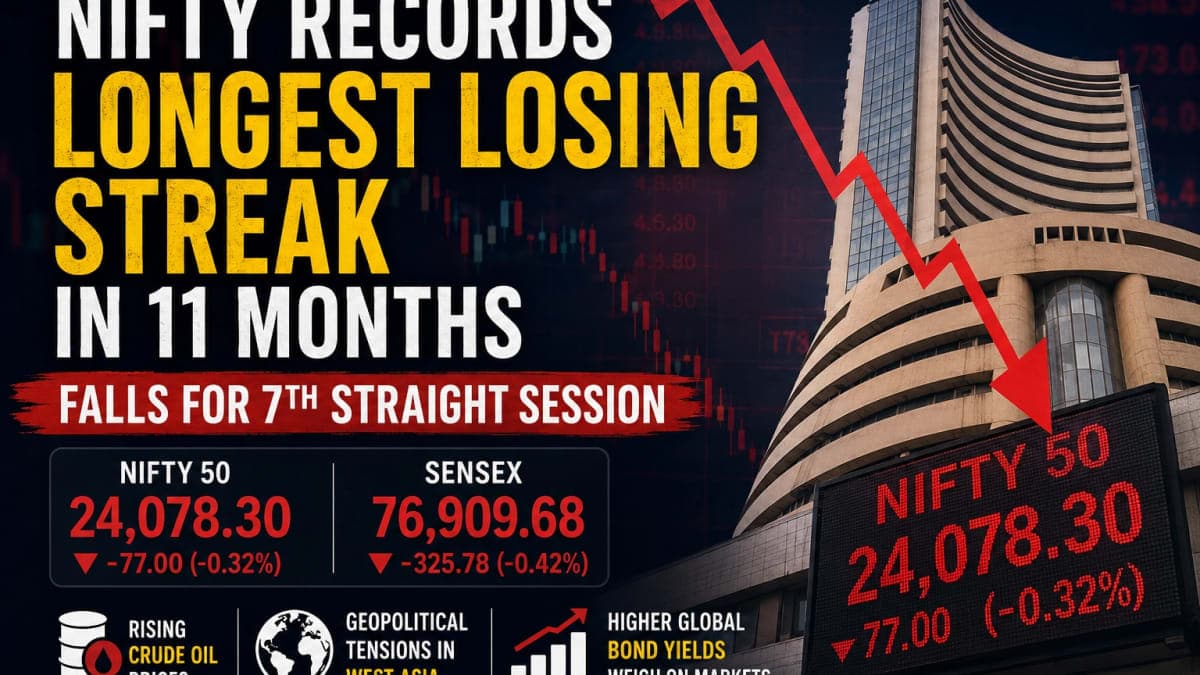
The Nifty 50 ended Wednesday at 24,078.30, down 77 points or 0.32%, extending its decline to seven straight sessions. Over this seven-session stretch, the benchmark has lost approximately 2.1%.
The BSE Sensex fell 325.78 points, or 0.42%, to 76,909.68. The Sensex has declined in six of the past seven trading sessions and is also down roughly 2.1% over that period.
Why Is the Nifty Falling?
The latest decline is being driven largely by a combination of international factors rather than a single domestic trigger.
One of the biggest concerns is the renewed rise in crude oil prices. Brent crude was trading around $92 per barrel as geopolitical tensions involving the United States and Iran continued to create uncertainty around energy supplies and the Strait of Hormuz.
Higher oil prices are particularly important for India because the country relies heavily on imported crude. A sustained increase in energy costs can increase India's import bill, add inflationary pressure and potentially squeeze profit margins for companies dependent on fuel and other energy-intensive inputs.
At the same time, rising government bond yields in major global economies have created another challenge for emerging markets. Yields in the United States, Germany and Japan have climbed to unusually high levels, making developed-market fixed-income assets relatively more attractive and reducing investors' appetite for riskier emerging-market equities.
Broad Market Weakness Signals Investor Caution
The weakness was not confined to a handful of heavyweight stocks. Fourteen of the 16 major sectoral indices finished lower, indicating relatively broad selling pressure.
The broader market also struggled, with small-cap and mid-cap indices declining around 0.5% and 0.2%, respectively. Financial shares contributed to the pressure, including declines in major lenders such as ICICI Bank and Axis Bank.
However, the session was not uniformly negative. The information technology index recovered about 0.7%, while gas distribution companies including Indraprastha Gas and Mahanagar Gas gained following government incentives.
Strong Earnings Provide a Counterweight
The seven-session decline comes despite a relatively encouraging corporate earnings backdrop.
Nifty 50 companies delivered average profit growth of around 18% in the June 2026 quarter, the strongest growth in 10 quarters, according to brokerage assessments. Earnings strength was spread across several sectors and has helped preserve optimism about India's underlying corporate growth trajectory.
This creates an important contrast in the market: domestic corporate fundamentals have shown improvement, while external factors such as oil prices, geopolitical tensions and global interest-rate conditions are suppressing investor risk appetite.
Why the Seven-Day Losing Streak Matters
A seven-session decline does not automatically indicate a long-term bear market. However, the fact that this is the Nifty's longest losing streak since September 2025 highlights how persistent the recent selling has become.
For investors, the 24,000 region could become an important psychological area to watch after the index closed only modestly above that level.
A sustained improvement in sentiment may depend heavily on external developments. Any meaningful cooling in crude prices or easing of geopolitical tensions could reduce some of the pressure currently affecting Indian equities.
Conversely, if oil remains elevated and global bond yields continue climbing, foreign investors may remain cautious toward emerging-market assets, potentially keeping Indian stocks volatile.
Balanced Analysis: Correction or Bigger Warning?
The current decline presents a mixed picture.
On the negative side, higher crude prices pose a genuine macroeconomic risk for India, while elevated global yields can make international capital more expensive and increase competition for foreign investment. Continued geopolitical uncertainty could therefore prolong volatility.
On the positive side, recent corporate earnings suggest that the domestic business environment has not weakened to the same degree as stock prices. Stronger earnings growth, credit expansion and consumer demand could provide fundamental support if global pressures ease.
That means the current losing streak appears to reflect a clash between improving domestic earnings and deteriorating global risk conditions. Which side ultimately dominates may determine whether the Nifty stabilises around current levels or experiences a deeper correction.
What Investors Will Watch Next
Market participants are likely to closely track crude oil prices, developments in the US-Iran conflict, global government bond yields, foreign institutional investment flows and the Nifty's ability to hold around the 24,000 level.
The coming sessions could therefore be important in determining whether the seven-day decline represents a temporary risk-off phase or develops into a broader market correction.