Sitharaman Highlights India's Consumption-Led Growth in France
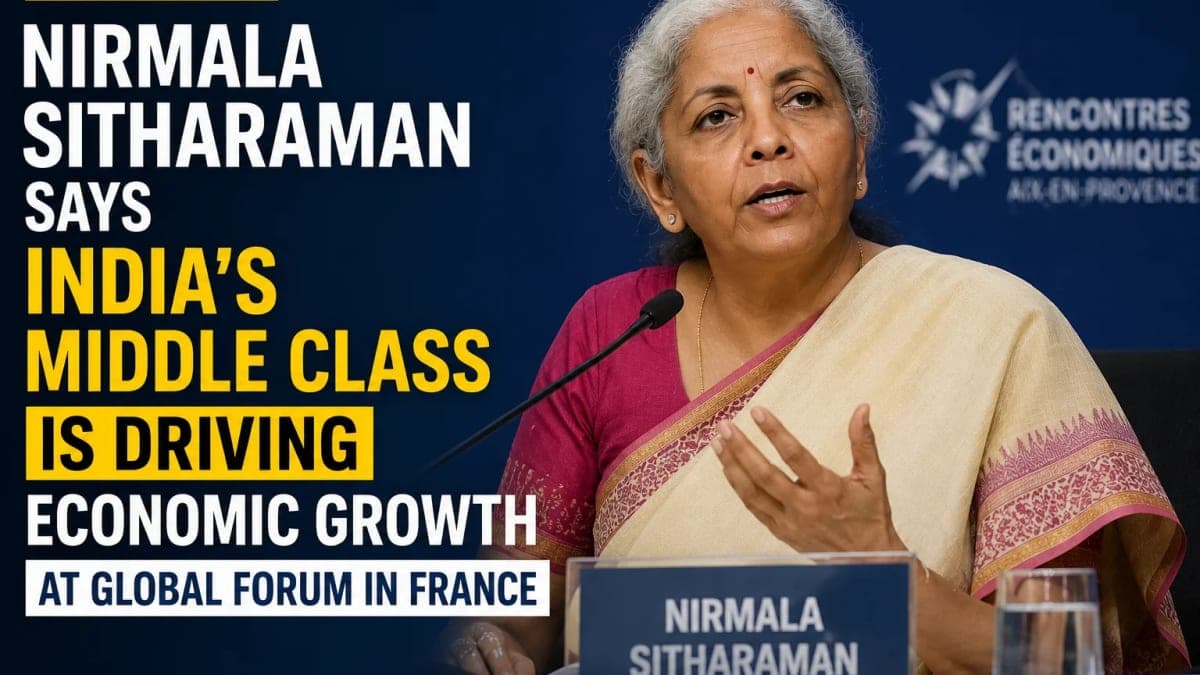
Finance Minister Nirmala Sitharaman said India's expanding middle class has become the backbone of the country's economic momentum, arguing that consumer spending has played a key role in keeping India among the world's fastest-growing major economies.
She made the remarks while participating in a panel discussion titled "How to Promote the Growth of a New Middle Class?" during the Rencontres Économiques d'Aix-en-Provence, an annual international economic forum held at Aix-Marseille University in France. The event brought together policymakers, economists and business leaders from several countries to discuss the future of middle-income societies.
Middle Class Has Become India's Growth Engine
Addressing the gathering, Sitharaman said India's middle class is no longer simply benefiting from economic expansion but is actively driving it.
According to the finance minister, domestic consumption generated by middle-income households helped sustain India's growth trajectory after the Covid-19 pandemic, creating a cycle of spending, investment and economic activity. She said the country's economic resilience has been supported largely by demand originating within India rather than relying solely on external markets.
Consumption Expected to Rise Sharply
Sitharaman pointed to projections suggesting that by 2036, nearly 93% of India's overall consumer spending could come from middle-class and slightly affluent households.
She also cited estimates indicating that India's middle-class population has expanded steadily since economic liberalisation and could surpass China's in absolute size between 2030 and 2035. These demographic changes, she said, are reshaping the country's economic landscape and creating new opportunities for businesses and investors.
Tier-II and Tier-III Cities Emerging as Growth Centres
The finance minister stressed that India's economic transformation is no longer confined to metropolitan regions.
She said increasing purchasing power in Tier-II and Tier-III cities is broadening the country's growth base, with nearly 500 cities expected to emerge as significant centres of economic activity. This shift, she argued, is contributing to a more geographically balanced pattern of development while expanding the reach of the middle class across the country.
Government Measures to Expand the Middle Class
During the discussion, Sitharaman outlined several policy initiatives that she said have strengthened the middle-income segment.
She referred to financial inclusion programmes, expansion of digital payments, credit access for first-time entrepreneurs, infrastructure investments, skill development initiatives and tax measures aimed at encouraging consumption and economic participation.
She also highlighted improvements in digital connectivity and financial services, arguing that these reforms have helped small businesses and entrepreneurs gain greater access to formal credit and economic opportunities.
Background
The Rencontres Économiques d'Aix-en-Provence is one of Europe's prominent economic forums, bringing together ministers, economists, business executives and academics to debate global economic challenges.
This year's discussion on the future of the middle class focused on how governments can promote inclusive growth amid changing labour markets, technological disruption, artificial intelligence and widening income disparities in many economies.
India has increasingly used such international platforms to present its economic strategy and attract investment while showcasing its domestic reforms and long-term growth potential.
Why the Statement Matters
The finance minister's remarks underscore the government's emphasis on domestic demand as a foundation for economic growth.
As global economies continue to face geopolitical tensions, slowing trade and inflationary pressures, policymakers increasingly view strong household consumption as a source of economic stability. India's large consumer market is often cited as one of its biggest structural advantages compared with export-dependent economies.
The comments also reinforce the government's focus on expanding economic opportunities beyond major cities, reflecting broader efforts to support regional development and improve financial inclusion.
Balanced Analysis
Sitharaman's assessment aligns with the government's view that rising household consumption and a growing middle class have strengthened India's economic resilience.
However, economists note that sustaining long-term growth will depend on more than consumer demand alone. Continued expansion of quality employment, higher productivity, private investment, manufacturing growth and improvements in household incomes will remain important factors in maintaining economic momentum.
Similarly, while projections about middle-class expansion are encouraging, future outcomes will depend on inflation, wage growth, access to affordable housing, education, healthcare and broader macroeconomic conditions.
The discussion therefore highlights both India's strong consumption base and the policy challenges involved in ensuring that economic growth remains broad-based and inclusive over the coming decade.