हिंदी में पढ़ें —JantaScope हिंदी
Finance

No Locker Theft Reported in Public Sector Banks in FY26 So Far; 40 Cases Recorded Over Last Five Years.

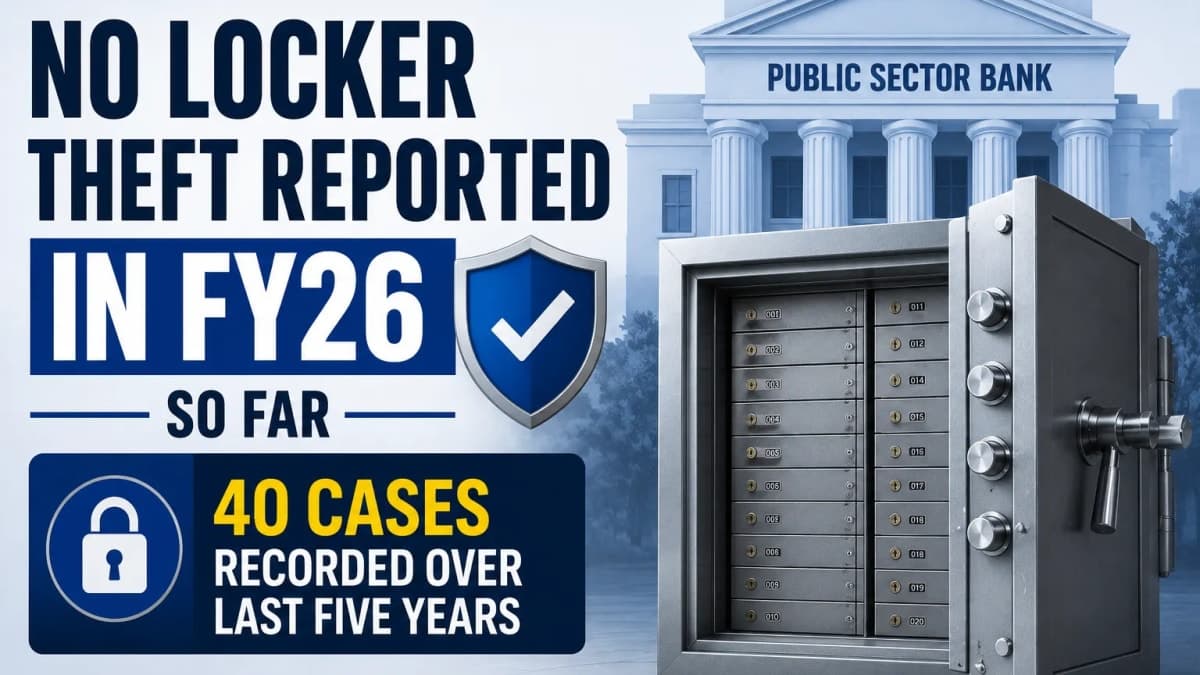
The central government has informed Parliament that no incidents of locker theft have been reported in public sector banks during the current financial year (FY26). Official data, however, shows that 40 locker theft cases were recorded across public sector banks over the previous five financial years, highlighting the importance of continued security upgrades and regulatory oversight.

No Locker Theft Reported in Public Sector Banks in FY26 So Far; 40 Cases Recorded Over Last Five Years.

By Jeet Nirmal

Source: Janta Scope

Government Shares Locker Theft Data in Parliament

The Union government has stated that public sector banks have not reported a single locker theft incident during the current financial year (FY26), indicating an improvement in the safety of bank locker operations.

The information was shared in Parliament in response to a question regarding the security of safe deposit lockers maintained by public sector banks. According to the government, while FY26 has remained free from reported thefts so far, a total of 40 locker theft cases were recorded between FY21 and FY25.

Five-Year Data Reflects Limited but Notable Incidents

The government noted that the reported cases were spread across multiple years rather than concentrated in a single period.

Although the number remains relatively small when compared with the millions of lockers operated by public sector banks across the country, each incident has financial and emotional consequences for affected customers. The disclosure highlights that banks continue to face the challenge of ensuring complete protection of valuables stored by customers.

Banks Continue to Strengthen Locker Security

Public sector banks have been implementing a range of security measures to safeguard customer lockers.

These include improved surveillance systems, biometric access, digital monitoring, strengthened vault infrastructure and tighter access controls. Banks have also been upgrading their locker management systems to reduce operational risks and improve customer confidence.

The absence of reported thefts in FY26 suggests that these measures, along with enhanced monitoring, may be contributing to stronger security standards.

Background

Safe deposit lockers remain one of the most widely used banking services in India, allowing customers to store jewellery, important documents and other valuables in bank vaults.

In recent years, locker safety has received increased attention following court rulings and updated regulatory guidelines issued by the Reserve Bank of India (RBI). The revised framework requires banks to maintain greater transparency, execute locker agreements with customers, maintain digital records and clearly define responsibilities in case of loss resulting from negligence.

The RBI has also directed banks to modernise locker systems and improve operational safeguards to reduce disputes and enhance customer protection.

Why the Development Matters

The government's statement is likely to reassure customers who rely on bank lockers for safeguarding valuable possessions.

Confidence in locker services is an important aspect of trust in the banking system. A decline in reported theft incidents reflects improvements in security practices while reinforcing the importance of regular audits, technology upgrades and strict compliance with regulatory standards.

The disclosure also demonstrates increased transparency, allowing Parliament and the public to monitor the effectiveness of security measures adopted by banks.

Balanced Analysis

The absence of reported locker thefts during FY26 represents a positive development for public sector banks and suggests that investments in security infrastructure and compliance may be yielding results.

However, experts point out that physical theft is only one aspect of locker safety. Operational errors, unauthorized access, natural disasters and legal disputes can also affect customers. Maintaining public confidence will therefore require continuous investment in technology, robust risk management and prompt grievance redressal whenever incidents occur.

The government's data indicates progress, but banking experts believe sustained vigilance and regular security upgrades remain essential as the volume of locker users continues to grow across India.


Related

More stories

Indian Government Bond Yields Stay Under Pressure as RBI Rate Outlook and Oil Risks Weigh on Market

Indian government bond yields remained elevated on Tuesday as investors weighed a more cautious monetary-policy outlook from the Reserve Bank of India, movements in global crude oil prices and uncertainty across international bond markets. The benchmark 10-year yield hovered around 6.87%-6.88%, keeping borrowing-cost concerns in focus.

Finance

Indian Government Bond Yields Stay Under Pressure as RBI Rate Outlook and Oil Risks Weigh on Market

India’s Forex Reserves Jump Nearly $10 Billion to Six-Month High of $716.9 Billion

India’s foreign exchange reserves climbed to a six-month high of $716.9 billion in the week ended August 14, 2026, rising by nearly $10 billion from the previous week. The increase was led by higher foreign currency assets and gold holdings, strengthening the country’s financial cushion amid volatility in global currency and commodity markets.

Finance

India’s Forex Reserves Jump Nearly $10 Billion to Six-Month High of $716.9 Billion

Indian Banks Raise $12 Billion Overseas as RBI Swap Window Sparks Funding Rush

Indian banks have raised about $12 billion from overseas debt markets in 2026, taking advantage of strong international demand for Indian banking debt and a special foreign-exchange swap facility introduced by the Reserve Bank of India (RBI). The surge has accelerated ahead of an important deadline for eligible foreign-currency deposits and highlights lenders’ growing ability to tap global pools of capital.

Finance

Indian Banks Raise $12 Billion Overseas as RBI Swap Window Sparks Funding Rush

RBI Opens Door for LIC to Nearly Double HDFC Bank Stake — What the 9.99% Approval Really Means

The Reserve Bank of India has approved Life Insurance Corporation of India’s request to increase its holding in HDFC Bank to as much as 9.99%. LIC held 4.11% of the private-sector lender as of August 14, 2026, meaning the regulatory clearance gives India’s largest insurer substantial room to increase its investment. The permission, however, does not mean LIC is required to purchase shares up to the approved limit immediately.

Finance

RBI Opens Door for LIC to Nearly Double HDFC Bank Stake — What the 9.99% Approval Really Means

Why HDFC Bank Shares Are in Focus Today as Blue-Chip Buying Supports the Market

HDFC Bank shares remained firmly on investors’ radar on Monday, August 24, as buying in heavyweight blue-chip stocks helped Indian benchmark indices trade with a positive bias. The private-sector banking major was among the large-cap names supporting the market, even as investors remained cautious about geopolitical tensions, crude oil prices and upcoming global monetary-policy signals.

Finance

Why HDFC Bank Shares Are in Focus Today as Blue-Chip Buying Supports the Market

India’s Dollar-Deposit Trade Is Booming — Why Citigroup and Axis Bank Are Joining the Rush

Citigroup and Axis Bank have teamed up on a financing arrangement linked to foreign-currency deposits from non-resident Indians, highlighting how the Reserve Bank of India’s efforts to attract overseas dollars are creating new opportunities in cross-border banking. The structure could help amplify NRI dollar inflows while strengthening banks’ access to foreign-currency funding.

Finance

India’s Dollar-Deposit Trade Is Booming — Why Citigroup and Axis Bank Are Joining the Rush