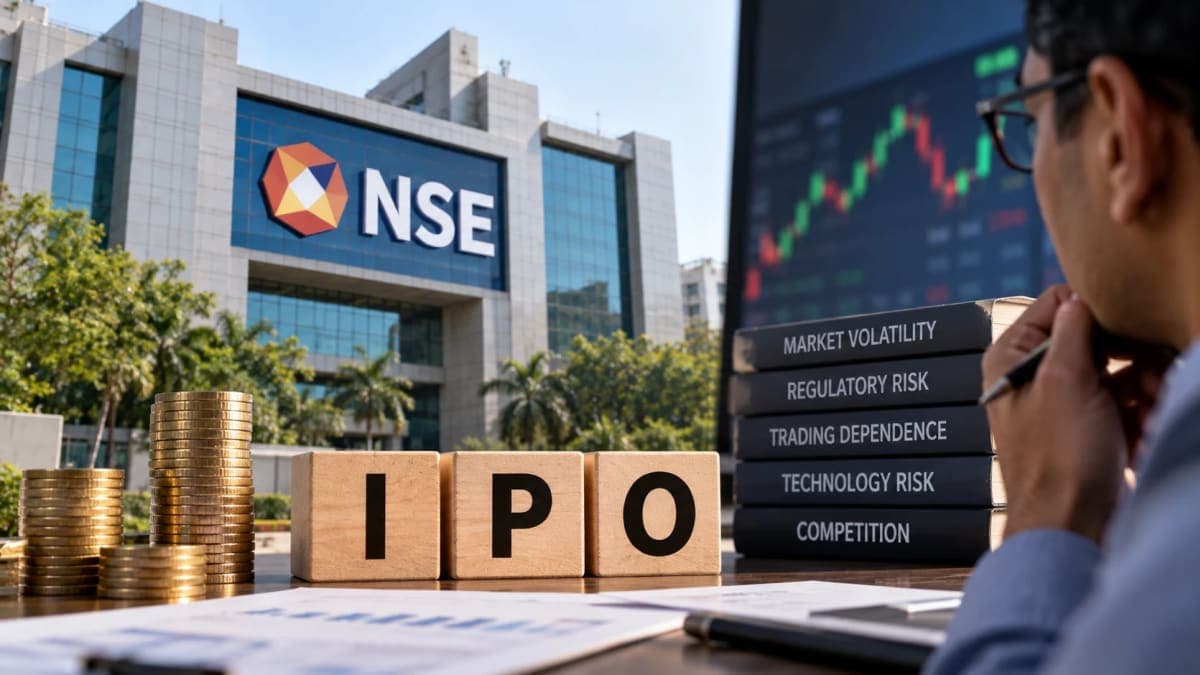
The long-awaited initial public offering of the National Stock Exchange of India (NSE) has reached its final day of bidding, putting one of India's most important financial-market institutions in the spotlight.
The IPO is worth ₹22,561.57 crore, with a price band of ₹1,700 to ₹1,785 per share. The offer comprises approximately 12.64 crore equity shares and is structured entirely as an Offer for Sale (OFS) by existing shareholders. That means the money raised through the offer will go to selling shareholders rather than NSE receiving fresh capital from the IPO.
NSE's scale, profitability and dominant position in India's capital markets make the IPO significant. But investors evaluating the business also need to examine the risks disclosed in its Red Herring Prospectus.
Five areas deserve particular attention: NSE's reliance on transaction volumes, its exposure to derivatives—especially options—revenue concentration among major trading members, regulatory scrutiny, and its dependence on technology infrastructure.
These risks do not determine whether the IPO is suitable for any particular investor. They explain where changes in regulation, market behaviour or operations could affect NSE's future financial performance.
1. NSE's Earnings Depend Heavily on Trading Activity
The first major risk is fundamental to the exchange business itself: trading activity matters enormously to revenue.
NSE earns transaction-based income from trades executed through its platforms. A prolonged decline in trading volumes or transaction values could therefore directly affect its revenue, profitability and cash generation.
The RHP identifies changes in investor participation, market conditions, regulations and trading behaviour as factors that can influence transaction volumes.
This is particularly relevant because Indian derivatives trading has already been affected by regulatory intervention.
Reuters reported ahead of the IPO that derivatives trading volumes had fallen about 27% from their 2024 peak, while NSE's FY26 revenue declined 3.1% and profit fell 15.5%.
For investors, the key question is therefore not simply how large NSE's current trading volumes are, but how resilient its revenue would be if activity in its most important segments were to decline further.
2. Options Trading Is a Major Revenue Engine
The second risk goes deeper than overall trading volumes: NSE has substantial exposure to derivatives activity.
Transaction charges represented 78.65% of NSE's FY26 revenue from operations, according to an analysis of the RHP. Equity options alone contributed roughly 60.2%, while equity futures contributed another 8.3%.
That makes options particularly important to NSE's economics.
The concentration matters because India's derivatives market has been subject to regulatory measures intended to address risks associated with speculative participation, particularly by retail investors.
Changes introduced by SEBI during 2024 and 2025 have affected derivatives activity, according to the company's filings and subsequent analyses.
This creates a potentially important link between regulation → derivatives volumes → transaction charges → NSE's financial performance.
NSE is not solely a derivatives business. It earns revenue from listings, data, clearing, index services and other activities. But the RHP numbers show why investors are paying particular attention to options trading.
3. Nearly Half of Operating Revenue Comes From the Top 10 Trading Members
A less obvious risk is concentration among NSE's biggest trading members.
According to the RHP, NSE's top 10 trading members accounted for 47% of revenue from operations in Q1 FY27.
The comparable figures were:
45.60% in Q1 FY26
46.78% in FY26
44.48% in FY25
45.26% in FY24
That means a relatively small group of trading members consistently accounts for a substantial portion of operating revenue.
This does not mean NSE depends on one single customer. However, the concentration creates exposure if major members significantly reduce their activity.
According to the risk disclosures, reduced activity, financial difficulties involving important trading members or their migration towards competing exchanges or alternative trading venues could negatively affect volumes and revenue.
For investors analysing the IPO, this concentration is worth considering alongside NSE's overall market leadership.
4. Regulatory Scrutiny Is an Inherent Risk for NSE
NSE sits at the centre of India's securities market and consequently operates within an unusually intensive regulatory environment.
Its primary regulator is the Securities and Exchange Board of India (SEBI), while aspects of the group's operations can also come under the oversight of the Reserve Bank of India, International Financial Services Centres Authority and other statutory bodies.
The RHP says NSE itself was not subject to enforcement action pursuant to SEBI inspections during Q1 FY27 and the preceding three financial years. However, SEBI initiated enforcement actions against two NSE subsidiaries during that period.
The broader risk is that regulatory requirements can change.
New rules affecting derivatives, market structure, transaction activity, clearing, settlement or other exchange operations could influence trading behaviour and NSE's financial results.
The IPO itself comes after a lengthy journey towards a public listing, during which regulatory and legal issues contributed to delays. Reuters described the IPO as the culmination of NSE's roughly decade-long effort to list.
Regulatory oversight should not automatically be interpreted as a negative—the exchange operates critical financial-market infrastructure where supervision is expected. But for shareholders, regulatory changes can have direct commercial consequences.
5. A Technology Failure Can Stop the Market
Perhaps the most operationally significant risk arises from NSE's dependence on technology.
Unlike many conventional businesses, a stock exchange cannot function normally if its core trading, clearing, settlement or connectivity infrastructure becomes unavailable.
The RHP identifies potential risks including software failures, connectivity problems, order-matching errors, cyberattacks, phishing, distributed denial-of-service attacks, human error, insufficient capacity, power outages, telecommunications failures and problems involving third-party service providers.
There is also a historical example demonstrating the potential impact.
On February 24, 2021, problems involving telecom service-provider links affected NSE's Storage Area Network system.
Although NSE's trading system itself was not affected, outages involving risk, clearing and settlement systems at NSE Clearing as well as index and surveillance systems resulted in trading across all segments being halted for approximately five hours and 24 minutes, according to the RHP.
For an institution handling critical financial infrastructure, even temporary disruption can create financial, operational and reputational consequences.
Cybersecurity adds another dimension to this risk. NSE has been designated as Critical Information Infrastructure (CII) under India's National Critical Information Infrastructure Protection Centre framework, reflecting the systemic importance of its technology systems.
One More Factor: NSE Is Not Raising Fresh Capital
Investors should also understand exactly what they are buying into.
The entire IPO is an Offer for Sale.
At the upper end of the ₹1,700–₹1,785 price band, the IPO size is approximately ₹22,561.57 crore, implying a market capitalisation of roughly ₹4.41–₹4.42 lakh crore.
Because existing shareholders are selling the shares, NSE itself will not receive the IPO proceeds.
This distinction does not make an OFS inherently positive or negative. But it means investors should not assume the ₹22,561 crore being raised will enter NSE's balance sheet to fund expansion, technology investment or acquisitions.
NSE's Strengths Still Matter
Risk disclosures should be considered alongside the characteristics that have made the NSE IPO one of India's most closely watched public issues.
The company highlights its market leadership, scale, profitability, technology infrastructure and cash-generation capabilities among its strengths.
NSE has also been expanding beyond its established businesses. Reuters reported that diversification initiatives include products such as electricity futures and plans involving a coal exchange, as the company seeks to broaden its revenue base over time.
The exchange has also continued to generate listing-related income.
NSE's listing-services revenue increased 12.30% to ₹352.44 crore in FY26, despite the number of IPOs on the exchange declining to 219 from 242 in FY25. In Q1 FY27, listing-services revenue rose 0.92% year-on-year to approximately ₹78.36 crore.
That diversification becomes particularly relevant if regulation continues to reshape derivatives trading.
What Should Investors Take From the RHP?
The central takeaway from NSE's prospectus is not that the company lacks strengths. Rather, its strongest competitive advantages exist alongside several concentrated exposures.
Its transaction business depends on market activity. A large portion of transaction income is linked to derivatives. A significant share of operating revenue is associated with its biggest trading members. Regulation can change the economics of important products, while uninterrupted technology infrastructure is essential to virtually every part of the business.
These factors become especially important when assessing NSE at the IPO's implied valuation.
The offer closes on September 21, 2026, with the shares scheduled to list on the BSE on September 24. The IPO had already been fully subscribed by its second day, according to Reuters.
Strong subscription demand, however, does not remove the business risks disclosed in the prospectus.
For investors considering the IPO, the RHP's risk-factor section is therefore just as important as NSE's market share, historical profitability or subscription numbers.
The decision to apply should ultimately depend on an investor's own assessment of the company's valuation, business model, regulatory exposure, financial performance and individual risk tolerance.