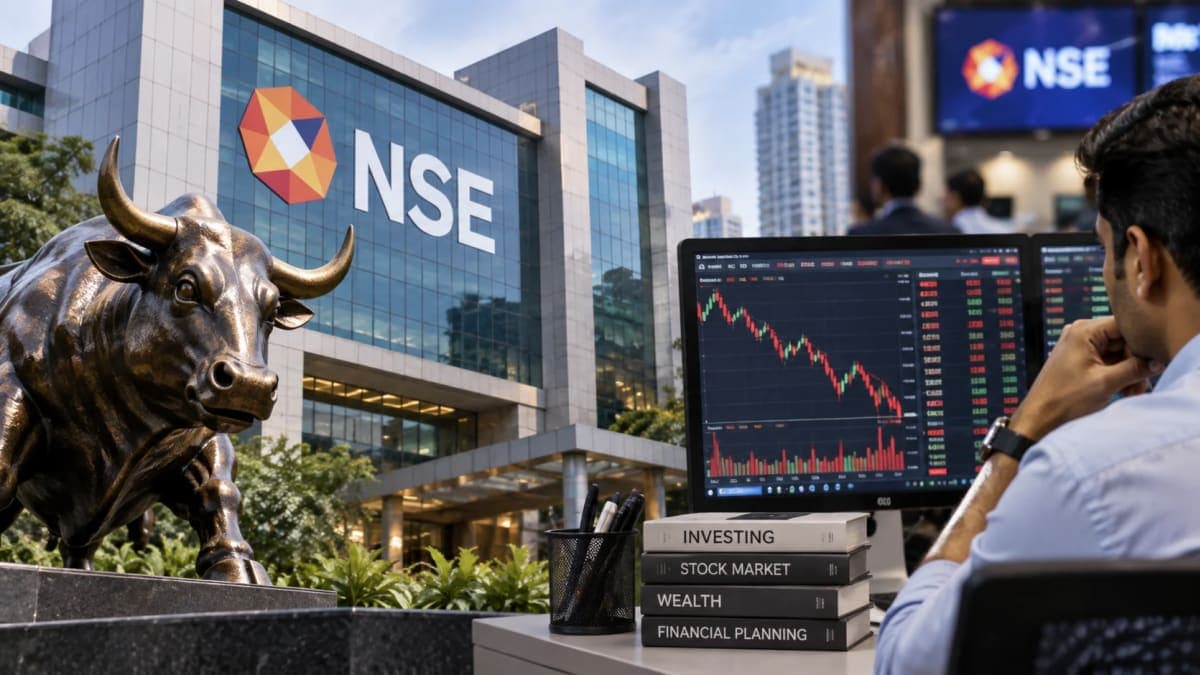
The National Stock Exchange of India (NSE) IPO entered its third and final day of bidding on Monday, September 21, with investors facing a noticeably different grey-market picture from when the ₹22,561.57 crore public offer opened.
The NSE IPO's grey market premium (GMP) has fallen to around ₹48, compared with ₹142 on the first day of subscription. At the upper issue price of ₹1,785, that implies an unofficial indicative price of roughly ₹1,833, or about 2.7% above the issue price.
The fall in GMP does not determine where NSE shares will actually list. Grey-market trading is unofficial, unregulated and can change rapidly before listing.
Meanwhile, the IPO itself had already achieved full subscription by the end of Day 2, receiving bids for about 1.16 times the shares available.
NSE IPO GMP Drops Sharply on Final Day
The most closely watched development ahead of Monday's bidding is the sharp decline in NSE's grey market premium.
According to market reports, the GMP had reached a high of around ₹160 before falling to approximately ₹142 on the first subscription day. By early September 21, it had dropped to around ₹48.
At ₹48, the premium represents roughly 2.69% over the upper price band of ₹1,785.
That gives an indicative calculation of:
Upper IPO price: ₹1,785
Latest reported GMP: ₹48
Indicative price based on GMP: ₹1,833
Implied premium: approximately 2.69%
This calculation should not be interpreted as a forecast of NSE's actual listing price. GMP can move substantially before listing and has no official role in determining the market price once shares begin trading.
NSE IPO Subscription Stood at 1.16 Times After Day 2
Despite the cooling grey-market premium, demand during the official bidding process was enough for the IPO to achieve full subscription by the end of its second day.
The ₹22,561.57 crore offer had received bids for approximately 1.16 times the shares available by the end of Friday's session.
Investor-category demand showed a noticeable difference:
Qualified Institutional Buyers (QIBs): 1.53 times
Non-Institutional Investors (NIIs): 1.68 times
Retail investors: 72%
Overall: 1.16 times
Institutional and non-institutional portions were therefore already oversubscribed, while the retail portion remained below full subscription at the end of Day 2.
Final subscription numbers can change significantly during the last hours of an IPO, particularly as institutional bids are placed.
NSE IPO Price Band and Minimum Investment
NSE has set a price band of ₹1,700 to ₹1,785 per equity share.
The minimum lot consists of 8 shares.
At the upper price band, a retail investor applying for one lot would therefore need:
8 × ₹1,785 = ₹14,280
The IPO opened on September 17 and closes on September 21, 2026.
NSE Will Not Receive Money From the IPO
One important feature investors need to understand is that the NSE IPO is entirely an Offer for Sale (OFS).
That means NSE itself is not issuing fresh equity shares to raise capital.
Existing shareholders are selling part of their holdings, and consequently the proceeds generated from the IPO will go to those selling shareholders rather than being received by NSE for expansion, investment or other corporate purposes.
This distinction matters when assessing an IPO because a fresh issue can provide new capital to a company, whereas an OFS primarily facilitates an exit or partial stake sale by existing shareholders.
Why Are Some Brokerages Still Positive?
The decline in GMP has not prevented several brokerages from maintaining positive recommendations on the IPO.
The Economic Times reported that LKP Securities, YES Securities and Angel One have recommended subscribing to the issue, citing factors including NSE's market position, profitability, debt-free balance sheet and valuation relative to BSE.
Angel One, for example, estimated that NSE is valued at a post-issue P/E multiple of 35.4 times at ₹1,785, compared with 54.2 times for BSE, arguing that the valuation provides relative comfort.
A lower valuation multiple relative to a peer does not automatically make a stock inexpensive, however. Differences in growth prospects, revenue composition, regulatory exposure and market expectations also affect valuations.
Five Risks Investors Should Not Ignore
The NSE Red Herring Prospectus also highlights risks that deserve attention beyond the GMP.
One important issue is the exchange's dependence on trading activity. A sustained decline in trading volumes and transaction values could affect revenues.
Transaction charges accounted for more than 79% of NSE's operational revenue in Q1 FY27, according to an analysis of the prospectus, with options trading accounting for a substantial share of that business.
Another issue is customer concentration. NSE's top 10 trading members contributed about 47% of Q1 FY27 revenue, creating exposure to changes in the behaviour of major participants.
Regulation is another material consideration. Stock exchanges operate under intensive regulatory supervision, and regulatory actions, changes to market rules or restrictions affecting trading activity can influence revenue and profitability.
Technology is equally important for an exchange. System outages, cybersecurity problems, vendor failures or other operational disruptions could affect trading and potentially create financial or reputational consequences.
Does Falling GMP Mean the IPO Has Become Weak?
Not necessarily.
GMP primarily reflects unofficial demand for shares before listing. A decline from ₹142 to ₹48 indicates that grey-market expectations for an immediate listing premium have weakened substantially, but it does not establish how NSE's shares will perform after listing.
The official subscription data tells a somewhat different story: the IPO was already fully subscribed by Day 2, with QIB and NII demand above their respective allocations.
Investors therefore need to separate two questions.
Someone seeking a short-term listing gain may pay greater attention to the deterioration in GMP, while a long-term investor would typically place greater weight on NSE's earnings, competitive position, valuation, regulatory environment and future growth prospects.
Neither approach guarantees a particular return.
What Investors Should Examine Before Applying
Instead of using GMP alone as the deciding factor, investors considering the NSE IPO can assess several elements together: the ₹1,700–₹1,785 valuation range, NSE's financial performance and market position, dependence on transaction-related income, regulatory exposure, customer concentration and the fact that the IPO is entirely an OFS.
The changing GMP is useful as a measure of unofficial short-term sentiment, but it is not a substitute for analysing the underlying business.
That distinction is especially relevant for a high-profile issue such as NSE, where enthusiasm surrounding the company's brand and market position can differ from the price investors are ultimately willing to pay for its earnings.
NSE IPO Allotment and Listing Date
After the subscription window closes on September 21, the basis of allotment is expected to be finalised on September 22, 2026.
NSE shares are scheduled to list on the BSE on September 24, 2026.
The actual listing price will ultimately be determined by market demand when trading begins — not by the pre-listing grey-market premium.