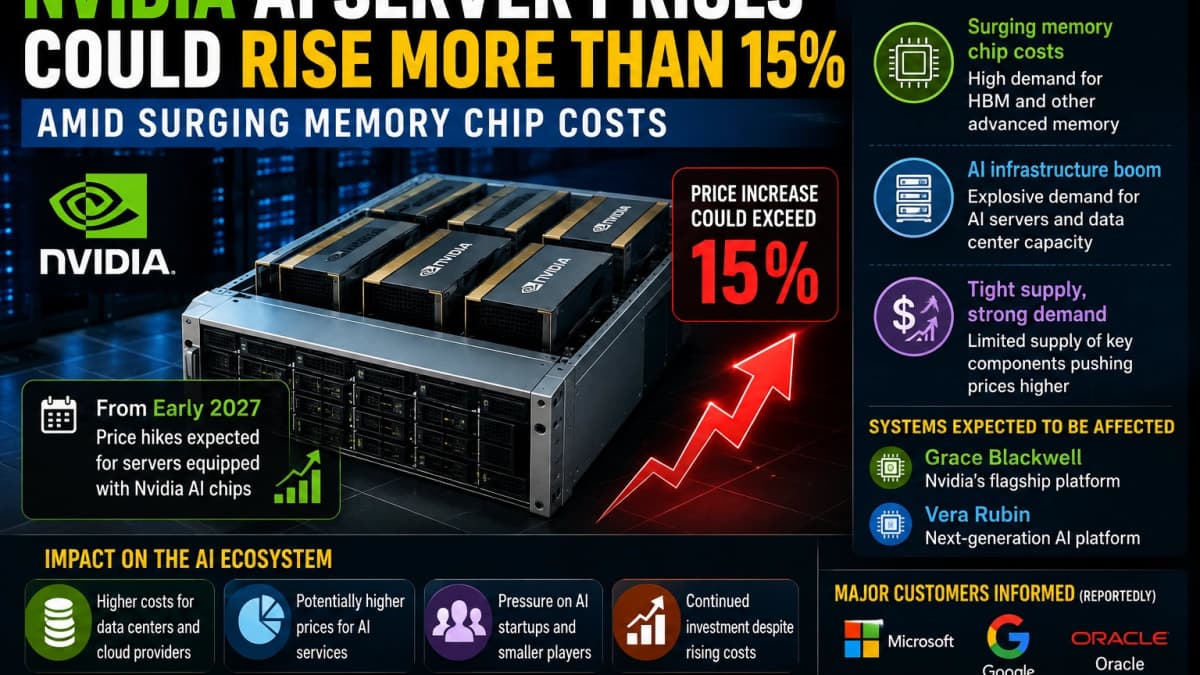
Nvidia AI Server Costs Face Sharp Increase
The extraordinary global race to build artificial intelligence infrastructure could become even more expensive.
Some major Nvidia customers have reportedly been told that prices for servers containing the company's AI processors will increase by more than 15% in many cases, largely because of rising memory-chip costs.
The higher pricing is expected to apply to systems scheduled for shipment beginning in early 2027. The exact increase could vary according to the generation of Nvidia processors used and the amount and type of memory included in individual systems.
The development is significant because Nvidia hardware sits at the centre of the enormous global investment cycle surrounding generative AI, cloud computing and increasingly powerful AI models.
Grace Blackwell and Vera Rubin Systems Expected to Be Affected
The reported increases would include systems built around Nvidia's flagship Grace Blackwell technology as well as its next-generation Vera Rubin platform.
Server manufacturers working with major data-centre operators have reportedly started informing customers about the expected increases. Companies referenced in reporting include Microsoft, Alphabet's Google and Oracle.
However, an important distinction remains: the reported increase concerns servers containing Nvidia AI chips, rather than a simple across-the-board announcement that every individual Nvidia GPU will become 15% more expensive.
Nvidia had not publicly commented on the reported increases at the time of the initial reports, while Reuters said it could not independently verify Bloomberg's account.
Why Are AI Server Prices Rising?
One of the biggest pressures comes from memory.
Powerful AI accelerators require enormous amounts of high-performance memory to process the datasets and calculations needed for training and running modern AI models.
Demand has expanded rapidly as technology companies construct larger data centres and deploy increasingly sophisticated AI systems.
Samsung Electronics, SK Hynix and Micron are among the dominant global memory manufacturers. Although producers have been expanding capacity, demand generated by the AI infrastructure boom has continued to put pressure on available supply and pricing.
The reported Nvidia server increases demonstrate how constraints in one part of the semiconductor supply chain can affect the price of an entire AI computing system.
AI Infrastructure Boom Creates Enormous Demand
Nvidia has become one of the central beneficiaries of the generative-AI revolution because its accelerators provide much of the computing power required to train and operate advanced AI models.
Cloud providers, technology companies and AI developers have spent heavily on GPUs, networking equipment, servers and data centres.
That investment has created an unusual situation: even as semiconductor manufacturers increase production, demand for certain advanced components remains extremely strong.
The resulting competition for memory, processors, manufacturing capacity, electricity and data-centre infrastructure is increasing the cost of expanding AI computing capacity.
What a 15%+ Increase Could Mean for Data Centres
A price increase of more than 15% becomes particularly significant when applied across enormous AI deployments containing thousands of accelerators.
Large technology companies are spending billions of dollars constructing facilities capable of training increasingly sophisticated AI models.
Higher server prices could therefore force companies to reconsider infrastructure budgets, delay some deployments or seek efficiencies elsewhere.
The pressure would be particularly important for smaller AI companies and cloud providers that have fewer financial resources than the world's largest technology corporations.
Could Higher Costs Reach AI Customers?
Potentially, although the impact would not necessarily be immediate.
Cloud providers typically charge businesses for access to GPU computing capacity. If the cost of purchasing and operating AI infrastructure continues rising, some providers could eventually pass a portion of those expenses to customers.
That could make training large AI models more expensive and increase the importance of techniques designed to reduce computing requirements.
However, competition among cloud companies could limit their ability to pass through every cost increase.
Nvidia’s Strong Market Position
Nvidia's position in AI computing gives the company considerable influence within the technology supply chain.
Its accelerators have become deeply embedded in the software and infrastructure used by AI developers, making rapid migration to alternative hardware difficult for many customers.
Major technology companies are nevertheless developing their own AI processors, while semiconductor rivals are attempting to capture more of the accelerator market.
The reported price increases could strengthen incentives for customers to diversify their hardware suppliers over the longer term.
But alternatives face the same broader supply-chain environment, particularly when competing processors also require large quantities of advanced memory.
Memory Manufacturers Gain Strategic Importance
The development also highlights an important shift within the semiconductor industry.
The AI boom is not benefiting GPU designers alone. Memory manufacturers have become strategically important because modern accelerators require increasingly large amounts of fast memory.
As AI models grow and data centres expand, securing enough memory could become almost as important as obtaining the processors themselves.
That gives suppliers such as Samsung, SK Hynix and Micron significant influence over the economics of AI infrastructure.
Why This Development Matters
The biggest question surrounding the AI boom is increasingly not whether companies want more computing power, but how quickly the physical infrastructure required to provide it can be built.
Higher Nvidia server prices add another potential challenge to an industry already dealing with expensive data-centre construction, power availability, financing requirements, project delays and other infrastructure constraints.
If component costs remain elevated, companies may need to become more selective about which AI projects justify enormous computing investments.
At the same time, continued willingness to pay higher prices would demonstrate just how strong demand for AI computing remains.
Balanced Analysis: A Warning Sign or Evidence of Strong AI Demand?
The reported increase can be interpreted in two different ways.
From one perspective, higher server costs represent another warning about the economics of the AI infrastructure boom. Companies are committing enormous amounts of capital to data centres, and rising hardware prices could make achieving attractive returns more difficult.
From another perspective, the ability of suppliers to raise prices reflects extraordinary demand. Companies continue competing for AI computing resources despite already high infrastructure costs.
The longer-term effect will depend partly on whether memory supply catches up with demand.
Greater production could eventually reduce pricing pressure. But if AI investment continues expanding faster than semiconductor manufacturing capacity, expensive computing infrastructure could remain a defining feature of the industry.
Competition will matter as well. Alternative accelerators and custom chips being developed by major technology companies could gradually reduce dependence on Nvidia, although replacing established hardware and software ecosystems is a complex process.
For now, the reported price increase provides another indication that the AI boom is creating pressure throughout the semiconductor supply chain — from advanced processors and memory to servers, data centres and electricity.
This article is based on reporting published by Business Standard.