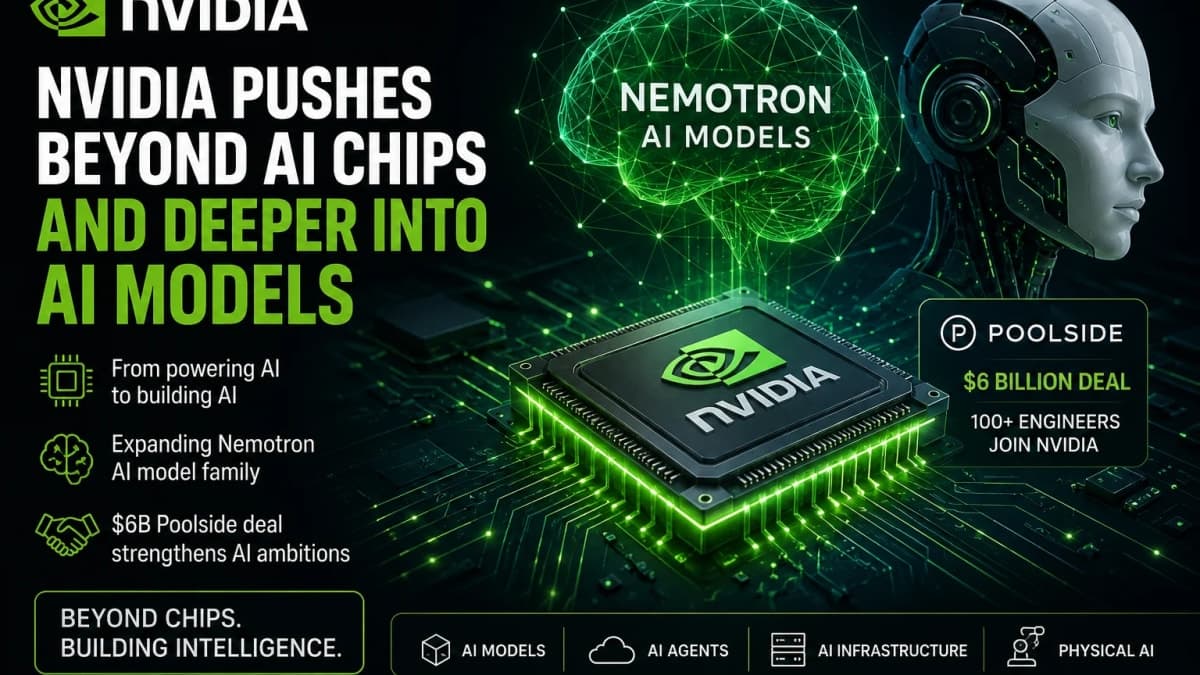
Nvidia Pushes Beyond AI Chips and Deeper Into AI Models
Nvidia built its dominant position in artificial intelligence by supplying the powerful graphics processors used to train and run many of the world's leading AI systems. Now, the company is making an increasingly ambitious move higher up the technology stack: developing and supporting the AI models themselves.
The shift has become more visible through Nvidia's expanding Nemotron model family and its latest move involving AI startup Poolside. According to reports on August 24, Nvidia has struck a roughly $6 billion deal that gives it access to Poolside's technology while bringing more than 100 of the startup's employees, primarily engineers, into Nvidia. Nvidia is also reportedly investing an additional $1 billion in Poolside at a $12 billion pre-money valuation.
The development suggests Nvidia increasingly wants to shape not only the infrastructure behind artificial intelligence, but also the software intelligence that ultimately consumes that computing power.
From Selling GPUs to Building More of the AI Stack
For years, Nvidia's biggest advantage has been straightforward: as companies raced to build increasingly sophisticated AI systems, they needed enormous amounts of computing power, and Nvidia's GPUs became a core component of that infrastructure.
But the AI market is evolving.
The competitive battlefield increasingly includes models, AI agents, inference software, developer tools and deployment platforms. Nvidia has steadily expanded into these areas rather than relying exclusively on demand for GPUs.
Nemotron is an important part of that strategy. Nvidia describes Nemotron as a family of open AI models designed for applications including complex AI-agent workflows. The company is offering developers not only model weights but also supporting resources such as training data and recipes for building specialized systems.
Nvidia is also developing Cosmos, its family of world foundation models and related technologies aimed at physical AI applications such as robotics and autonomous machines.
The Poolside Deal Adds Another Piece
The Poolside transaction potentially accelerates Nvidia's ambitions.
Poolside has focused heavily on AI systems for software development, making its technology and engineering talent particularly relevant as the industry moves toward autonomous AI agents capable of completing complicated tasks.
The reported arrangement gives Nvidia access to Poolside technology and adds more than 100 employees to Nvidia while maintaining an investment relationship with the startup.
That combination matters because building competitive AI models requires more than GPUs. It requires researchers, specialized training techniques, high-quality data, model architectures and extensive experience optimizing models for real-world workloads.
Acquiring or licensing technology while recruiting experienced teams can potentially accelerate that process.
Nvidia's Open-Model Strategy Could Strengthen Its Hardware Business
At first glance, Nvidia moving deeper into AI models might appear to represent diversification away from chips.
In practice, the two businesses can reinforce each other.
If developers adopt Nvidia models that have been heavily optimized for Nvidia hardware and software, those models can encourage greater usage of the company's computing platforms.
Nvidia already emphasizes optimization as a competitive advantage. Its AI-model platform includes both its own models and third-party open-weight systems optimized to run efficiently on Nvidia infrastructure.
That creates the possibility of a powerful ecosystem.
Developers can build with Nvidia-supported models, customize them through Nvidia software, deploy them through Nvidia's AI infrastructure and ultimately run those workloads on Nvidia processors.
The more tightly these layers work together, the harder it could become for competitors to challenge Nvidia solely by producing faster or cheaper chips.
Why Open Models Are Strategically Important
Nvidia's emphasis on open models also gives the company a different position from companies primarily focused on proprietary AI systems.
Instead of necessarily trying to reproduce the consumer-chatbot businesses of leading AI labs, Nvidia can encourage enterprises and developers to customize models for their own applications.
That could be particularly valuable as companies increasingly experiment with specialized AI agents.
Businesses may want models optimized for software engineering, customer support, cybersecurity, research, industrial operations or internal workflows rather than relying exclusively on enormous general-purpose models.
Nemotron is being positioned around this broader agentic-AI opportunity, with Nvidia describing the family as optimized for complex, long-running workflows.
Nvidia Is Entering a Much More Competitive Arena
Moving into models, however, presents a different competitive challenge from Nvidia's traditional semiconductor business.
The AI-model market already contains powerful developers, and improvements can happen extremely quickly. A model that appears technologically impressive today can face stronger or cheaper competition within months.
Nvidia therefore does not automatically inherit its GPU dominance when it moves into the model layer.
Its biggest advantages are instead its enormous computing resources, engineering expertise, developer ecosystem and ability to optimize models alongside the hardware that runs them.
There is also a strategic balancing act.
Many of the companies developing competing AI models are simultaneously major Nvidia customers. Nvidia benefits when those companies continue purchasing enormous quantities of its processors.
Becoming more aggressive in models could therefore create competitive tension with customers that remain important to Nvidia's core hardware business.
Why This Matters for the AI Industry
Nvidia's expansion illustrates how the artificial-intelligence industry is becoming increasingly vertically integrated.
The biggest technology companies no longer want to control only one piece of the AI supply chain.
Chipmakers are moving toward software and models. Cloud providers are designing their own processors. Model developers are building infrastructure, developer platforms and consumer applications.
Nvidia's strategy appears designed to make the company relevant across as many of those layers as possible.
Instead of simply providing the engines powering the AI revolution, Nvidia increasingly wants to help design the intelligence running on those engines.
Balanced Analysis: Opportunity and Risk
The opportunity is substantial.
Nvidia already occupies one of the strongest positions in AI infrastructure. Building influential open models could deepen its relationships with developers, increase demand for inference computing and make its overall platform more difficult to replace.
But success is far from guaranteed.
Model development is expensive, competition is relentless and the economics of AI software remain unsettled. Open models can also make differentiation difficult because developers can rapidly modify, redistribute and improve competing systems.
Nvidia must therefore demonstrate that its model strategy produces meaningful advantages beyond simply encouraging more GPU usage.
Still, the direction is increasingly clear: Nvidia is evolving from a semiconductor company at the center of the AI boom into a broader AI-platform company spanning chips, software, models, agents and physical AI.
The Poolside deal provides another indication that Nvidia believes the next phase of AI competition will be fought not only over who supplies the computing power—but also over who controls the technologies built on top of it.
This article is based on reporting published by Janta Scope.