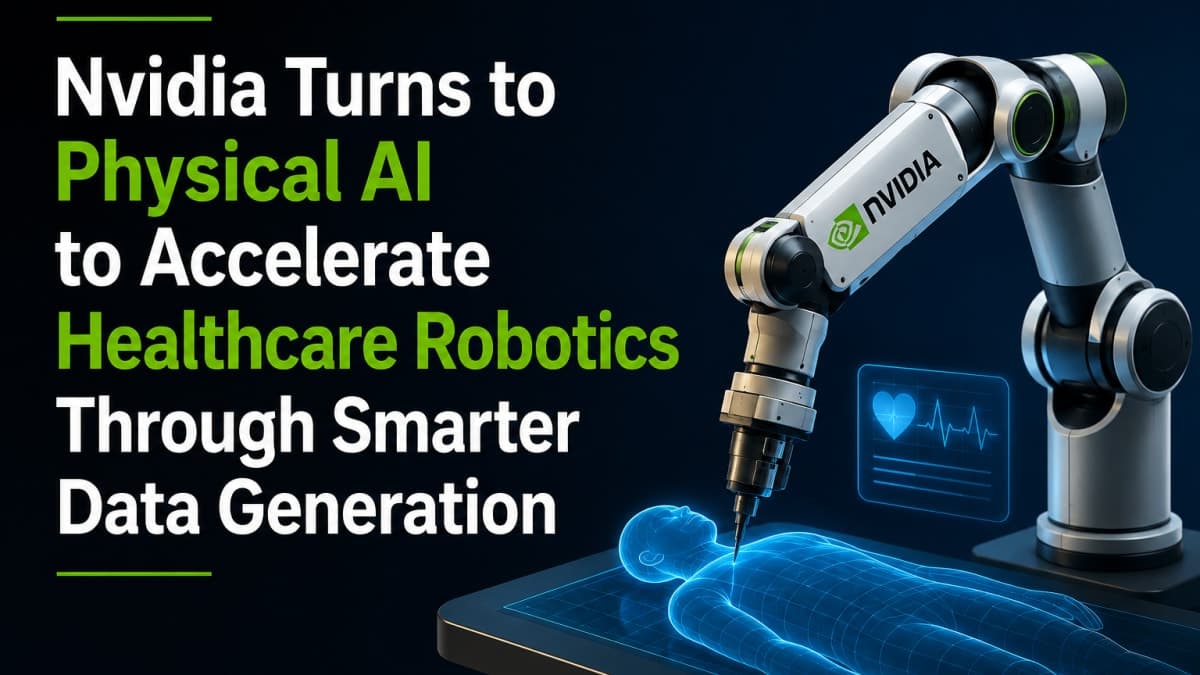
Nvidia Bets on Physical AI to Tackle Healthcare Robotics’ Data Challenge
Introduction
Nvidia is strengthening its commitment to physical artificial intelligence (AI), positioning the technology as a solution to one of the healthcare robotics industry's most pressing obstacles—limited access to diverse, high-quality training data. The initiative highlights the growing importance of simulation-based AI development as robotics becomes increasingly integrated into hospitals, laboratories, and patient care environments.
The company believes that combining advanced computing with realistic virtual environments can significantly improve how healthcare robots learn, adapt, and perform complex medical tasks before entering real-world clinical settings.
Why Healthcare Robotics Faces a Data Bottleneck
Healthcare robotics depends heavily on vast amounts of accurate, real-world data for training AI models. Unlike consumer applications, collecting medical robotic data is expensive, time-consuming, and subject to strict safety, privacy, and regulatory requirements.
Robots designed for surgery, rehabilitation, diagnostics, or hospital logistics require exposure to countless scenarios before they can operate reliably. However, gathering enough real-world examples is often impractical because patient interactions are limited and clinical environments cannot easily accommodate large-scale AI training experiments.
This shortage of training data has become one of the industry's biggest barriers to rapid innovation.
How Physical AI Could Change the Process
Physical AI combines artificial intelligence with realistic digital simulations that replicate physical environments, objects, and interactions. Instead of relying exclusively on data collected from hospitals, developers can generate synthetic training scenarios inside virtual environments.
These simulated environments allow robots to practice thousands—or even millions—of different situations, including rare medical cases that would otherwise be difficult to capture.
By exposing robotic systems to diverse conditions before deployment, developers can improve navigation, object handling, precision, and decision-making while reducing development time and costs.
Potential Impact on Healthcare Innovation
If simulation-based training proves effective, healthcare robotics companies could accelerate product development without depending solely on real-world clinical datasets.
Potential benefits include:
Faster development of medical robotic systems.
Reduced costs associated with collecting specialized training data.
Improved testing under controlled and repeatable conditions.
Better preparation for uncommon medical scenarios.
Enhanced safety before robots are introduced into hospitals.
The approach may also support researchers working on next-generation robotic assistants, automated laboratory systems, rehabilitation devices, and surgical technologies.
Challenges Still Remain
While synthetic data offers significant advantages, experts caution that virtual training cannot completely replace real-world validation.
Healthcare remains one of the most highly regulated industries, meaning robotic systems must still demonstrate safety, reliability, and effectiveness in real clinical environments before widespread adoption.
Developers must also ensure that simulated environments accurately reflect the complexity of hospitals, patient variability, and unpredictable medical situations. Any gap between simulation and reality could affect system performance.
As a result, physical AI is expected to complement—not replace—real clinical data.
Why This Matters
The announcement reflects a broader trend in artificial intelligence where simulation and synthetic data are becoming essential tools for training increasingly sophisticated AI systems.
As healthcare providers seek automation to improve efficiency, reduce workforce pressures, and enhance patient care, better-trained robotic systems could play an expanding role across hospitals and medical facilities.
For Nvidia, investing in physical AI reinforces its strategy of supporting industries that require advanced AI infrastructure beyond traditional language models, extending into robotics, manufacturing, autonomous machines, and healthcare technologies.
Conclusion
Nvidia's emphasis on physical AI represents a strategic effort to overcome one of healthcare robotics' most significant development challenges—the lack of sufficient training data. By enabling AI systems to learn through highly realistic simulations, the company hopes to accelerate innovation while improving the safety and reliability of future medical robots.
Although synthetic environments cannot entirely replace real-world validation, they may become an increasingly important foundation for the next generation of intelligent healthcare robotics.