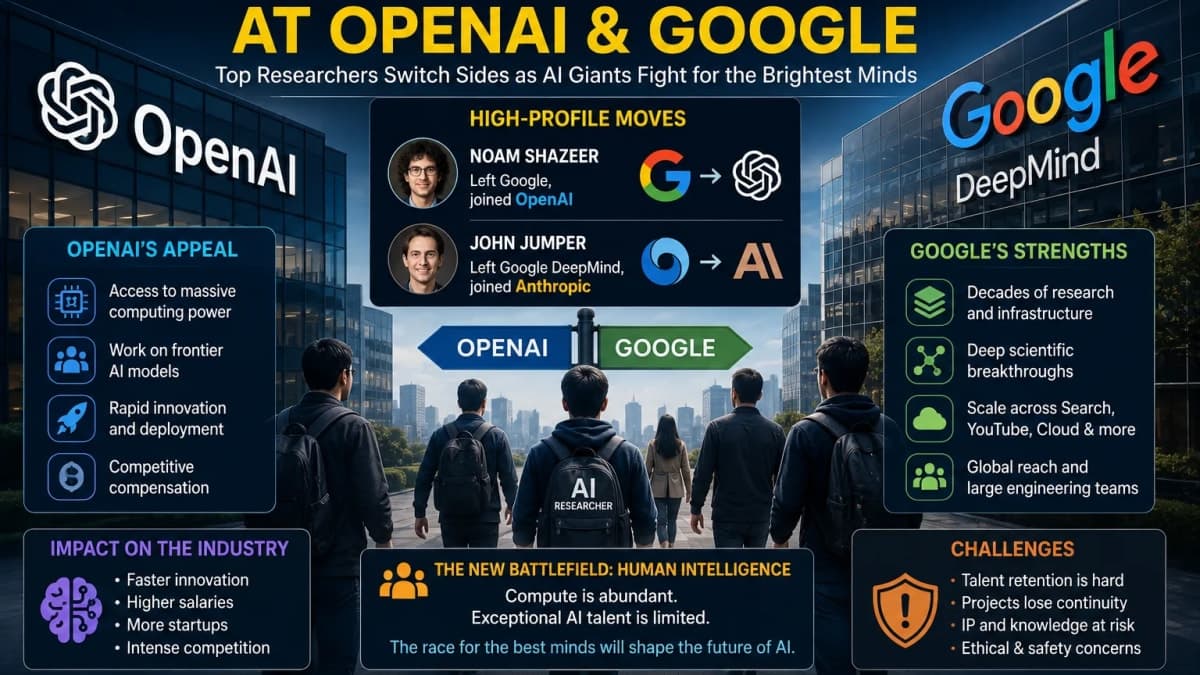
AI Talent Race Enters a New Phase
The battle to dominate artificial intelligence is increasingly becoming a battle over people.
OpenAI and Google are among the companies competing for a relatively small pool of researchers capable of designing and training frontier AI models. At the same time, Anthropic, Meta and ambitious startups are competing for many of those same specialists.
The result is an unusually fluid employment market in which prominent researchers can move between companies that are direct competitors.
Recent departures from Google have put renewed attention on the issue. In June, prominent researcher Noam Shazeer left Google for OpenAI, while AlphaFold scientist and Nobel Prize winner John Jumper moved from Google DeepMind to Anthropic.
The movement has continued beyond those two researchers.
In August, longtime Google AI leader Jeff Dean and several other prominent Google researchers announced their departure to establish a new AI venture, Discovery Loop.
Why Noam Shazeer's Move Matters
Shazeer's move is particularly striking because of his long history with Google.
He was one of the authors of the landmark 2017 research paper that introduced the Transformer architecture, the technical foundation that ultimately enabled the modern large-language-model revolution.
Shazeer left Google in 2021 and co-founded Character.AI.
Google later entered into a major licensing agreement with Character.AI in 2024 that brought Shazeer and several colleagues back to the company.
His subsequent departure for OpenAI in 2026 demonstrates how difficult retaining elite researchers has become, even for companies with enormous financial and computing resources.
Google Faces a Wider AI Talent Challenge
Individual departures would normally represent routine movement within the technology sector.
Taken together, however, Google's recent losses have attracted greater attention.
Jeff Dean, one of Google's longest-serving and most influential technical leaders, left in August alongside researchers including Sanjay Ghemawat, Quoc Le and Oriol Vinyals to create Discovery Loop.
The new venture intends to use artificial intelligence to accelerate scientific experimentation.
Google DeepMind has simultaneously undergone a significant leadership reorganization.
Demis Hassabis moved from CEO of Google DeepMind to chairman and Alphabet chief scientist, while Koray Kavukcuoglu took responsibility for leading Google's AI organization.
The changes arrive as Google faces intense pressure to accelerate Gemini development while competing with increasingly capable models from OpenAI and Anthropic.
OpenAI Is Competing Aggressively for Researchers
OpenAI has emerged as one of the most desirable destinations for frontier AI researchers.
The company can offer something particularly valuable to ambitious scientists: access to enormous computing resources and the opportunity to work directly on some of the world's most advanced AI systems.
But OpenAI is not immune to the same talent pressures affecting Google.
Researchers move in both directions across the industry, and OpenAI itself has experienced departures to competitors and newly formed startups.
That means the current talent war cannot simply be described as OpenAI winning employees from Google.
Instead, the entire frontier-AI ecosystem has developed something resembling a revolving door.
Researchers who worked together at one laboratory can become competitors at another company months later.
Money Is Only Part of the Story
Extraordinary compensation has become one of the most visible aspects of the AI hiring boom.
Top researchers can potentially command packages far beyond conventional technology-industry salaries because companies believe a small number of exceptional scientists can materially influence the quality of future models.
But compensation does not completely explain why researchers change companies.
Several other factors matter:
Access to large quantities of computing power
Freedom to pursue specific research ideas
Influence over major AI projects
Opportunities to lead research teams
Company culture and management
Equity and potential financial upside
Different philosophies regarding AI development and safety
For researchers attempting breakthroughs at the frontier of machine intelligence, having thousands of advanced accelerators available for experiments may sometimes matter as much as salary.
Industry reporting suggests that these combinations of money, resources, influence and research freedom are driving unusually intense competition.
Why One Researcher Can Be Worth So Much
Modern AI research differs from many traditional software businesses.
A breakthrough developed by a small research group can influence an entire generation of products.
The Transformer architecture provides perhaps the clearest example.
Research breakthroughs involving model architecture, reasoning, reinforcement learning, multimodal systems, efficiency or autonomous agents could potentially produce major competitive advantages.
Companies therefore aren't simply hiring additional engineers.
They are competing for researchers who might discover the techniques behind the next major leap in AI capability.
That possibility helps explain why elite researchers have become strategically valuable assets.
OpenAI and Google Still Have Different Advantages
Despite intense competition, OpenAI and Google offer researchers different environments.
OpenAI has built its identity around rapidly developing and deploying frontier artificial intelligence. Its success with ChatGPT gives researchers a direct route from experimental models to products used globally.
Google has a different set of strengths.
The company possesses decades of research experience, massive computing infrastructure and established businesses spanning Search, YouTube, Android and Google Cloud.
Google DeepMind also has a strong record of scientific breakthroughs, including AlphaFold.
Its careers program continues to recruit researchers internationally for work across advanced AI and scientific applications.
Neither organization therefore lacks the resources to attract talent.
The challenge is keeping the most sought-after researchers when competing opportunities are constantly available.
Researcher Loyalty Is Becoming Harder to Secure
The AI talent market has developed an unusual contradiction.
Companies can offer enormous compensation packages, prestigious positions and extraordinary computing resources — yet researchers may still leave.
The reason is partly structural.
The same relatively small group of researchers has professional connections across OpenAI, Google DeepMind, Anthropic, Meta and numerous startups.
Many have previously worked together or collaborated academically.
As a result, frontier AI increasingly operates as an interconnected research ecosystem even while the companies involved compete fiercely with one another.
Industry reporting suggests retention is becoming almost as challenging as recruitment.
Startups Add Another Dimension to the Talent War
OpenAI and Google are not only competing against each other.
They must also compete against researchers who decide to start their own companies.
The departure of Jeff Dean and colleagues from Google illustrates the attraction of entrepreneurship for experienced AI researchers.
Successful scientists can potentially raise significant amounts of venture capital, build their own research organizations and retain substantial ownership in the technologies they develop.
That creates another challenge for large laboratories.
A researcher does not necessarily need to choose between Google and OpenAI.
They may choose neither.
Why the AI Talent War Matters
Artificial intelligence companies often emphasize their models, computing infrastructure and data.
But people remain responsible for deciding how those resources are used.
A company possessing enormous numbers of GPUs but lacking researchers capable of developing better training techniques may struggle against a smaller organization with stronger scientific teams.
Talent can therefore influence:
Model performance: Better researchers can discover more efficient architectures and training methods.
Product development: Research breakthroughs can quickly become commercial AI features.
Safety: Experienced specialists are needed to understand increasingly capable systems and develop safeguards.
Speed: Strong teams can shorten the time between research experiments and usable models.
Strategic knowledge: Researchers accumulate valuable experience from previous generations of AI systems.
This makes talent retention a strategic issue rather than simply a human-resources problem.
Could Constant Job Switching Hurt AI Development?
The intense hiring market also carries disadvantages.
Advanced research depends heavily on institutional knowledge and collaboration.
Teams may spend months or years developing research programs, infrastructure and experimental techniques.
When senior researchers repeatedly move between organizations, projects can lose expertise and continuity.
Companies may also become increasingly protective of proprietary research as employees move between competitors.
At the same time, researcher mobility can spread ideas and create new companies, potentially accelerating innovation across the wider industry.
The impact therefore cuts both ways.
Companies may suffer from losing employees, while the broader AI ecosystem could benefit when experienced researchers establish new laboratories and pursue alternative approaches.
The AI Race Is Becoming a Competition for Human Intelligence
The AI industry's biggest companies are spending billions of dollars on chips, data centers and model development.
Yet the latest talent movements demonstrate that one resource remains particularly difficult to scale: exceptional human expertise.
Google has enormous infrastructure and decades of research experience. OpenAI has established itself as a major frontier-model developer. Anthropic continues expanding, Meta is investing aggressively and new startups are offering researchers opportunities to build organizations from scratch.
That competition means the AI race will not necessarily be determined solely by which company owns the most GPUs.
It may also depend on which organizations can attract — and retain — the people who know what to do with them.
As frontier AI development accelerates, the struggle for those researchers is likely to remain one of the technology industry's most consequential battles.
This article is based on reporting published by The Wall street Journal.