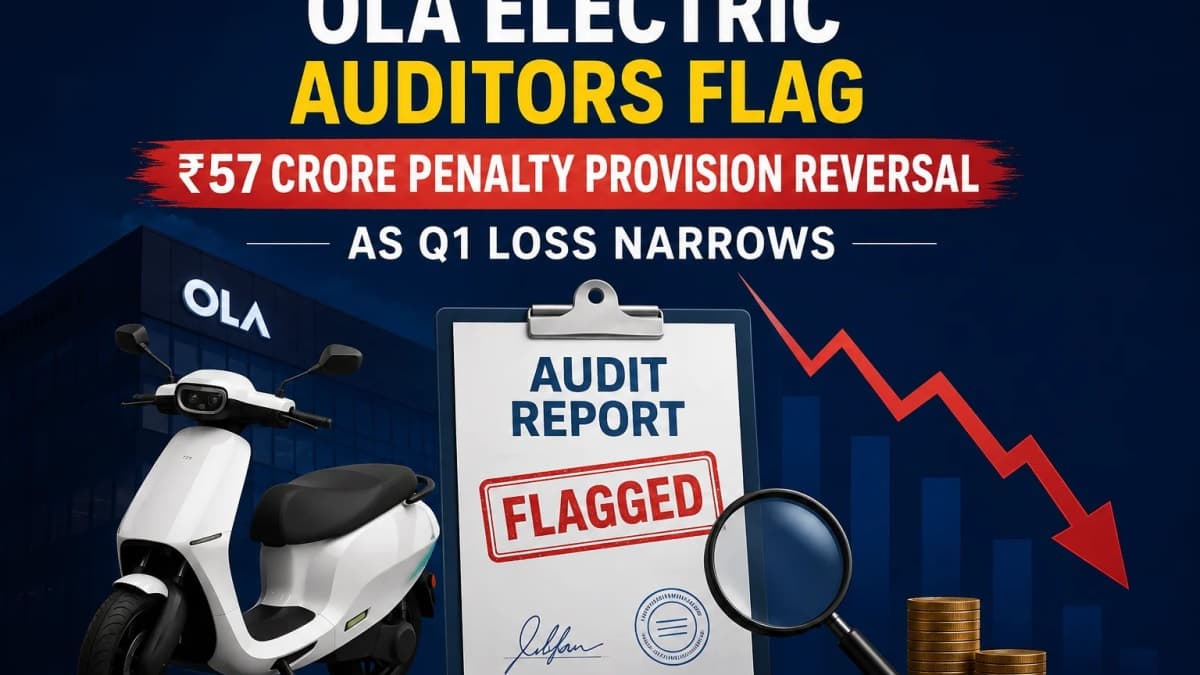
Ola Electric Q1 FY27 Results
Ola Electric Mobility reported a consolidated net loss of ₹336 crore for the quarter ended June 2026, compared with a loss of ₹428 crore in the corresponding quarter a year earlier.
The result also represented an improvement from the ₹500 crore loss recorded in the March 2026 quarter.
However, the headline reduction in losses came alongside a significant accounting development. The company reversed a provision of about ₹57 crore that had been created for potential penalties associated with missed investment milestones under a government battery manufacturing programme.
The reversal reduced the loss reported for the quarter. Without the ₹57 crore impact, the quarterly loss would have been approximately ₹393 crore.
Why Auditors Flagged the ₹57 Crore Reversal
Ola Electric’s statutory auditor, B S R & Co. LLP, raised an issue with the accounting treatment because the company had reportedly not received a formal waiver from the Ministry of Heavy Industries when the provision was reversed.
The company expects the penalty to be waived based on its discussions with the ministry and consequently concluded that the provision was no longer required.
The auditor, however, indicated that in the absence of formal government approval, it could not determine whether reversing the provision was appropriate.
This distinction is important. Management's expectation that a liability will eventually be waived is different from having written confirmation that the obligation has been removed.
Revenue Falls Sharply From Last Year
While Ola Electric reduced its quarterly loss, its revenue performance continued to reflect pressure on the core electric vehicle business.
Revenue for the June quarter fell about 45% year-on-year to approximately ₹455 crore.
At the same time, the company's performance improved sequentially from the weak March quarter. Vehicle deliveries recovered substantially compared with Q4 FY26, providing evidence that volumes were beginning to rebound after an exceptionally difficult period.
The combination presents investors with two contrasting trends: sequential operating improvement on one side and a steep year-on-year revenue contraction on the other.
Why the Auditor's Observation Matters
The ₹57 crore provision is relatively limited when viewed against the scale of Ola Electric's overall operations and accumulated losses. Nevertheless, the issue can matter beyond its immediate financial value.
Accounting provisions are intended to recognise obligations when companies have sufficient reason to expect that a cost may arise. Reversing such provisions can increase reported earnings—or, in a loss-making company's case, reduce the reported loss.
For that reason, investors generally pay close attention when auditors disagree with, qualify or raise concerns about management's treatment of uncertain liabilities.
In Ola Electric's case, the key question is whether the expected government waiver ultimately receives formal confirmation.
If the waiver is granted, management's assessment would gain important support. If it is not granted, the company could potentially need to recognise the financial obligation again.
Ola Electric Faces a Wider Turnaround Challenge
The accounting issue arrives as Ola Electric works to rebuild momentum in India's increasingly competitive electric two-wheeler market.
The company has been focusing on cost controls, improving product economics, strengthening its service operations and expanding its battery-cell manufacturing capabilities.
In Q4 FY26, Ola Electric had highlighted improvements in gross margins and reported positive operating cash flow for the quarter, describing the period as evidence that its operational reset was beginning to produce results.
Q1 FY27 subsequently delivered a sequential recovery in vehicle volumes and a lower consolidated loss.
However, the sharp annual decline in revenue shows that the turnaround remains incomplete.
Competition in India's electric scooter market has intensified, making sustained volume growth, customer service, product reliability and financial discipline increasingly important for manufacturers.
Stock Reaction Puts Focus on Quality of Earnings
Ola Electric shares reacted to the quarterly results as investors assessed both the operational improvement and the auditor's concerns surrounding the penalty provision.
For shareholders, the quality of the improvement in profitability is particularly important.
The reported loss declined substantially from both the previous year and previous quarter, but part of that improvement came from the ₹57 crore provision reversal rather than purely from operating performance.
Excluding that accounting benefit provides investors with another way of evaluating the underlying progress of the business.
Balanced Analysis: Improvement Comes With Important Caveats
Ola Electric's Q1 FY27 numbers contain some encouraging signals. Sequential vehicle deliveries improved, and the consolidated loss was considerably lower than in Q4 FY26.
Those trends could indicate that measures taken to reduce costs and stabilise operations are beginning to have an effect.
However, there are equally significant reasons for caution.
A roughly 45% year-on-year revenue decline highlights the scale of the company's sales challenge, while the auditor's observation over the ₹57 crore provision reversal creates uncertainty around part of the reported improvement in losses.
The issue does not by itself determine Ola Electric's longer-term prospects. Instead, it increases the importance of future disclosures—particularly formal clarification regarding the government penalty waiver and evidence that operating improvements can continue without depending on one-off accounting adjustments.
For investors, upcoming quarters are therefore likely to be judged on sustained vehicle sales, margins, cash flows, market-share trends and progress toward reducing losses.
This article is based on reporting published by CNBC TV18.