OpenAI Lowers GPT-5.6 Sol API Costs
OpenAI has announced a significant pricing reduction for GPT-5.6 Sol, its frontier model designed for demanding professional, coding and agentic workloads.
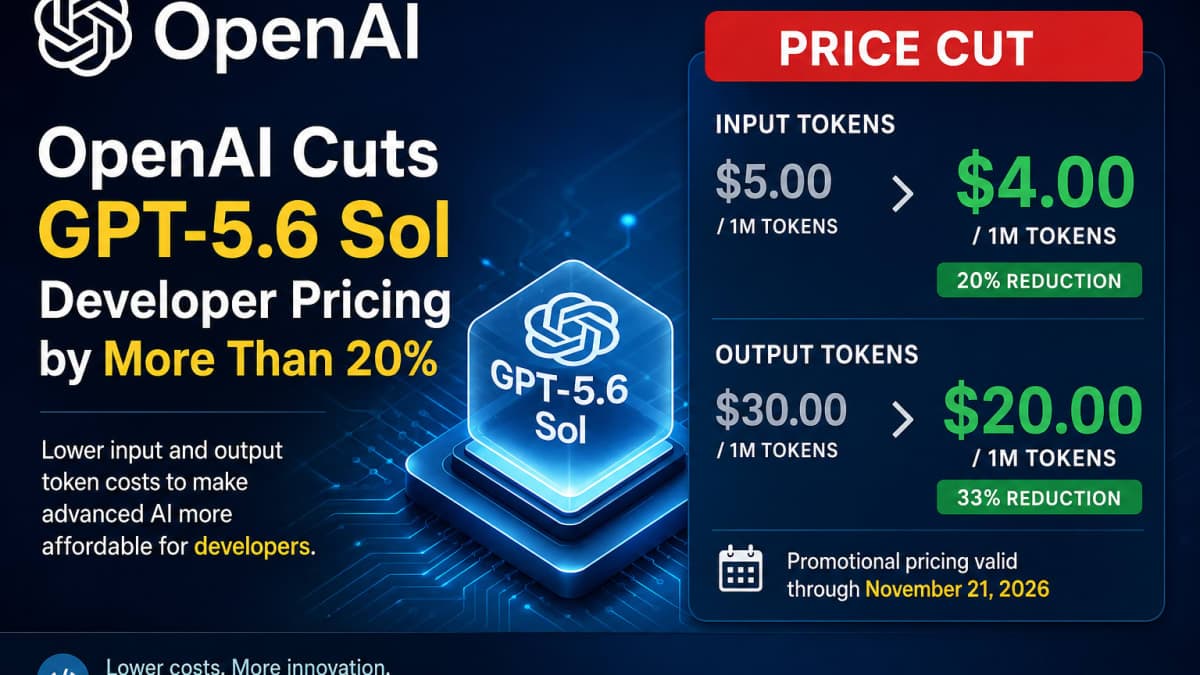
Under the new pricing structure, GPT-5.6 Sol costs $4 per million input tokens, compared with $5 previously. Output pricing has fallen more sharply, from $30 to $20 per million tokens. That represents a 20% reduction in the standard input rate and roughly a 33% reduction in output pricing.
OpenAI says the promotional pricing will remain available at least through November 21, 2026.
The reduction is notable because the cost of output tokens can account for a substantial part of the expense associated with AI applications that generate lengthy responses, write code or perform multi-step tasks.
Why OpenAI Is Cutting Prices
The move comes as competition among major AI developers continues to increase. OpenAI is competing not only with US-based rivals such as Anthropic but also with a growing group of Chinese AI developers offering increasingly capable models, often with aggressive pricing strategies. Reuters reported that the pricing decision arrives against this increasingly competitive backdrop.
Price has consequently become an important part of the AI industry's competitive landscape alongside model intelligence, speed, reliability and context capacity.
OpenAI had already reduced prices for other models in the GPT-5.6 family. In July, the company announced lower pricing for GPT-5.6 Terra and Luna, positioning them as more economical options for workloads where the maximum capabilities of Sol may not be necessary.
The latest Sol reduction extends that push toward the premium end of OpenAI's model lineup.
What the Price Cut Means for Developers
For developers and businesses operating AI applications at scale, relatively small changes in per-token costs can translate into meaningful differences in monthly infrastructure spending.
The new pricing could make GPT-5.6 Sol more attractive for applications involving software development, sophisticated agents, research, complex analysis and other workloads that require a frontier model.
The reduction could also encourage developers who previously selected cheaper models primarily because of operating costs to experiment with Sol for a larger share of their workloads.
However, model price is only one part of the total cost of deploying AI. Developers must also consider factors including latency, token efficiency, caching, infrastructure, reliability and the number of model calls required to complete a task.
GPT-5.6 Sol's Position in OpenAI's Model Family
OpenAI positions GPT-5.6 Sol as the frontier member of its GPT-5.6 lineup for complex professional work. The broader family also includes Terra, designed to balance capability and cost, and Luna, aimed at faster and more cost-sensitive workloads.
This tiered approach gives developers greater flexibility to select different models according to workload requirements rather than using the most powerful model for every request.
For example, high-volume routine operations may be better suited to less expensive models, while Sol can be reserved for tasks where stronger reasoning or agentic capabilities justify the additional expense.
Why the GPT-5.6 Sol Price Cut Matters
The decision illustrates a broader shift taking place in generative AI: competition is increasingly focused on performance per dollar, rather than model capability alone.
As frontier models become more capable, developers are paying greater attention to whether improvements in intelligence produce enough additional value to justify higher inference costs.
Lower prices can also accelerate experimentation. Startups and smaller development teams that previously found sustained use of frontier models expensive may be able to test more ambitious AI products without increasing their budgets proportionally.
For established enterprises processing millions or billions of tokens, the financial impact could be considerably larger.
Balanced Analysis: A Win for Developers, but Competition Remains Fierce
For developers, lower GPT-5.6 Sol pricing is broadly positive because it reduces one barrier to deploying advanced AI systems at scale.
For OpenAI, however, the reduction also highlights how quickly the economics of the AI industry are changing. Model providers are under pressure to simultaneously improve capabilities, increase inference speed and reduce the cost of serving customers.
The temporary nature of the promotional pricing is another important consideration. Businesses planning long-term deployments will need to monitor whether the reduced rates become permanent or are revised after the promotional period.
At the same time, lower headline token prices do not automatically make one model the cheapest option for every application. A less expensive model that requires additional calls, produces longer outputs or completes fewer tasks successfully can sometimes generate higher overall costs.
The increasingly relevant metric for developers may therefore be the cost of successfully completing a task, rather than simply the cost of one million tokens.
Growing AI Price Competition
OpenAI's decision could place additional pressure on competing AI providers to improve their own price-performance ratios.
As models from OpenAI, Anthropic and other global AI developers compete for enterprise and developer adoption, pricing is becoming another major battleground alongside coding performance, reasoning, multimodal capabilities and agentic functionality.
If the trend continues, developers could benefit from both stronger models and progressively lower inference costs — potentially making sophisticated AI applications economically viable for a much wider range of businesses.
Conclusion
OpenAI's decision to cut GPT-5.6 Sol developer pricing marks an important shift in the economics of its flagship model. With input pricing reduced to $4 per million tokens and output pricing lowered to $20 per million, developers now have a less expensive route to using OpenAI's frontier model.
The reduction could encourage greater adoption of advanced AI agents, coding systems and professional applications while adding further pressure to an already competitive AI market.
Ultimately, the significance of the move extends beyond one model's price. It reflects an industry increasingly competing on how much useful intelligence developers can obtain for every dollar they spend.
This article is based on reporting published by ETCIO COM