After a Decade in India, Polish Creator Says Viral Reels Tell Only Part of the Story
Introduction
Dominika Patalas-Kalra does not argue that the uncomfortable images of India circulating online are fabricated. Her objection is to what happens when those images become the entire story.
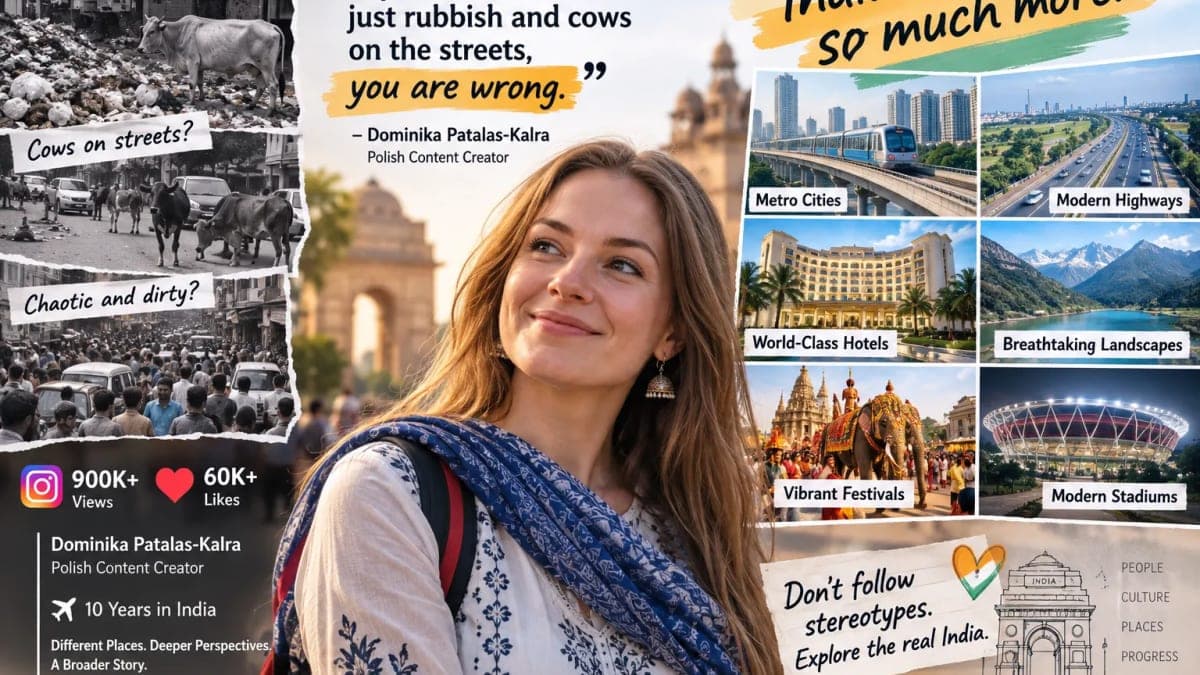
The Polish content creator, who says she has lived and travelled in India for 10 years, has attracted a large audience with a video challenging some of the country's most persistent stereotypes. Instead of presenting India largely through rubbish, cattle and chaotic streets, she points to another side of everyday life: modern public transport, new highways, metro systems, hotels, residential developments, stadiums, landscapes and festivals.
“If you think India is just rubbish and cows on the streets, you are wrong,” she says in the video.
Posted on Instagram on July 28, the clip had passed 900,000 views and attracted nearly 60,000 likes by the time Indian media reported on it.
Its popularity has turned a personal observation into a broader discussion about how social platforms shape perceptions of a country that is difficult to represent through any single set of images.
What Gets Left Out of the Viral Version of India
Patalas-Kalra builds her argument through contrasts.
Alongside the images commonly associated with India online, she draws attention to comfortable buses and trains, newer highways, expanding metro networks, modern stadiums, hotels and residential complexes.
She also includes elements that have little to do with infrastructure: natural scenery, sunsets, tourist destinations and festivals.
“India can really shock you,” she says.
Her point is not that these experiences are universal. Infrastructure, wealth and public services differ sharply across India, and conditions can vary considerably even within the same city.
Rather, she questions why certain parts of the country repeatedly become shorthand for the whole.
‘Rubbish and Cows’ Attract Attention
Patalas-Kalra has her own explanation for why negative imagery travels so effectively.
“People show rubbish and cows because this ‘sells’ very fast…” she said.
The comment reflects a familiar feature of social media. Content built around surprise, disorder or sharp cultural contrasts can attract immediate engagement. Once a particular type of video performs well, creators and recommendation systems have reasons to produce and circulate more of it.
That does not make the underlying footage untrue.
Waste management, pollution, overcrowding and uneven civic infrastructure remain genuine problems in parts of India. Ignoring them would produce another distorted picture.
The issue is proportion. A real scene can still mislead when viewers are repeatedly shown similar examples without enough context to understand how representative they are.
Transport Changed Some of Her Expectations
Among the areas Patalas-Kalra emphasises most is transport.
She says she has encountered modern buses and trains in India that compare favourably with services she has used in Europe. She also points to newer highways that have shortened some intercity journeys.
Metro networks feature prominently in the video as another part of urban India that she believes international audiences do not always see.
Her observations are personal, but the contrast they reveal is useful.
India's transport system does not fit neatly into a description of either modernity or dysfunction. New expressways can coexist with badly congested local roads. Sophisticated metro systems operate in cities where surface transport remains difficult. Premium trains run within a railway network serving passengers across vastly different levels of comfort.
The contradiction is not an exception to the story. It is part of the story.
Ten Years Offer a Different View From a Short Visit
Patalas-Kalra's perspective is also shaped by time.
She says she has spent a decade living and travelling in India, giving her experience a different basis from the first-impression videos that often dominate travel content.
Her earlier posts have discussed Indian hospitality, cultural habits and the differences between expectations formed before arriving and the realities she encountered after living in the country.
In another recent account, she described taking an 11-hour bus journey in India that proved better than she had expected. She praised the cleanliness of the seating, punctuality and the meals provided during the trip.
That experience fits naturally with her latest argument. Expectations built through reputation or online content do not always survive sustained contact with a place.
India Resists Simple Narratives
There is an obvious risk in responding to a negative stereotype with an equally sweeping positive one.
India has world-class airports, metro systems, expressways and luxury hotels. It also has neighbourhoods struggling with sanitation, congestion and basic public infrastructure. Rapid economic development sits alongside substantial inequality.
Both descriptions can be accurate at the same time.
That makes Patalas-Kalra's argument more convincing when understood as a call for perspective rather than praise.
Showing a modern highway does not invalidate footage of a polluted street. A crowded neighbourhood does not erase sophisticated infrastructure elsewhere. Neither image, on its own, explains a country of more than a billion people spread across vastly different regions and economic conditions.
Social media rarely rewards that kind of complexity. Short-form video works best when its message can be understood immediately.
India is considerably harder to compress.
Why Her Video Found an Audience
The response to Patalas-Kalra's post suggests there is also an appetite for challenging established online narratives.
By the time the video entered wider media coverage, it had accumulated more than 900,000 views and close to 60,000 likes.
Much of the attention focused on her positive observations about India. But the more interesting part of her argument is not whether the country deserves praise.
It is how easily repetition becomes reputation.
A traveller who repeatedly encounters videos of the same type may reasonably assume those images describe normal life everywhere. Another person consuming only polished tourism content could leave with an equally incomplete understanding.
Patalas-Kalra's decade in India has led her somewhere between those versions.
The country she describes has problems she does not deny and development she believes outsiders often fail to see. Her message is less about choosing which India is real than recognising that several versions can exist alongside one another.
That is harder to package into a viral reel. It is also closer to the experience she says 10 years in the country has given her.