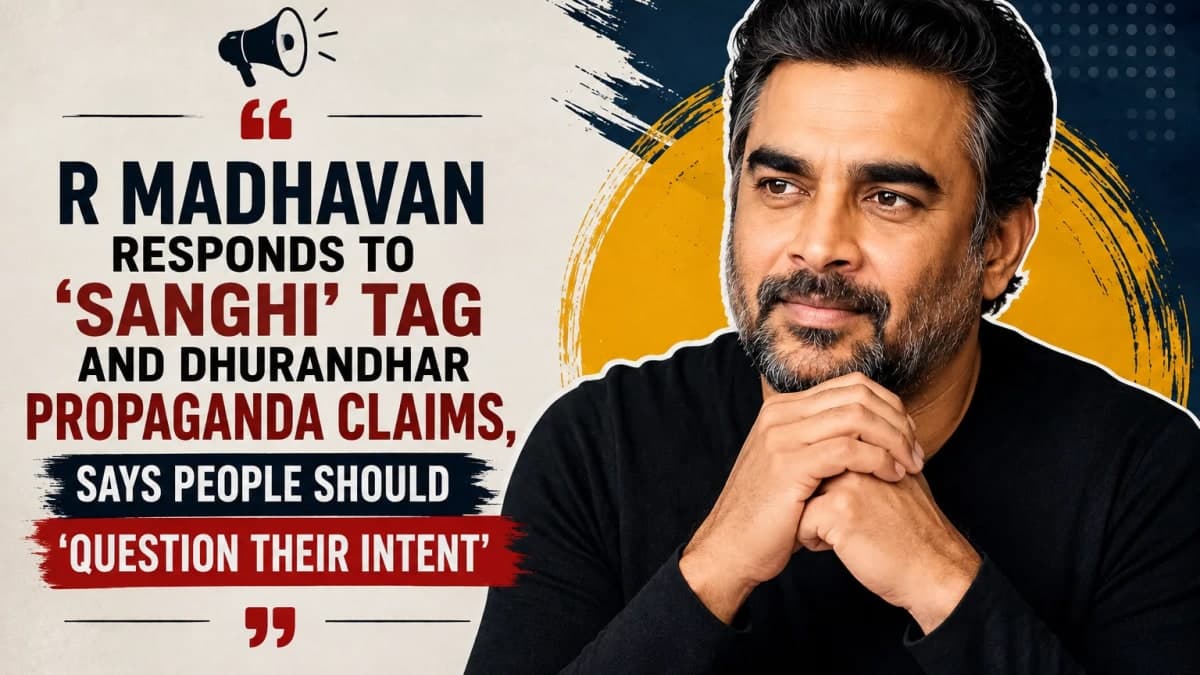
R Madhavan Addresses Political Labels and Dhurandhar Propaganda Debate
Actor R Madhavan has spoken about the politically charged labels directed at him on social media and the debate surrounding Dhurandhar, which has faced accusations of being propaganda.
Responding to criticism from trolls who have referred to him as a “sanghi”, Madhavan indicated that such labels should not automatically determine how an individual or their work is perceived. He also addressed criticism of Dhurandhar, suggesting that people should question the intent behind allegations describing the project as propaganda.
His comments bring attention to a wider debate surrounding Indian cinema, where films and actors increasingly find themselves drawn into political conversations online.
Madhavan Reacts to the ‘Sanghi’ Label
The term “sanghi” is frequently used in Indian political discourse, particularly on social media, to describe or criticise people perceived as sympathetic to right-wing or Hindu nationalist viewpoints.
Madhavan's reaction suggests that he does not believe such online labels should be accepted without examining why they are being applied. His emphasis on questioning intent shifts attention from the label itself to the motivations of those making the accusation.
For public figures, political categorisation can quickly influence online perceptions. Actors may find their personal statements, professional choices and even film roles interpreted through an ideological lens, regardless of whether they have explicitly associated themselves with a particular political position.
Dhurandhar Faces Propaganda Claims
Madhavan also addressed criticism surrounding Dhurandhar, which has been labelled propaganda by some critics and online commentators.
Rather than treating the accusation as automatically valid, Madhavan's response encourages audiences to consider why a particular film is being described in those terms and what may be motivating the criticism.
The controversy reflects a broader discussion about politically sensitive storytelling in Indian cinema. Films dealing with nationalism, security, historical conflicts or political events frequently generate competing interpretations. What one section of viewers considers legitimate storytelling may be viewed by another as an attempt to promote a particular ideological narrative.
Why the Debate Matters
The discussion surrounding Madhavan and Dhurandhar illustrates how the boundaries between cinema, celebrity and politics have become increasingly blurred.
Social media allows audiences to immediately react to actors and films, but it can also reduce complicated debates to political labels. Terms such as “propaganda” can carry significant weight because they question whether a creative work is primarily telling a story or attempting to influence political opinion.
At the same time, criticism of films with political themes remains a legitimate part of cultural discussion. Audiences and critics are entitled to examine how events, institutions and ideologies are represented on screen.
The challenge is distinguishing evidence-based criticism from assumptions based primarily on the perceived politics of the people involved.
A Larger Conversation Around Bollywood and Politics
Indian actors increasingly operate in an environment where their interviews, social-media activity and movie choices can become subjects of political interpretation.
Madhavan's remarks highlight the difficulty celebrities face when online conversations attempt to place them into fixed ideological categories. His response also raises a broader question about how audiences evaluate politically sensitive cinema: whether judgments should be made primarily on the content of a film or on assumptions about the motivations behind it.
Ultimately, the controversy around Dhurandhar demonstrates how films touching politically sensitive subjects can generate discussions extending far beyond entertainment. Whether viewers agree with the propaganda criticism or reject it, the debate reinforces the importance of evaluating a film's content, context and presentation before reaching conclusions about its political purpose.
Balanced Analysis
Madhavan's argument places emphasis on scrutinising the motivations behind politically charged criticism. That approach can encourage viewers to avoid accepting social-media labels without examination.
However, questioning critics' intentions should not replace scrutiny of the film itself. Viewers can reasonably analyse whether a movie presents its subject in a balanced manner, selectively frames events or advances a particular perspective.
The most constructive discussion therefore depends on evaluating both sides carefully: the evidence within the creative work and the reasoning behind the criticism directed at it.
This article is based on reporting published by Hindustan Times.