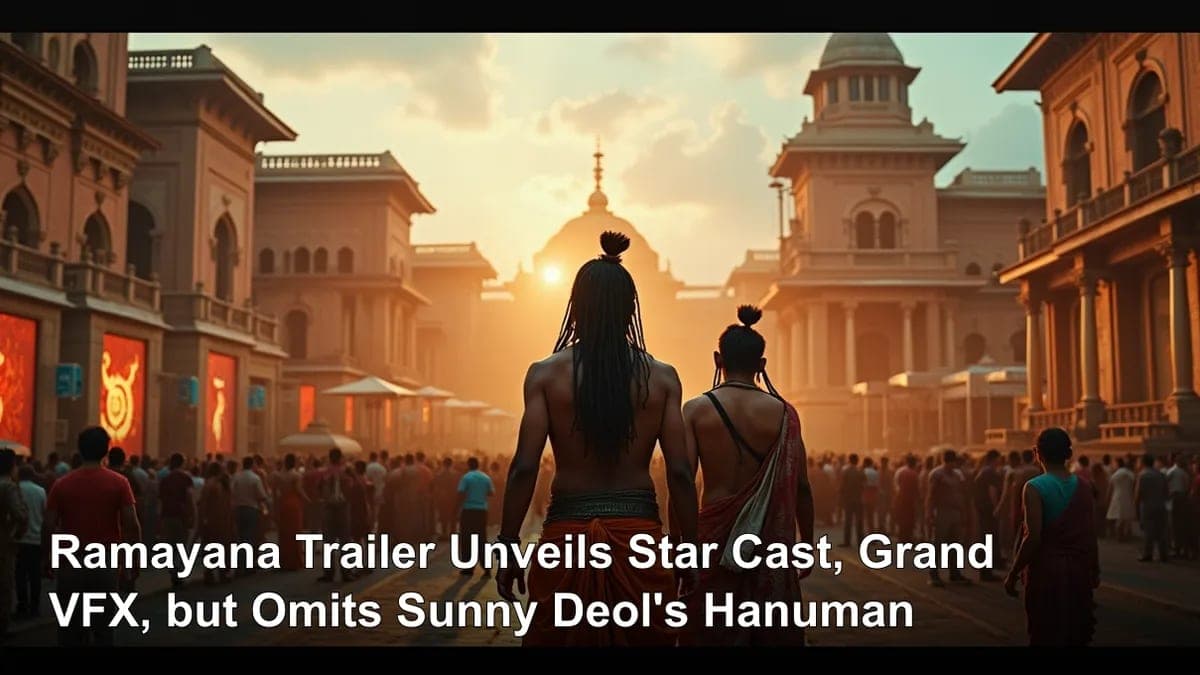
The early‑morning debut of the Ramayana trailer on July 30 gave Indian cinema fans their first extensive glimpse of what promises to be the country’s most expensive mythological venture. Produced by Namit Malhotra and directed by Nitesh Tiwari, the teaser introduces a roster of A‑list performers, highlights a Hollywood‑scale visual‑effects budget, and hints at a global musical collaboration, yet it conspicuously leaves out Sunny Deol’s Hanuman.
Running for just over two minutes, the clip sets a dramatic tone with Yash’s dreadlocked Ravana asserting dominance over the three worlds, before shifting focus to Ranbir Kapoor’s poised Rama and Sai Pallavi’s serene Sita. The trailer’s release has ignited a wave of commentary across social platforms, as audiences dissect casting choices, VFX ambition and the strategic omission of key characters.
What Happened
The trailer opens with a shadowed figure cloaked in a shawl, his face hidden until Yash steps forward as the ten‑headed demon king. His long dreadlocks and fierce gaze immediately differentiate this interpretation from earlier portrayals, positioning Ravana as a modern anti‑hero rather than a purely mythic villain.
Following the introduction, the narrative pivots to the birth of Rama, portrayed by Ranbir Kapoor, whose calm demeanor contrasts sharply with Yash’s intensity. The visual language underscores the inevitable clash between the two, framing Rama’s arrival as the catalyst for Ravana’s eventual downfall.
Interspersed with these central figures are cameo‑style reveals of the supporting cast: Sai Pallavi embodies Sita, Ravi Dubey appears as Lakshman, veteran Arun Govil returns as King Dasharatha, Lara Dutta takes on Kaikeyi, Rakul Preet Singh portrays Shurpanakha, Shobana steps in as Kaikesi, and Vivek Oberoi plays the demon prince Vidyutjihva. A brief glimpse of the mythical bird Jatayu also appears.
While the teaser showcases an array of talent, it omits Sunny Deol, who is slated to play Hanuman, as well as Rama’s brothers Bharat and Shatrughan and his mother Kausalya. The absence has prompted speculation about whether these characters will be introduced in later promotional material or reserved for narrative surprise.
Background
Ramayana, a two‑part film slated for release ahead of Diwali 2026 and Diwali 2027, represents a multi‑year effort by producer Namit Malhotra to reimagine the ancient Indian epic for a contemporary, global audience. The project, which has been in development for six to seven years, is billed as one of the costliest Indian productions, with a combined budget exceeding 4,000 crore rupees (approximately $500 million).
The decision to enlist Oscar‑winning composer Hans Zimmer alongside Indian maestro A.R. Rahman marks the first collaboration between the two, signaling an intent to fuse Western orchestral grandeur with traditional Indian motifs. According to Rahman, the goal is to craft a fresh sonic landscape that honors the story’s cultural roots while appealing to viewers worldwide.
Timeline
2019 – Initial concept and script development begin.
2021 – Casting announcements for lead roles, including Ranbir Kapoor and Yash.
Early 2023 – Principal photography commences across multiple Indian locations.
Mid‑2024 – VFX partner studios are onboarded to handle CGI‑intensive sequences.
July 30 2026 – Official trailer released at 4:15 a.m. IST.
November 2026 – First part of Ramayana slated for worldwide theatrical release.
November 2027 – Second part scheduled for Diwali release.
Why It Matters
The trailer’s visual ambition signals a shift in Indian filmmaking toward blockbuster‑level production values traditionally associated with Hollywood. By allocating a budget comparable to major global franchises, the producers aim to set a new benchmark for Indian cinema’s technical capabilities, particularly in computer‑generated imagery (CGI) and large‑scale set design.
From a cultural perspective, the film attempts to bridge generational gaps. While the Ramayana story is deeply ingrained in Indian consciousness, the modern aesthetic—exemplified by Yash’s unconventional look and the high‑octane action sequences—seeks to attract younger viewers who may be more accustomed to fast‑paced, effects‑driven entertainment.
Commercially, the project’s scale could reshape financing models for Indian epics. A $500 million budget demands a wide international distribution strategy, potentially encouraging more Indian studios to pursue cross‑border collaborations and to target non‑domestic markets for recouping costs.
Industry Impact
Ramayana’s blend of star power, cutting‑edge VFX, and a dual‑composer soundtrack may influence upcoming productions to adopt similar hybrid approaches. Studios could view the film as a proof of concept for investing heavily in mythological or historical narratives that have universal appeal.
Regulatory bodies may also take note, as the film’s massive budget and anticipated box‑office draw could prompt discussions about tax incentives, subsidies, and the need for clear guidelines on foreign talent involvement in Indian projects.
Key Takeaways
Yash’s dreadlocked Ravana offers a fresh visual take that dominates the trailer’s opening.
Ranbir Kapoor and Sai Pallavi lead as Rama and Sita, supported by a veteran‑rich ensemble.
Sunny Deol’s Hanuman, along with several other key figures, are absent from the teaser.
The production boasts Hollywood‑level CGI, positioning it as a visual benchmark for Indian cinema.
Hans Zimmer and A.R. Rahman collaborate on the soundtrack, marking a historic first.
With a reported budget over Rs 4,000 crore, the two‑part saga aims for a global box‑office impact.
Conclusion
As the Ramayana trailer circulates, anticipation builds not only for the film’s release but also for how it may redefine the scale and ambition of Indian storytelling on the world stage. The next weeks will likely reveal whether the missing characters, especially Sunny Deol’s Hanuman, will surface in subsequent teasers or remain a strategic surprise for the full-length feature.
Stakeholders will be watching closely to see if the project’s massive investment translates into box‑office returns, and whether its blend of traditional narrative with cutting‑edge technology sets a new template for future Indian epics.