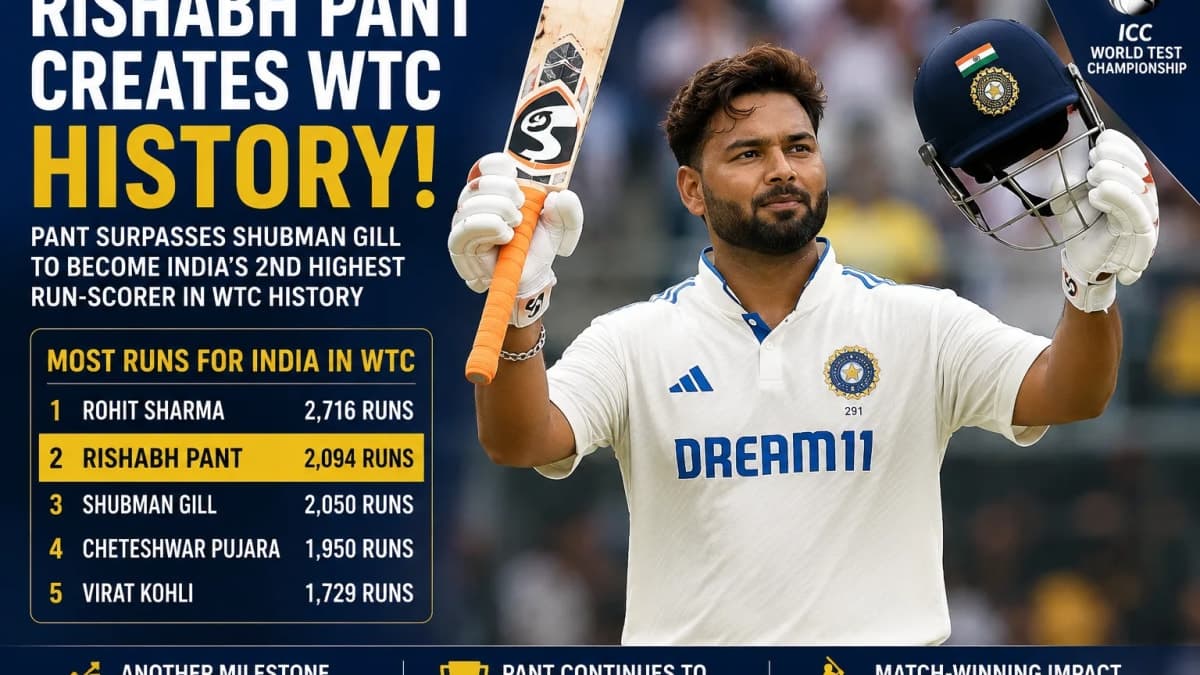
Rishabh Pant Adds Another WTC Record to His Name
Rishabh Pant has once again written his name into India's World Test Championship record books.
The wicketkeeper-batter overtook Shubman Gill to become India's second-highest run-scorer in World Test Championship history during the ongoing Test against Sri Lanka in Colombo. (hindustantimes.com)
The milestone underlines Pant's remarkable influence on India's Test batting since the WTC format was introduced.
Unlike many traditional Test batters, Pant has built his reputation through a combination of aggressive stroke-making and the ability to produce match-changing innings under pressure.
His latest achievement further demonstrates that his attacking approach has also translated into sustained run-scoring across multiple WTC cycles.
Pant Goes Past Shubman Gill
Before the Colombo Test, Pant and Gill were already among India's most productive batters in World Test Championship cricket.
Pant's latest innings took him beyond Gill's career WTC tally, moving the wicketkeeper into second place among Indian run-scorers in the competition.
Rohit Sharma remains ahead of Pant on India's all-time WTC run-scoring list. (hindustantimes.com)
The comparison with Gill is particularly interesting because the two batters represent different approaches to Test batting.
Gill is generally associated with technically elegant stroke play, while Pant has built his Test identity around calculated aggression and an ability to disrupt opposition bowling plans.
Yet Pant's position among India's leading WTC run-makers shows that his aggressive style has been accompanied by significant consistency.
Why Pant's WTC Achievement Matters
The World Test Championship has become one of the most important measures of sustained performance in modern Test cricket.
Rather than focusing on one bilateral series, WTC statistics capture performances across different countries, opponents and playing conditions over multiple championship cycles.
Pant's position near the top of India's run-scoring charts therefore reflects more than a handful of memorable innings.
He has produced important performances in several demanding environments, including overseas conditions where wicketkeeper-batters traditionally face an especially difficult challenge.
That combination of wicketkeeping responsibility and middle-order batting makes his numbers even more notable.
Rishabh Pant's Unusual Impact on Test Cricket
Pant's influence cannot always be measured through runs alone.
His willingness to attack can rapidly change the tempo of a Test match. A session that appears evenly balanced can shift dramatically if Pant successfully puts pressure back on the bowling side.
That approach inevitably carries risk.
Aggressive strokes can sometimes result in dismissals that attract criticism, particularly when India are in a difficult position. However, the same attacking instinct has also been central to some of Pant's most important Test performances.
His growing WTC run tally suggests that India have largely benefited from allowing him to maintain that natural style rather than attempting to transform him into a conventional defensive middle-order batter.
Pant's Comeback Makes the Record More Significant
Pant's career numbers carry additional context because his international journey was interrupted following the serious car accident he suffered in December 2022.
He spent an extended period away from competitive cricket before eventually returning to international action.
Re-establishing himself as India's first-choice Test wicketkeeper-batter required not only physical recovery but also rebuilding the rhythm and endurance necessary for five-day cricket.
His subsequent return to the upper reaches of India's WTC batting records therefore represents an important chapter in his career.
A Key Player in India's Current Test Generation
Pant's latest milestone also highlights his growing importance during a period of transition in India's Test team.
As senior players gradually make way for a newer generation, players such as Pant and Gill are increasingly becoming central figures in India's long-term red-ball plans.
Pant's experience gives him a particularly important role.
Despite still having many potential years of international cricket ahead of him, he has already played high-pressure Test matches across Australia, England, South Africa and India.
That experience could become increasingly valuable as India build toward future World Test Championship campaigns.
Can Pant Become India's Leading WTC Run-Scorer?
Moving into second place naturally raises another question: can Pant eventually reach the top?
If he remains fit and continues playing regularly, the opportunity is certainly there.
Pant's ability to score quickly also allows him to accumulate substantial runs without necessarily requiring extremely long innings.
However, Test cricket places significant physical demands on wicketkeepers. Managing workload and avoiding injuries will therefore be important if Pant is to continue climbing the WTC record charts.
Individual records will also remain secondary to India's larger objective of collecting enough championship points to challenge for another WTC final.
Balanced Analysis
Pant overtaking Gill is an impressive statistical achievement, but comparisons between the two players require context.
They occupy different batting roles, have played different numbers of matches and often enter the crease under very different circumstances.
A simple career run tally therefore cannot definitively establish which player has been more valuable.
What the milestone does demonstrate is Pant's remarkable productivity in World Test Championship cricket.
His aggressive reputation can sometimes overshadow his consistency, but becoming one of India's leading WTC run-scorers provides strong statistical evidence of his sustained contribution.
For India, that may ultimately be more important than the record itself. A fit and confident Rishabh Pant gives the Test side something few teams possess—a wicketkeeper capable of changing the direction of a match with the bat in a single session.
This article is based on reporting published by TOI.


