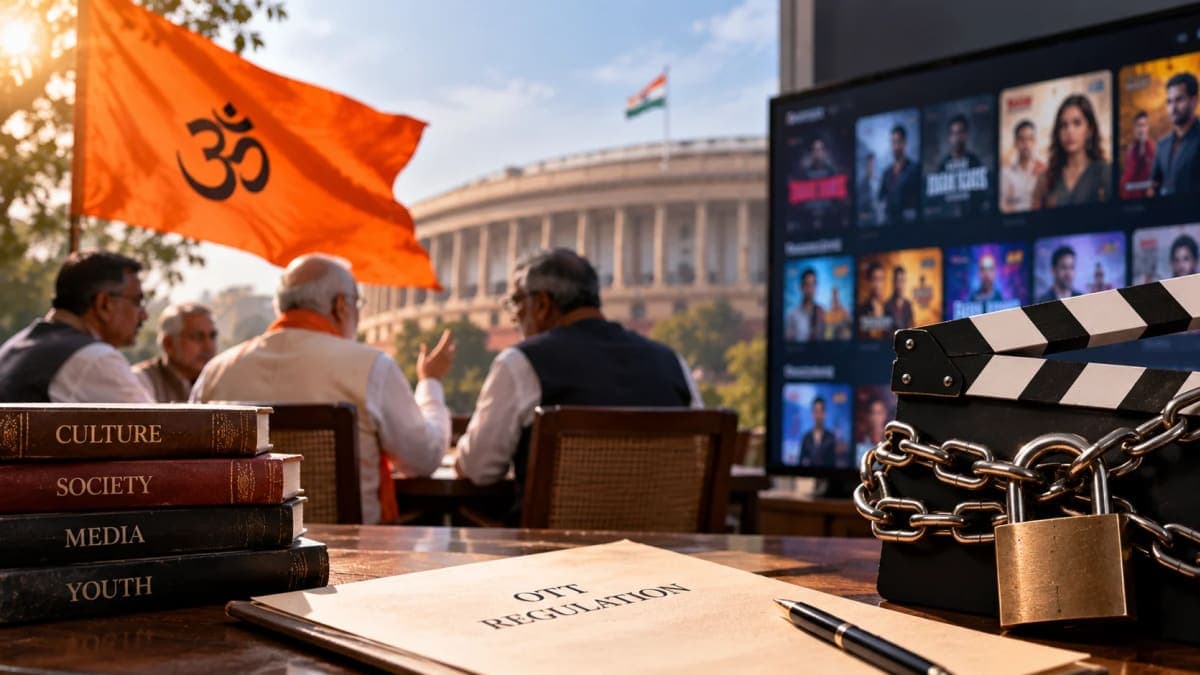
The Rashtriya Swayamsevak Sangh (RSS) has constituted an informal group to examine content on streaming platforms and recommend measures against what the organisation describes as “cultural pollution,” according to a report published by The Indian Express on September 16.
The group reportedly includes former vice-chancellors as well as RSS pracharaks working in education and culture. It was constituted several months ago and held its first meeting last month, according to RSS sources quoted by the newspaper.
One RSS source told the newspaper that the organisation believes something resembling a “censor board” is needed to deal with content it considers harmful to families and younger audiences. Another said the group has no fixed deadline and intends to consult legal experts before developing its proposal.
There is an important distinction, however: this is an RSS initiative, not a new government regulatory body or announced government policy. According to the report, the informal group intends eventually to submit proposals to the Union Ministry of Culture and other central-government stakeholders.
The development nevertheless reopens a complicated policy question.
India already regulates OTT platforms. What it does not currently have is a film-style pre-certification system for streaming programmes equivalent to the Central Board of Film Certification (CBFC).
That distinction is central to understanding the controversy.
What exactly has the RSS created?
According to The Indian Express, the RSS panel was formed following feedback associated with Kutumb Prabodhan, an RSS activity focused on family and inter-generational values. RSS sources told the newspaper that some functionaries regard OTT programming as a contributor to what they describe as moral deterioration.
The precise membership of the panel has not been publicly disclosed in the reporting available so far.
Nor has a formal proposal been released.
That means claims about exactly what restrictions the RSS ultimately wants—or how a proposed new institution would operate—would currently be premature.
What is known is the direction of the discussion: RSS sources are advocating stronger institutional oversight of streaming content, including consideration of something comparable to a censor or certification body.
This concern did not begin in 2026
The new panel follows earlier public comments from RSS chief Mohan Bhagwat.
During his Vijayadashami address in Nagpur on October 12, 2024, Bhagwat criticised material available through OTT platforms and called for legal regulation, arguing that such content was contributing to what he characterised as moral deterioration.
His broader argument concerned children's access to digital content and what he described as inadequate control over material available through phones and other connected devices.
That history is significant because the newly reported panel appears to turn a previously stated cultural concern into a more organised effort to develop policy proposals.
But it still does not mean the government has accepted those proposals.
India does regulate OTT platforms already
One potentially misleading interpretation of the current debate is that OTT services operate in an unregulated environment.
They do not.
The Ministry of Information and Broadcasting administers Part III of the Information Technology (Intermediary Guidelines and Digital Media Ethics Code) Rules, 2021 for publishers of online curated content, including OTT platforms.
The framework contains a Code of Ethics and a three-tier grievance-redressal mechanism.
The government describes the system as involving publisher-level self-regulation, self-regulatory bodies and government oversight.
OTT services are also required to classify programmes according to age categories.
The framework provides classifications including U, U/A 7+, U/A 13+, U/A 16+ and A, while requiring parental locks for content classified U/A 13+ or above and age-verification mechanisms for adult-rated material.
Classification also considers themes including violence, nudity, sex, language, drug and substance abuse and horror. The government reiterated those requirements in Parliament as recently as August 2026.
So the current dispute is not accurately described as:
regulation versus no regulation.
It is closer to:
the existing self-classification/grievance framework versus demands for stronger, potentially certification-style oversight.
Why OTT is treated differently from cinema
Traditional theatrical films operate under a different regulatory structure.
Films intended for public exhibition in cinemas are subject to certification through the CBFC under India's cinematograph law.
Streaming content does not go through an equivalent CBFC pre-certification process before being made available to subscribers. Instead, OTT publishers operate within the IT Rules framework, including self-classification and grievance mechanisms.
That difference partly reflects how the two media work.
A cinema release is a relatively fixed work presented publicly through theatres.
Streaming libraries can contain thousands of titles distributed on demand across phones, televisions, tablets and computers, with new programming appearing continuously.
Introducing a film-style certification mechanism for that volume of programming would therefore raise practical questions about its scope, timing and administration.
Those implementation questions have not yet been answered by the RSS group's reported proposal because no final proposal has been made public.
The government has already taken action against OTT services
The existence of a self-regulatory structure also does not mean authorities lack enforcement powers.
In July, the Ministry of Information and Broadcasting told Parliament that 50 OTT platforms had been disabled for public access in India during the preceding two years for displaying obscene material and violating applicable laws.
The government cited provisions including Sections 67 and 67A of the Information Technology Act, Section 294 of the Bharatiya Nyaya Sanhita and Section 4 of the Indecent Representation of Women (Prohibition) Act.
The government separately reiterated in July that OTT publishers must not transmit content prohibited under existing law.
This is important context for the RSS proposal.
The question is therefore not whether unlawful OTT content can currently face government action—it can.
The policy debate concerns whether additional oversight should occur before or beyond the mechanisms already available under existing law.
Government advisories have also become more specific
The Ministry's approach has continued evolving without the creation of an OTT equivalent of the CBFC.
Its current digital-media advisories include directions concerning compliance with Indian laws and the Code of Ethics, inclusion of classification ratings in promotional material, and streaming content involving narcotic drugs and psychotropic substances.
In August, the government reiterated that the IT Rules require OTT platforms to exercise caution and discretion and classify programming according to its content.
That shows an important middle ground in the debate.
India's present model is neither completely hands-off nor equivalent to traditional cinema certification.
It combines self-classification with legal obligations, complaints procedures and government oversight and enforcement.
The real policy question is about pre-certification
This is where the RSS initiative potentially becomes more consequential.
If a future proposal merely recommends tougher enforcement of existing laws, that would be one type of policy change.
If it recommends mandatory government approval before OTT programmes can be streamed, that would be considerably different.
A pre-certification regime could raise questions about creative freedom, administrative capacity and the legal standards used to determine what content may be distributed.
Supporters of stronger controls may argue that streaming services reach children and households directly and that the existing framework does not adequately prevent exposure to obscene or otherwise harmful material.
Critics of stronger state certification may argue that age classifications, parental controls, existing criminal law and post-publication enforcement are preferable to requiring prior government approval of creative works.
Those are competing policy positions. The newly reported RSS panel has not yet produced a public document detailed enough to establish exactly where its eventual proposal will fall between them.
The phrase ‘cultural pollution’ also needs attribution
The term “cultural pollution” should not be presented in a news report as an objective description of OTT programming.
It represents the RSS's characterisation of content it considers objectionable.
Likewise, assertions that OTT programmes cause “moral corruption” are political and cultural claims made by RSS figures, not established causal findings demonstrated by the creation of the panel.
That distinction is especially important because streaming platforms carry an enormous range of material—from children's programmes and documentaries to mainstream entertainment and adult-rated drama.
A debate over specific categories of illegal or age-inappropriate material is different from making a general factual claim about OTT programming as a whole.
The debate also predates the latest RSS move
Concern about OTT content has existed within government and political discussions for years.
In February 2024, then Information and Broadcasting Minister Anurag Thakur said the government supported the growth of OTT platforms while arguing that self-regulation should be exercised responsibly and that artistic freedom should not become a justification for unlawful obscenity.
Interestingly, at the same event, RSS spokesperson Sunil Ambekar also acknowledged the contribution of OTT services to Indian languages and creativity while advocating responsible content creation.
That history illustrates why the current debate cannot be reduced simply to “RSS versus OTT.”
There has long been a broader discussion in India over how to balance creative freedom, adult choice, child protection, cultural concerns and enforcement against unlawful content.
The newly reported panel represents another stage in that discussion.
What happens next?
For now, there is no new OTT censor board.
There is no publicly released RSS proposal.
And there has been no confirmed government announcement accepting a recommendation for a new certification authority.
According to The Indian Express, the informal RSS group intends to hold wider consultations—including with legal experts—before submitting proposals to government stakeholders.
That makes the eventual document more important than speculation surrounding it.
Once a proposal emerges, several questions will determine its significance: whether it seeks pre-certification or stronger enforcement after publication; which platforms and types of programming would be covered; who would make content decisions; whether existing age classifications would remain; what appeal process would exist; and how any new mechanism would interact with the IT Rules.
Until those details are available, describing the initiative as an already-decided new censorship regime would overstate what has happened.
What is confirmed — and what isn't
The confirmed development is relatively narrow but significant: the RSS has formed an informal group examining OTT content and, according to RSS sources cited by The Indian Express, intends to develop recommendations for government stakeholders. One source argued for something comparable to a censor board.
Separately, primary government sources confirm that OTT platforms are already governed by the IT Rules, a Code of Ethics, age-based classification requirements and a three-tier grievance mechanism, and that authorities have taken enforcement action against platforms accused of carrying unlawful obscene content.
What remains unverified or unresolved is the panel's full membership, the exact regulatory model it will recommend, when its work will be completed, whether it will specifically propose mandatory pre-certification, and whether the Union government would accept any such recommendation.
Those uncertainties should remain explicit in any JantaScope version of the story.