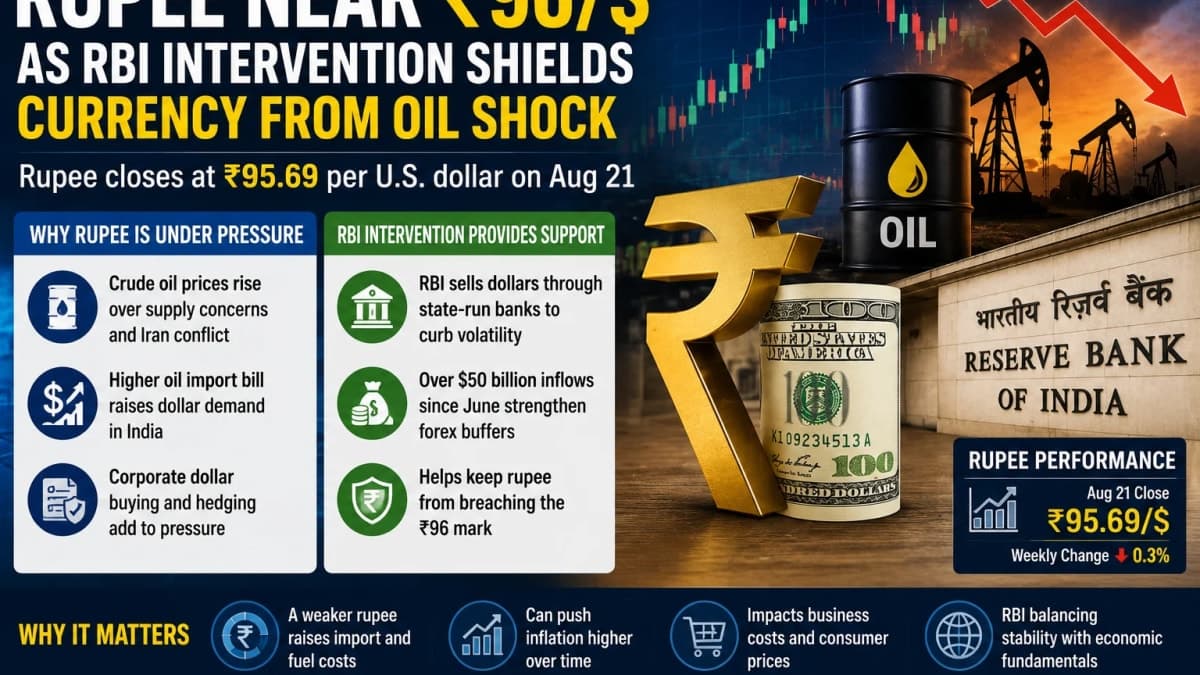
Rupee Stays Close to ₹96 Against the Dollar
India's currency remains under pressure, but the Reserve Bank of India's presence in the foreign-exchange market appears to be preventing a more disorderly decline.
The rupee finished Friday, August 21, at approximately ₹95.69 against the U.S. dollar. While it was almost unchanged during the session, it lost around 0.3% over the week.
The ₹96 level has emerged as an important psychological threshold for currency traders. Persistent RBI intervention has so far helped keep the rupee stronger than that mark during the latest bout of oil-driven volatility.
Oil Prices Put Fresh Pressure on Indian Currency
Crude oil remains one of the biggest challenges facing the rupee.
Oil prices rose more than 5% during the week amid concerns about supply disruptions linked to the Iran conflict. Higher energy prices are particularly important for India because the country imports the overwhelming majority of the crude oil it consumes.
When oil becomes more expensive, Indian refiners and other importers generally need more dollars to pay for their purchases.
That increases demand for the U.S. currency and can consequently put downward pressure on the rupee.
A weaker rupee can then make dollar-denominated commodities even more expensive in local-currency terms, creating an additional challenge for an oil-importing economy.
RBI Intervention Creates a Currency Shield
The Reserve Bank of India has been highly active in the foreign-exchange market.
Traders have repeatedly observed state-run banks offering dollars when the rupee comes under pressure, activity widely interpreted as intervention conducted on behalf of the central bank. On August 19, for example, the rupee fell to ₹95.7525 per dollar, but sustained central-bank presence helped contain the decline.
This intervention does not necessarily mean the RBI is trying to establish a permanent exchange rate of ₹96 or stronger.
Central banks commonly intervene to limit excessive volatility rather than defend a particular exchange rate indefinitely.
For India, avoiding sudden currency movements can be particularly important when geopolitical tensions are simultaneously driving energy prices higher.
Rupee Volatility Falls Despite Global Uncertainty
One striking feature of the latest currency movement has been its relatively low volatility.
Despite substantial pressure from oil markets, the rupee's two-week realised volatility has fallen below 2%, putting it among the least volatile Asian currencies over that period.
That suggests RBI intervention has been effective at smoothing daily movements.
However, low volatility should not necessarily be interpreted as an absence of underlying pressure.
Strong importer demand for dollars and elevated commodity prices continue to create headwinds for the currency.
Foreign Exchange Inflows Strengthen RBI’s Position
The central bank's ability to intervene has also been strengthened by substantial foreign-currency inflows.
More than $50 billion has entered through measures announced in June to reinforce India's balance of payments, according to bankers and analysts cited by Reuters.
India's foreign-exchange reserves have consequently provided policymakers with a substantial buffer against external shocks.
This matters because a central bank with large foreign-exchange resources has greater capacity to supply dollars when market conditions become unusually volatile.
Why ₹96/$ Matters
There is nothing economically magical about the ₹96 level, but round numbers can become important reference points in financial markets.
Traders may place orders around such thresholds, businesses may adjust hedging strategies, and investors can interpret a sustained break as a signal of changing market conditions.
The rupee has already traded beyond ₹96 during earlier periods of severe pressure.
In May, it reached a record low of approximately ₹96.96 per dollar as the oil shock intensified. RBI data later showed that the central bank sold a net $6.1 billion in the spot foreign-exchange market during that month after selling $8.9 billion in April.
The current defence around ₹96 therefore comes after several months of unusually challenging conditions for the currency.
How a Weak Rupee Affects India
Currency depreciation creates both winners and losers.
For import-dependent businesses, a weaker rupee raises the local cost of products purchased in dollars. Energy, electronics, machinery and other imported inputs can consequently become more expensive.
Oil is particularly important because higher crude prices combined with a weaker currency can increase India's overall import bill.
That can potentially contribute to:
Higher imported inflation
Greater pressure on fuel and transportation costs
A wider trade or current-account deficit
Higher input costs for businesses
Increased corporate hedging demand
Export-oriented industries can experience the opposite effect.
Companies earning a substantial portion of their revenue in dollars while paying many of their expenses in rupees can benefit when foreign earnings translate into more local currency.
Why RBI Cannot Completely Control the Rupee
Central-bank intervention can smooth currency movements, but it cannot permanently eliminate fundamental economic pressures.
If oil prices remain elevated for an extended period, Indian companies will continue requiring dollars for imports.
Global interest rates, foreign investment flows, geopolitical tensions and movements in the U.S. dollar can also influence the rupee.
The RBI therefore faces a balancing act: allowing the exchange rate to respond to economic conditions while preventing sudden movements that could destabilise markets or intensify inflationary pressures.
Could the Rupee Fall Beyond ₹96 Again?
The possibility cannot be ruled out.
The rupee has already crossed ₹96 during previous episodes this year, including July, when it weakened to ₹96.2375 before ending one session around ₹96.20 as oil prices jumped.
The near-term direction will likely depend heavily on crude oil prices, geopolitical developments, importer dollar demand, global interest-rate expectations and the intensity of RBI intervention.
A sustained easing in oil prices could provide meaningful relief.
Another sharp energy-price surge, however, could again test the central bank's willingness to defend the currency from abrupt depreciation.
Balanced Analysis: Stability Does Not Remove the Underlying Risk
The RBI's intervention appears to have achieved an important short-term objective: the rupee has remained relatively stable despite an unusually difficult external environment.
Keeping volatility contained can provide businesses and investors with greater certainty and reduce the risk of panic-driven currency movements.
But intervention cannot by itself remove India's vulnerability to expensive imported energy.
A prolonged oil shock could worsen the trade balance, increase demand for dollars and add to inflationary pressure even if the exchange rate itself appears relatively calm.
There is also a trade-off associated with repeated intervention because supporting the rupee requires the central bank to deploy its foreign-exchange resources or adjust its positions in currency markets.
For now, India's strengthened foreign-currency buffers give the RBI substantial room to manage volatility. The bigger question is how long elevated energy prices persist.
The rupee's position near ₹96 therefore tells two stories at once: it demonstrates the effectiveness of active currency management, while also highlighting how strongly India's external finances remain connected to global oil markets.
This article is based on reporting published by Reuters.