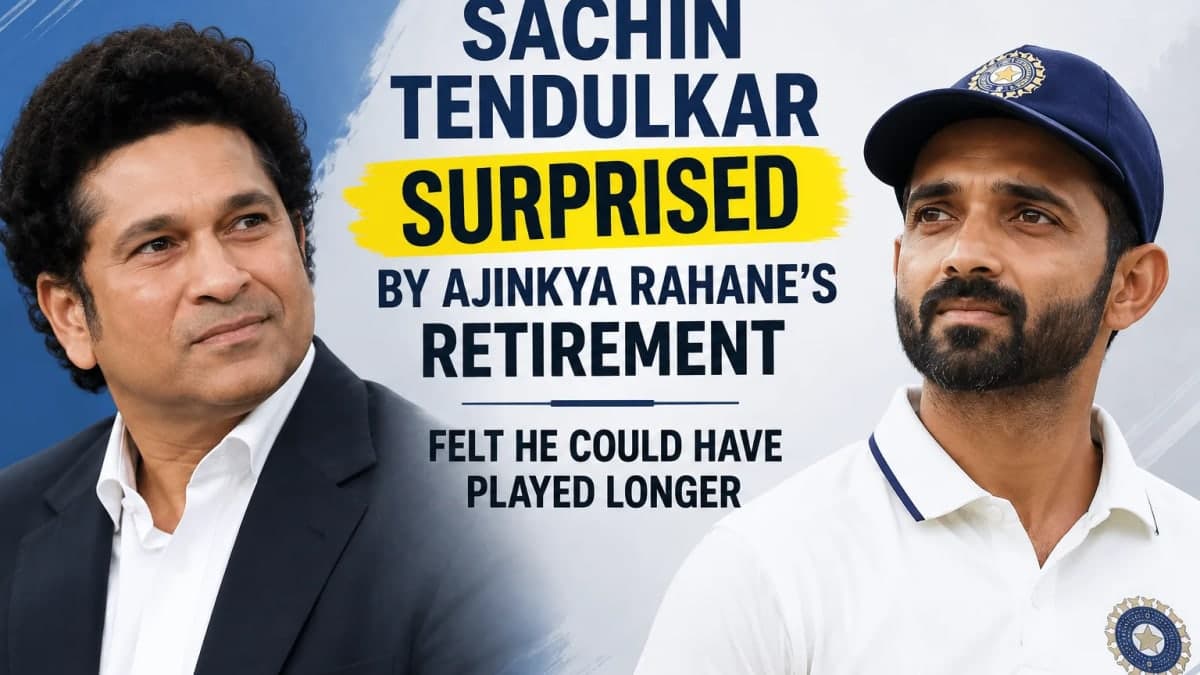
Ajinkya Rahane Reveals Sachin Tendulkar’s Reaction to Retirement
Ajinkya Rahane’s decision to bring the curtain down on his cricket career surprised many followers of Indian cricket, and Sachin Tendulkar apparently felt Rahane still had more cricket left in him.
Rahane announced his retirement on July 30, 2026. Speaking about the response he received afterward, the former India batter revealed that Tendulkar was the first person to call him.
According to Rahane, Tendulkar indicated that he had expected the experienced batter to continue playing for longer. Rahane, however, explained that he felt the time was right to move on and did not want to unnecessarily prolong his career.
The exchange highlighted the mutual respect between two cricketers closely associated with Mumbai and Indian cricket.
Rahane Wanted to Leave at the Right Time
For professional athletes, deciding when to retire can be as difficult as establishing themselves at the highest level.
Rahane's comments suggest that his decision was based on his personal assessment of where he stood in his career rather than an attempt to wait indefinitely for another opportunity.
By choosing retirement, Rahane effectively drew a line under a lengthy playing journey that included major assignments for India, leadership responsibilities and several memorable performances away from home.
His explanation also provides context to why the announcement may have surprised Tendulkar. Even as opportunities at international level became limited, Rahane remained an experienced figure with years of top-level cricket behind him.
Tendulkar’s Call Highlights Their Mumbai Cricket Connection
The fact that Tendulkar contacted Rahane immediately after the announcement carries particular significance because both players emerged through Mumbai's highly competitive cricket system.
Tendulkar became the defining figure of Indian batting across generations, while Rahane later established his own identity as a technically disciplined batter who often delivered important performances in demanding overseas conditions.
Their careers also briefly overlapped at Test level. Rahane made his Test debut in 2013, the same year Tendulkar concluded his international career.
Tendulkar's belief that Rahane could have continued longer can therefore be viewed as recognition of the younger batter's ability and experience.
Messages From Former India Teammates
Rahane also received messages and calls from several prominent cricketers following his retirement announcement.
The response demonstrated the relationships he built during his years in the Indian dressing room and reflected the respect he earned among teammates and senior players.
Beyond individual statistics, Rahane's career became closely associated with composure, team-first cricket and his willingness to perform different responsibilities depending on what India required.
Rahane’s Leadership Remains an Important Part of His Legacy
Rahane's contribution to Indian cricket cannot be assessed only through batting numbers.
One of the defining chapters of his career came through leadership. His calm approach as captain became particularly significant during challenging overseas assignments, strengthening his reputation as a player capable of handling pressure.
His understated personality also distinguished him in an era increasingly shaped by aggressive on-field expression and intense public attention.
Rahane rarely relied on theatrics. Instead, his cricketing identity was built around preparation, technique and a measured temperament.
Why Sachin Tendulkar’s Reaction Matters
Tendulkar's surprise offers another perspective on Rahane's retirement.
From the outside, retirement decisions are often judged through age, recent performances or selection prospects. For the player involved, however, the calculation can be considerably more personal.
Rahane's decision suggests he valued ending his career with clarity rather than allowing uncertainty over future opportunities to dictate how long he continued.
Tendulkar's reaction, meanwhile, indicates that respected figures within the game still believed Rahane possessed the ability to extend his playing career.
Both perspectives can coexist: a player may still be capable of competing while also deciding that the moment has arrived to move forward.
Balanced Analysis: A Retirement Based on Timing, Not Just Ability
Rahane's departure represents an increasingly familiar dilemma in modern cricket.
Experienced players must balance form, physical demands, selection competition and their own motivation while younger cricketers push for opportunities. Continuing longer can provide another chance for success, but it can also leave established players waiting for opportunities that may never arrive.
Rahane appears to have chosen certainty.
That does not necessarily mean he had nothing more to offer. Tendulkar's response suggests the opposite. Instead, Rahane's explanation indicates that he wanted control over the final chapter of his career.
Ultimately, retirement remains an intensely personal decision. Rahane's choice may have surprised Tendulkar and others, but it also fits the composed approach that characterised much of his time in cricket.
This article is based on reporting published by Hindustan Times.


