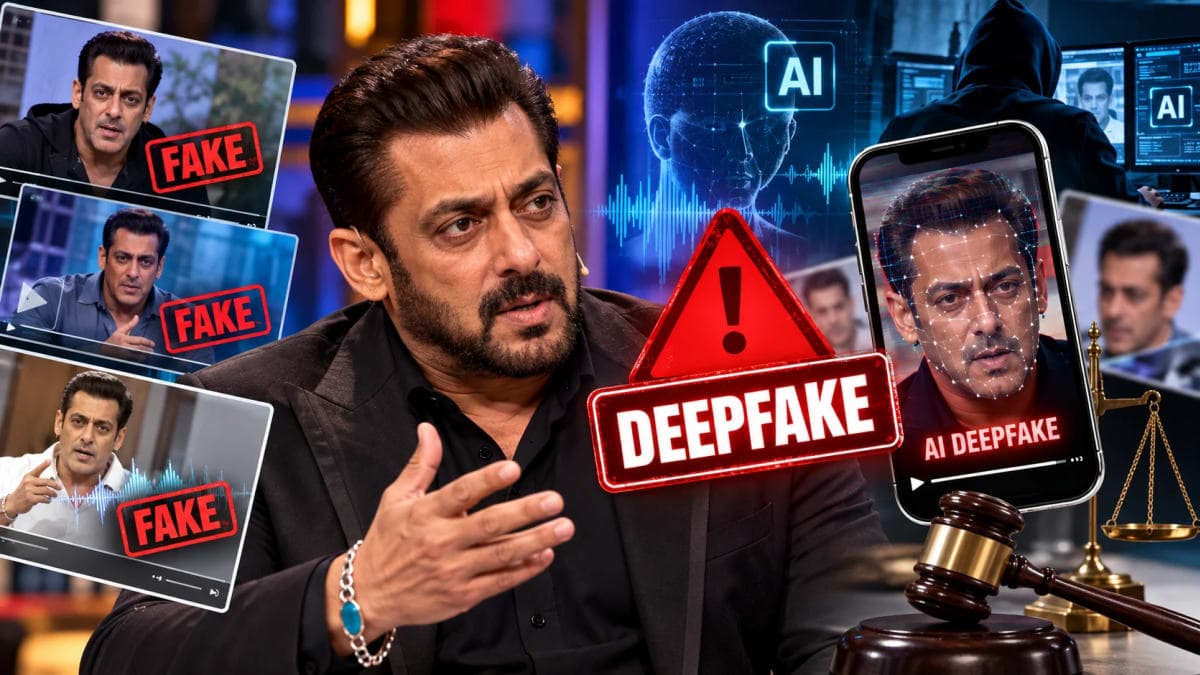
Bollywood actor Salman Khan has spoken out about the growing misuse of artificial intelligence to create fake videos and manipulated voice recordings, warning that increasingly convincing synthetic content could damage reputations and mislead social-media users.
During the September 27 episode of Bigg Boss 20 Weekend Ka Vaar, Khan said he had himself appeared in AI-generated videos and argued that people who knowingly manufacture deceptive content should face legal consequences. His comments were reported by NDTV, India Today, The Times of India and other publications on September 28.
Salman Khan Calls AI Manipulation ‘Very Scary’
Khan raised the issue while discussing online trolling and how technology can be used to make someone appear to say something they never actually said.
He specifically highlighted AI-generated videos and voice cloning, where a person's voice can be digitally reproduced and inserted into fabricated content.
“Someone made an AI video, or did AI voice dubbing; that is wrong. AI has progressed so much that it's very scary. It's a very serious thing.”
Khan added that manipulated material featuring numerous people was circulating online and said that he too had appeared in AI-generated videos.
Why Khan Says Deepfakes Can Mislead Viewers
One of the distinctions Khan made was between people who unknowingly encounter or share synthetic content and those who intentionally create deceptive material.
A social-media user, he suggested, could see a convincing fabricated clip and mistakenly believe that the person shown actually performed the depicted action or made the statement.
His stronger criticism was directed at people who knowingly create fake AI content.
Khan said:
“Now those kinds of people should be put behind bars.”
He argued that enforcement against deliberate creators could act as a deterrent and called for a law addressing such misuse.
The call for imprisonment and social-media controls represents Khan's stated position, rather than a description of the legal consequence that automatically applies to every AI-generated video.
‘There Has to Be Censorship on Social Media’
Khan also advocated tighter controls on social-media content.
“There has to be a law that needs to be passed, and there has to be censorship on social media.”
He added that he intended to take the issue “very seriously.”
The actor's comments should not be interpreted as opposition to AI-generated content in general. His remarks specifically focused on deceptive or manipulated videos and audio that falsely attribute actions or statements to real people.
That distinction matters because synthetic media can also have legitimate uses in entertainment, accessibility and creative production when its use is authorised and transparent.
Concern Goes Beyond Celebrities
Khan also drew attention to how deepfakes could affect people who do not have the resources available to prominent public figures.
According to Hindustan Times, he said celebrities can approach cyber cells and attempt to identify the origin of manipulated content, while ordinary people targeted by similar material may have greater difficulty obtaining assistance. He warned that such fabricated material could affect victims and their families.
This adds another dimension to the debate: deepfake misuse is not solely a celebrity-image issue. The same underlying technology can potentially be used for impersonation, harassment, misinformation and fraudulent endorsements.
Celebrity Deepfakes Are Becoming a Wider Digital-Identity Issue
Khan's comments come amid broader concerns over unauthorised use of celebrity identities through generative AI.
Just days before his remarks, The Economic Times reported that Bengaluru-based ContentLens had launched an AI-powered system designed to detect unauthorised uses of celebrity faces, voices and other identifiers across social media. The report specifically highlighted deepfakes, fake endorsements and voice cloning as emerging challenges for celebrity identity rights.
That context shows why the problem extends beyond whether an individual viral video looks convincing. Generative AI can reproduce several elements of someone's identity—including their appearance and voice—making verification increasingly important before viewers share sensational clips.
What Social-Media Users Should Watch For
Khan's comments also highlight a practical challenge for audiences: seeing or hearing a familiar celebrity in a video is no longer sufficient proof that the recording is authentic.
For questionable clips, viewers can look for the original source, check whether the person or organisation involved has published the footage, examine credible news coverage and avoid reposting sensational material when its origin cannot be established.
A missing source does not automatically prove that a video is AI-generated, but it is a reason to avoid treating the material as verified.
Why Salman Khan’s Comments Matter
Khan's remarks bring a technical problem into a mainstream entertainment setting watched by a large audience.
Rather than discussing AI as an abstract future risk, he described a problem that already affects public figures: convincing videos and voices can be generated that depict people saying or doing things they did not actually say or do.
The larger question is therefore not whether generative AI should exist, but how platforms, regulators, creators and users distinguish legitimate synthetic media from deceptive impersonation while balancing safeguards with lawful expression.