Samsung SDS Expands Partnerships With OpenAI and Anthropic to Accelerate Enterprise AI Transformation
Samsung SDS is strengthening its ties with OpenAI and Anthropic as the Samsung Group IT services company looks to move enterprise customers beyond simply adopting artificial intelligence and toward redesigning business operations around the technology.
The company outlined the expanded partnerships at REAL Summit 2026 in Seoul on September 8, where CEO Lee June-hee presented Samsung SDS’s strategy for what the company calls AI Transformation, or “AX.”
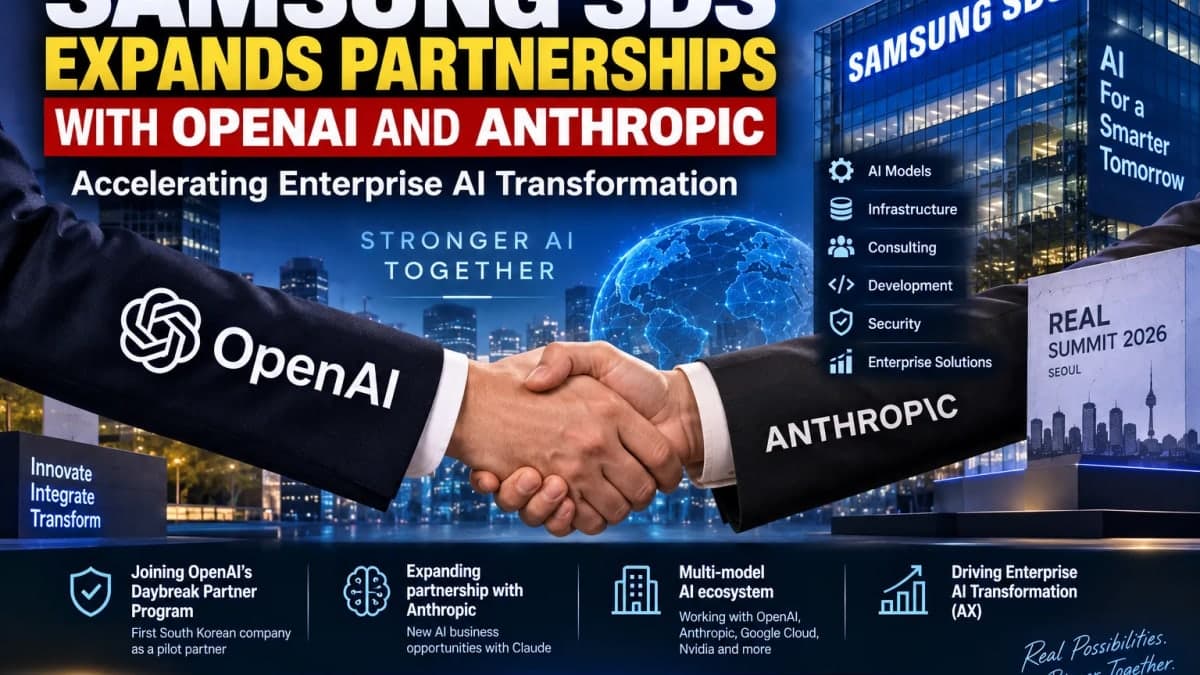
Among the most significant announcements, Samsung SDS said it will participate as a pilot partner in OpenAI’s Daybreak Partner Program. It is also expanding work with Anthropic following a strategic partnership established in July.
The moves place two of the world’s leading frontier AI developers at the centre of Samsung SDS’s broader effort to build an enterprise AI ecosystem spanning models, infrastructure, consulting, development and operations.
Samsung SDS Joins OpenAI’s Daybreak Partner Program
Samsung SDS said it will become the first South Korean company to participate as a pilot partner in OpenAI’s Daybreak Partner Program.
Daybreak is a cybersecurity initiative designed to bring frontier AI models into software security workflows. The partnership gives Samsung SDS an opportunity to use advanced AI capabilities in identifying and assessing software vulnerabilities.
The new collaboration builds on an existing relationship between the companies.
Samsung SDS signed a reseller partnership agreement with OpenAI in December 2025, which it described as the first such agreement in Korea. The company subsequently expanded its ChatGPT Enterprise business and strengthened cooperation around ChatGPT Edu.
Samsung SDS said its latest role in Daybreak also reflects the importance of security as enterprises deploy increasingly capable AI systems.
Anthropic Partnership Adds Claude to Samsung SDS’s AI Strategy
Samsung SDS is simultaneously deepening its relationship with Anthropic, the company behind the Claude family of AI models.
The two companies established a strategic partnership in July 2026, making Samsung SDS the first South Korean company to enter such an arrangement with Anthropic.
Their cooperation is expected to cover the identification of new AI transformation business opportunities by combining Anthropic’s AI technology with Samsung SDS’s enterprise expertise.
Samsung SDS previously said the partnership would include identifying new Claude-based businesses, cultivating Applied AI Engineers and expanding enterprise AI adoption.
The Anthropic agreement also broadens Samsung SDS’s ability to work across different AI model providers rather than tying its enterprise strategy to a single model ecosystem.
Samsung SDS Builds a Multi-Model AI Ecosystem
The OpenAI and Anthropic partnerships form part of a much larger network.
Samsung SDS says it is working with major technology companies including OpenAI, Anthropic, Google Cloud, Nvidia and Accenture as it develops an AI ecosystem covering models, infrastructure and enterprise implementation.
The company has previously described its multi-LLM approach as a competitive advantage because it allows customers to use models suited to their particular environments and requirements.
That strategy could become increasingly important as performance, pricing, security requirements and specialised capabilities continue to vary across frontier AI models.
For enterprise customers, the question is therefore shifting from simply gaining access to generative AI toward determining which models should handle particular workloads — and how multiple AI systems can be securely integrated into existing operations.
CEO Lee June-hee: AX Is About Redesigning Business
At REAL Summit 2026, Lee argued that companies need to think beyond deploying individual AI tools.
“AX is not simply about reducing time and costs. It means completely redesigning the way businesses and work are done from the ground up,” Lee said.
He summed up the distinction by saying: “AI changes the way we work, but AX changes the business.”
Samsung SDS cited research showing a substantial gap between corporate AI adoption and measurable financial impact. According to figures discussed at the summit, 88% of global businesses have introduced at least one AI system into their work processes, while only 6% reported that AI was making a meaningful contribution to profits.
Samsung SDS sees that gap as an opportunity for enterprise AI providers that can combine models with data preparation, process redesign, security and deployment expertise.
‘Client Zero’ Strategy Puts Samsung SDS’s Own Operations First
Samsung SDS is also following what it calls a “Client Zero” strategy.
Instead of taking newly developed AI transformation solutions directly to external customers, the company first deploys and validates them within its own operations.
Samsung SDS is building AX capabilities across seven major internal processes, including development, procurement and quality management. Successful approaches can then be adapted for customers.
The strategy effectively turns Samsung SDS into a testing environment for its own enterprise AI services before wider commercial deployment.
Expansion Goes Beyond Generative AI Into Robotics
The company’s AI ambitions are not limited to software.
Samsung SDS also announced plans to expand into robotics transformation, or RX, bringing AI-driven automation into physical manufacturing environments.
The company plans to introduce a robot orchestration platform beginning in 2027. The system is intended to connect production equipment and robots so they can be managed through centralised control.
Samsung SDS is initially targeting automation demand at manufacturing sites, including Samsung affiliates, while considering broader international expansion after validating the performance of general-purpose robots.
This gives its wider strategy two interconnected tracks: AX for transforming digital business processes and RX for applying AI-driven automation to physical operations.
Why the OpenAI-Anthropic Strategy Matters
Samsung SDS’s approach is notable because the company is building relationships with competing frontier-model providers instead of placing a single AI developer at the centre of its enterprise offering.
OpenAI brings the ChatGPT ecosystem and its frontier models, while Anthropic contributes its Claude platform and enterprise-focused AI capabilities. Samsung SDS adds infrastructure, implementation, security and experience managing large corporate IT environments.
The strategy could allow Samsung SDS to position itself as an intermediary between global AI model developers and South Korean enterprises that need those technologies integrated into complex existing systems.
What has been confirmed so far is an expansion of cooperation rather than exclusivity: Samsung SDS continues to maintain partnerships across a broader ecosystem that also includes Google Cloud, Nvidia and other technology companies.
As enterprise AI moves from experimentation toward deployment at scale, Samsung SDS is betting that access to multiple leading AI models — combined with consulting, infrastructure, cybersecurity and operational expertise — will give it a larger role in how companies implement the technology.