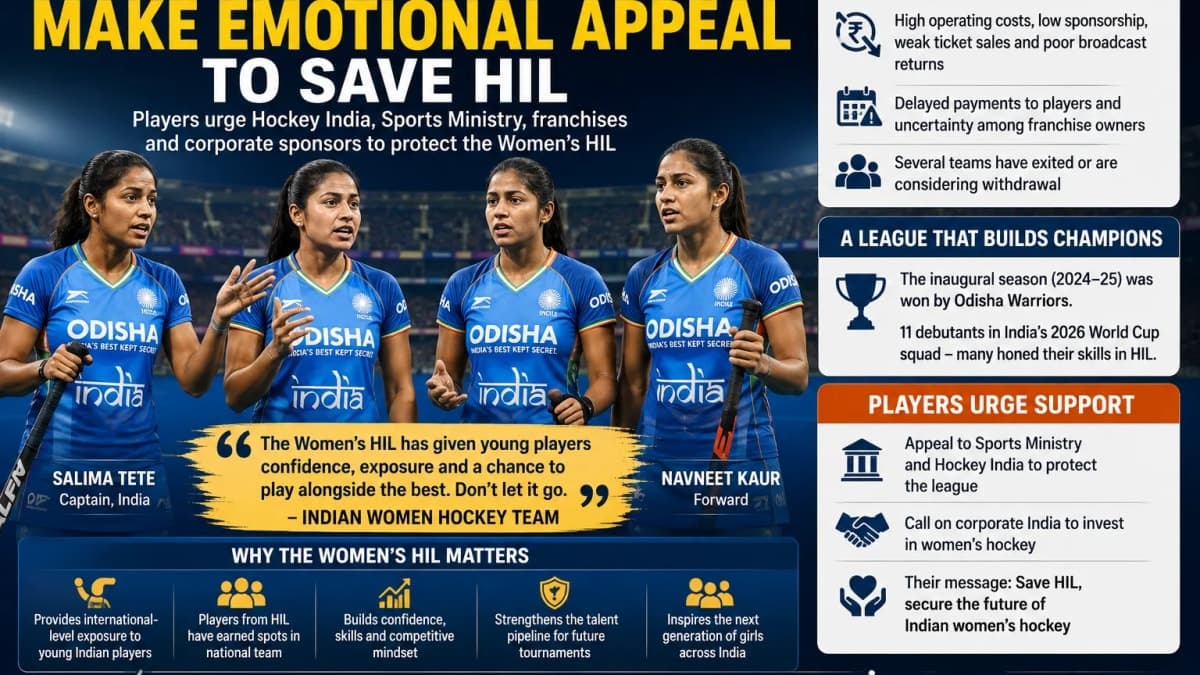
Indian Players Rally Behind Women's Hockey India League
At a moment when Indian women's hockey is demonstrating encouraging progress on the international stage, some of its leading players are worried that one of the structures helping create that progress could disappear.
Members of the Indian women's team have appealed to the Sports Ministry, Hockey India, franchises and corporate sponsors to ensure the survival of the Women's Hockey India League (HIL).
Their message is straightforward: the league is more than a domestic tournament.
For emerging Indian players, it provides competitive exposure that can be difficult to replicate through junior and senior national championships alone.
The players believe losing that platform now could weaken the pathway that connects promising domestic talent with the national team.
Why the Appeal Has Come Now
The timing makes the players' intervention particularly significant.
India's women's team has produced one of its strongest World Cup campaigns in decades.
The 2026 squad contains 11 World Cup debutants, demonstrating the extent to which a younger generation is becoming central to India's international plans.
India held Olympic silver medallists China to a 2-2 draw and suffered only one defeat during the relevant stage of the tournament, against Olympic champions the Netherlands.
A goalless draw with Australia ended India's semifinal hopes, but the team moved into the contest for fifth and sixth position.
A fifth-place finish would represent India's best Women's Hockey World Cup result in 52 years, since 1974.
Against that backdrop, players argue that dismantling an important domestic development platform would be particularly damaging.
Salima Tete Says HIL Expands India's Talent Pool
India captain Salima Tete has highlighted the connection between the league and the national-team pathway.
Several players who have impressed in HIL have subsequently received opportunities in national camps.
That pathway matters because elite international hockey demands qualities that cannot always be developed through domestic tournaments alone.
Players need to experience faster matches, tactical pressure and competition against athletes accustomed to international hockey.
The Women's HIL provides that environment by bringing Indian prospects into teams containing experienced domestic and overseas players.
For Salima, maintaining that structure is important if India wants to expand rather than narrow its pool of international-quality players.
Neha Points to Players Produced by the League
Veteran midfielder Neha, who captained Odisha Warriors to the inaugural Women's HIL championship in the 2024-25 season, has offered one of the clearest arguments for keeping the competition alive.
She pointed to emerging players such as Baljeet, Sakshi and Rutuja, who have progressed into India's World Cup setup after gaining league exposure.
Her argument focuses on competitive standards.
National championships remain important for identifying talent, but the HIL gives players an opportunity to experience a different level of hockey.
Young players suddenly find themselves sharing training sessions, tactical meetings and dressing rooms with established international athletes.
That environment can accelerate development in ways conventional domestic competitions struggle to reproduce.
Sakshi Rana: HIL Helped Build Confidence
Sakshi Rana represents the kind of player the league is designed to develop.
Her experience in HIL gave her the opportunity to play alongside established international names, including Dutch star Yibbi Jansen.
For a young athlete, that experience can change perceptions.
International stars stop appearing like distant figures seen only at major tournaments. They become teammates, training partners and opponents.
Sakshi has credited that exposure with improving her ability to handle pressure during the World Cup.
That psychological benefit may be one of HIL's most important contributions.
At international level, technical ability alone is not enough. Players must make decisions under intense pressure while facing opponents with significantly more experience.
Navneet Kaur Calls on Corporate India
Indian forward Navneet Kaur has taken the appeal beyond Hockey India.
She has urged India's corporate sector to support the women's league.
Her message reflects a persistent imbalance within Indian sport.
Cricket attracts enormous sponsorship, broadcasting and advertising investment, while many Olympic sports operate with substantially smaller commercial ecosystems.
Navneet's argument is that women's hockey does not require cricket-sized investment.
What players need is a stable professional platform that provides exposure, competition and financial opportunities.
She has also appealed directly to the Sports Ministry and Hockey India to protect the league.
The request comes amid reports that some franchises are withdrawing or reconsidering their involvement because of financial pressures.
Why Women's HIL Is in Financial Trouble
The players' concerns are rooted in difficult commercial realities.
The Women's HIL is reportedly dealing with several problems simultaneously:
high operating costs,
limited sponsorship revenue,
weak ticket income,
modest broadcast returns,
delayed player payments,
and uncertainty among franchise owners.
Franchise sources estimate that operating combined men's and women's HIL teams can cost approximately ₹10-12 crore, including administrative expenses.
For businesses evaluating their participation purely as an investment, the current economics can therefore be difficult to justify.
The women's franchise fee of approximately ₹2.5 crore has been removed for the third season, an attempt to reduce the financial burden.
But removing one fee does not solve the league's broader revenue challenge.
Franchise Instability Raises Bigger Concerns
The league has already experienced franchise disruption.
The inaugural women's competition featured Delhi SG Pipers, JSW Soorma Hockey Club, Shrachi Rarh Bengal Tigers and Odisha Warriors.
Odisha Warriors were later terminated amid issues involving unpaid player dues and franchise fees.
Ranchi Royals replaced them for the second season but were subsequently terminated as well, with reports indicating that Indian players were still awaiting payments.
Shrachi Rarh Bengal Tigers, finalists in the previous season, have also reportedly considered withdrawing because of financial pressure.
That creates a serious structural problem.
A professional league cannot become an effective talent pipeline if teams repeatedly enter and disappear.
Players, coaches and sponsors need predictable seasons and stable organisations to make long-term commitments.
Why HIL Matters for Young Indian Players
The biggest value of a professional league may not be measured by ticket revenue alone.
For young athletes, it creates a bridge between domestic hockey and international competition.
A promising teenager or early-career player can suddenly train with an Olympian or face one of the world's best players in a competitive match.
That experience can accelerate tactical understanding.
It can improve physical preparation.
It can expose weaknesses before a player reaches international competition.
Most importantly, it can make national selectors aware of athletes who might otherwise take longer to emerge.
Players including Ishika, Sakshi, Shilpi Dabas and Lalthanluangi reached India's World Cup squad after strong HIL performances, illustrating how the league can function as a talent-identification platform.
Playing With International Stars Changes the Mindset
Navneet Kaur has highlighted another benefit: removing fear.
Young Indian players who have previously trained and competed alongside major international stars are less likely to be intimidated when they meet them at a World Cup or Olympic tournament.
That familiarity matters.
At the highest level, small psychological advantages can influence performance.
A player who believes she belongs on the same field as an Olympic champion is more likely to make aggressive decisions rather than play cautiously because of an opponent's reputation.
The league effectively gives Indian players repeated exposure to that environment before they enter major international tournaments.
India's World Cup Performance Strengthens the Players' Case
The players' appeal would carry weight at any time.
Making it during one of India's strongest Women's World Cup campaigns in decades gives it considerably more significance.
India's young squad has demonstrated that the national team possesses emerging depth.
The question is whether the system can continue producing players capable of sustaining that progress.
A successful national team requires more than a strong starting eleven.
Injuries, retirements, form and competition for places mean elite teams need a large pool of players capable of stepping into international hockey.
That is exactly the type of depth Salima Tete believes the Women's HIL can help build.
The Commercial Argument Cannot Be Ignored
The players' case is powerful, but franchise concerns are also legitimate.
Professional sports leagues cannot survive indefinitely on emotion alone.
Owners must pay players, coaches, staff, travel expenses, venue costs and administrative charges.
If sponsorship, broadcasting and ticket income consistently fail to cover a meaningful portion of those expenses, private investors will eventually question whether participation makes financial sense.
That does not necessarily mean the Women's HIL should disappear.
It means the business model may require restructuring.
Possible solutions could include lower operating costs, stronger central sponsorship, improved broadcasting arrangements, more efficient scheduling and closer cooperation between Hockey India and corporate partners.
Women's Hockey Faces a Familiar Sports-Economics Problem
The debate reflects a problem seen across women's professional sport worldwide.
A league needs investment to develop players and build audiences.
But investors often want established audiences before committing significant money.
That creates a cycle that can be difficult to break.
Without investment, production quality, marketing and player development remain limited.
Without those improvements, audiences and sponsors may grow slowly.
Women's HIL therefore needs enough financial runway to build an audience rather than being judged exclusively on immediate profitability.
At the same time, league administrators need to demonstrate a credible path toward commercial sustainability.
Both realities can be true.
Corporate India Could Determine What Happens Next
Navneet's appeal to corporate houses may ultimately be critical.
India has a rapidly expanding sports sponsorship market, but the overwhelming commercial dominance of cricket means Olympic disciplines compete for a much smaller pool of money.
Women's hockey offers companies something different.
India's national team has an established international profile, Olympic history and a growing group of recognisable athletes.
Companies interested in women's sport, grassroots development or Olympic success could potentially use HIL as a long-term branding platform.
But attracting such investment will require consistent scheduling, strong broadcast distribution and confidence that the league will continue operating.
Sponsors are less likely to make multi-year commitments if the competition's existence itself remains uncertain.
Saving HIL Is About More Than One Season
The players' appeal is ultimately about the structure beneath the national team.
International success tends to attract attention during World Cups and Olympics.
Development happens in the years between those tournaments.
A sustainable professional league can provide competitive matches, coaching, income, visibility and opportunities during that less glamorous period.
For established players, HIL offers elite competition.
For younger players, it offers a route into the national setup.
For aspiring girls watching from outside the sport, it can demonstrate that women's hockey has a professional future.
That broader ecosystem is difficult to recreate once lost.
A Critical Moment for Indian Women's Hockey
Indian women's hockey appears to be approaching an important crossroads.
On the field, a young national team is showing signs of progress and could record its strongest World Cup finish in more than half a century.
Off the field, the domestic league credited by players with helping create that progress is struggling financially.
That contrast explains the urgency behind the players' appeal.
The question is not whether the Women's HIL has sporting value. The testimony of players benefiting from it provides substantial evidence that it does.
The harder question is how that sporting value can be converted into a financially sustainable competition.
Hockey India, government institutions, franchises, broadcasters and corporate sponsors will all have a role in answering it.
For India's players, however, the message is already clear:
Do not allow a league that is beginning to produce results to disappear before Indian women's hockey discovers how far it can go.
This article is based on reporting published by TOI.


