Indian Stock Market Opens Under Pressure
Indian benchmark indices traded lower on Tuesday as investors reacted cautiously to another increase in international crude oil prices.
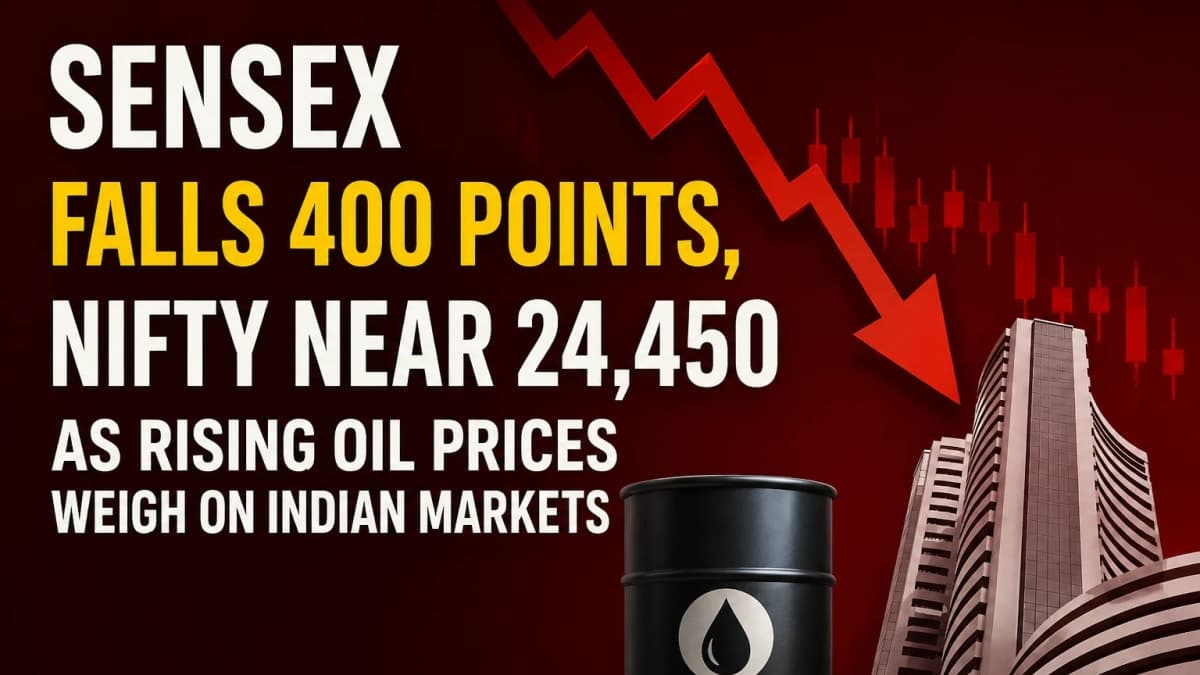
The Sensex dropped around 400 points during trade, while the Nifty slipped towards 24,450, reflecting weaker risk appetite across the domestic market.
The decline followed a largely flat session on Monday, when gains in selected heavyweight stocks were offset by concerns surrounding crude oil and geopolitical uncertainty.
Rising Crude Oil Prices Put Investors on Alert
The biggest source of pressure was the renewed strength in oil prices.
Global crude prices climbed amid uncertainty surrounding US-Iran negotiations and developments affecting the Strait of Hormuz, a strategically important route for global energy supplies. Brent crude was trading around the $88-per-barrel level on Tuesday.
For India, a sustained increase in crude prices carries particular significance because the country relies heavily on imported energy.
More expensive oil can increase India's import bill and potentially put pressure on inflation, the current account and the rupee. It can also raise input and transportation expenses for companies, creating concerns about profit margins in sectors that are sensitive to fuel and raw-material costs.
Rupee Weakness Adds to Market Concerns
Currency-market movements also contributed to the cautious mood.
The Indian rupee weakened against the US dollar as a stronger dollar and higher crude prices increased pressure on the currency.
A combination of a weaker rupee and expensive crude can be particularly challenging because international oil purchases are generally priced in dollars. If both factors persist, the effective cost of energy imports can rise further.
Global Uncertainty Keeps Risk Appetite in Check
Indian equities were also navigating a mixed global environment.
Asian markets showed a cautious trend as investors assessed higher energy prices and waited for important US inflation data. Expectations surrounding inflation and future Federal Reserve policy remain important for global equities because changes in US interest-rate expectations can influence capital flows into emerging markets.
Geopolitical developments are another key variable. Any escalation that threatens energy supplies could keep crude prices elevated and increase volatility across stocks, currencies and commodities.
Why Higher Oil Prices Matter for India
The connection between crude oil and Indian equities extends beyond energy companies.
Higher crude prices can influence transportation, aviation, paints, chemicals, logistics and several manufacturing businesses through higher operating or raw-material costs.
At the broader economic level, persistent energy inflation could complicate the outlook for consumer prices and potentially reduce the flexibility available to policymakers.
However, the eventual impact depends heavily on how long oil prices remain elevated. A temporary spike may have a limited effect, while a prolonged period of expensive crude could create more meaningful pressure on inflation and corporate profitability.
Is the Market Decline a Sign of a Bigger Correction?
A roughly 400-point decline in the Sensex does not by itself establish the beginning of a prolonged market correction.
The current weakness reflects a combination of immediate global risks and investor caution rather than a single domestic trigger. Markets can also recover quickly if crude prices retreat or geopolitical tensions ease.
At the same time, continued increases in oil prices could keep volatility elevated, particularly if accompanied by sustained rupee weakness or deterioration in global risk sentiment.
Investors are therefore likely to watch energy markets closely before taking aggressive positions.
What Investors Will Watch Next
Crude oil prices are likely to remain one of the most important near-term indicators for Indian equities. Developments surrounding the Middle East and the Strait of Hormuz could influence whether the latest oil-price increase proves temporary or develops into a longer-lasting problem.
Investors will also track the rupee, foreign institutional flows and upcoming US inflation data for clues about the direction of global monetary policy.
Domestic corporate earnings and sector-specific developments will meanwhile determine whether individual stocks can withstand the broader market uncertainty.
Balanced Analysis
The latest decline highlights India's sensitivity to sudden changes in global energy prices. Higher crude can simultaneously affect inflation expectations, currency markets and corporate costs, giving investors several reasons to become defensive.
Still, short-term market volatility should be distinguished from a fundamental deterioration in the domestic equity outlook. If oil prices stabilise and geopolitical tensions ease, some of the pressure currently affecting sentiment could fade.
Conversely, a sustained energy-price shock would present a more difficult environment and could force investors to reassess earnings expectations for oil-sensitive sectors.
For now, the Sensex's decline and the Nifty's move towards 24,450 indicate that markets are assigning greater importance to external risks, with crude oil once again becoming a central factor in India's market outlook.
This article is based on reporting published by Moneycontrol.