Sensex Enters Its Weakest Two-Year Stretch Since 2012
India's equity market is going through one of its most prolonged periods of underperformance in more than a decade.
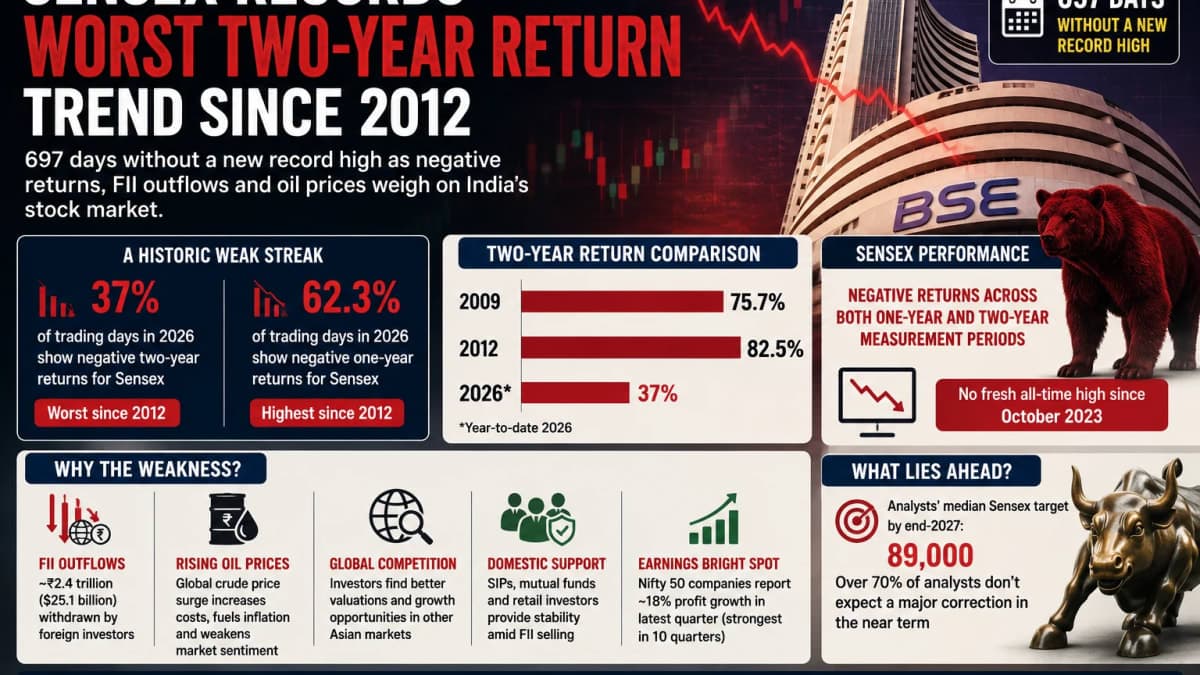
An analysis published on August 25 found that the BSE Sensex recorded negative two-year returns on 37% of trading days in 2026, the highest proportion since 2012. The benchmark has also produced negative returns across both the one-year and two-year measurement periods, highlighting how persistent the slowdown has become.
The figures are significant because Indian equities have historically rewarded investors over longer holding periods despite frequent short-term corrections.
This time, however, weakness has persisted long enough to challenge that pattern.
697 Days Without a New Record High
Perhaps the most striking measure of the slowdown is the length of time the market has spent below its previous peak.
As of August 25, the Sensex had gone 697 days without establishing a fresh all-time high.
That does not mean the index has fallen continuously for almost two years. Markets have experienced recoveries, corrections and periods of consolidation during that time.
Instead, the statistic demonstrates how difficult it has been for the benchmark to generate enough sustained momentum to move decisively beyond its previous record.
For investors accustomed to India's strong post-pandemic equity rally, that represents a major change in market behaviour.
One-Year Returns Show Even Greater Weakness
The shorter-term statistics underline the extent of the pressure.
In 2026, 62.3% of Sensex trading sessions have produced negative one-year returns, according to the same analysis.
That is higher than the 59% recorded in 2012, 58.3% in 2016 and 47.6% in 2008.
The comparison with 2008 requires caution. Today's economic and financial environment is very different from the global financial crisis.
Nevertheless, the data demonstrate how unusual the current period of weak rolling returns has become.
2026 Is Weak, but It Is Not 2012
The headline comparison with 2012 can sound dramatic, but historical context is important.
In 2012, approximately 82.5% of Sensex trading sessions showed negative two-year returns. The comparable figure in 2026 is 37%.
The figure was even higher in 2009, at 75.7%.
Therefore, saying the Sensex is experiencing its "worst two-year return trend since 2012" does not mean current conditions are equally severe.
It means 2026 has produced the highest proportion of negative two-year return days recorded since that period.
That distinction provides investors with a more accurate picture of the market.
Foreign Investors Have Turned More Cautious on India
Foreign capital flows have become an important part of the story.
A Reuters poll published on August 26 found that India's equity-market outlook had been downgraded for a third consecutive quarter. Indian shares were down more than 7% for the year at the time of the poll, while foreign investors had withdrawn roughly ₹2.4 trillion ($25.1 billion).
Foreign investors have increasingly found alternatives elsewhere in Asia, including markets offering lower valuations or greater exposure to the artificial-intelligence investment cycle.
That shift matters because foreign institutional investors can influence large-cap Indian equities significantly when capital moves rapidly across markets.
India's Valuation Premium Faces a Test
For years, investors have been willing to pay relatively high valuations for Indian equities because of expectations surrounding economic growth, corporate profitability, demographics and domestic consumption.
But strong fundamentals do not automatically guarantee strong stock-market returns.
When valuations are already elevated, companies need to deliver sufficiently strong earnings growth to justify those prices.
If earnings expectations weaken—or other Asian markets begin offering similar growth at lower valuations—international investors may shift capital.
The current market slowdown therefore represents more than a simple correction. It is also testing how much premium global investors are willing to pay for India's long-term growth story.
Oil Prices Have Added Another Layer of Pressure
Energy prices have also complicated the outlook.
India imports a large proportion of the crude oil it consumes, meaning sustained increases in international oil prices can affect inflation, corporate costs, government finances and the rupee.
Recent geopolitical tensions pushed oil prices higher and contributed to weaker risk appetite. During the week ending August 21, both major Indian benchmarks recorded losses as higher crude prices and global bond yields weighed on markets.
Conversely, falling oil prices can quickly improve sentiment. On August 26, Indian equities initially rose as crude prices declined amid optimism surrounding the Strait of Hormuz, although those gains were later erased and the Sensex closed 183 points lower.
This sensitivity shows why global energy developments remain particularly important for Indian equities.
Domestic Investors Are Providing an Important Cushion
The market's weakness could have been more severe without continued participation from domestic investors.
Systematic investment plans, mutual funds and other domestic institutions have become an increasingly important source of equity demand.
Reuters reported that resilient domestic investment flows are helping cushion the impact of foreign selling.
This structural change distinguishes today's Indian market from earlier periods when foreign institutional flows had an even greater influence over index direction.
Domestic participation cannot eliminate volatility, but it can provide a stabilising source of capital during periods when global investors reduce exposure.
Corporate Earnings Offer a More Positive Signal
Not every indicator is negative.
Despite weak equity-market performance, Reuters reported that Nifty 50 companies recorded around 18% profit growth in the latest reported quarter, the strongest pace in ten quarters.
That creates an interesting divergence.
Share prices have struggled, but underlying corporate profitability has shown improvement.
If earnings continue strengthening while stock prices remain subdued, valuations could eventually become more attractive.
However, investors will need to determine whether recent earnings momentum can survive external pressures such as energy costs, global interest rates and geopolitical uncertainty.
Could the Sensex Recover?
There are reasons for cautious optimism, but predicting the timing of a market recovery remains difficult.
A Reuters survey of 28 analysts conducted between August 13 and August 26 produced a median forecast of 89,000 for the Sensex by the end of 2027. More than 70% of respondents also said they did not expect a major correction in the coming months.
Forecasts, of course, are not guarantees.
A sustainable recovery would likely require some combination of stronger corporate earnings, easing foreign selling, more attractive valuations, stable oil prices and improved global investor sentiment.
What the Long Market Lull Means for Investors
Periods of weak rolling returns can be psychologically difficult because investors experience neither a dramatic crash nor a convincing bull market.
Instead, markets can spend extended periods moving sideways while individual sectors and companies behave very differently.
That makes stock selection, valuation and risk management increasingly important.
It also means the headline Sensex performance may not fully represent what is happening underneath the index. Some companies can continue producing strong earnings and shareholder returns even while the broader benchmark struggles.
India's Growth Story Faces a Market Reality Check
The Sensex's weakest two-year return pattern since 2012 does not necessarily signal the end of India's long-term equity story.
India continues to possess structural advantages, including a large domestic economy, expanding consumer demand, digitalisation and significant infrastructure investment.
But markets price expectations rather than economic growth alone.
The prolonged period without a record high demonstrates that strong economic narratives must eventually translate into corporate earnings and valuations that investors consider attractive.
For now, India's benchmark indices remain caught between resilient domestic fundamentals and a challenging global investment environment.
Whether the 697-day record-high drought becomes the foundation for the next major market cycle—or extends into an even longer period of consolidation—will depend heavily on earnings, oil prices, foreign capital and the relative attractiveness of India compared with other global markets.
This article is based on reporting published by The Economic times.