Indian Stock Market Rebounds After Prolonged Selling
Indian benchmark indices returned to positive territory on Thursday, August 20, as investors stepped back into equities following a sustained period of selling.
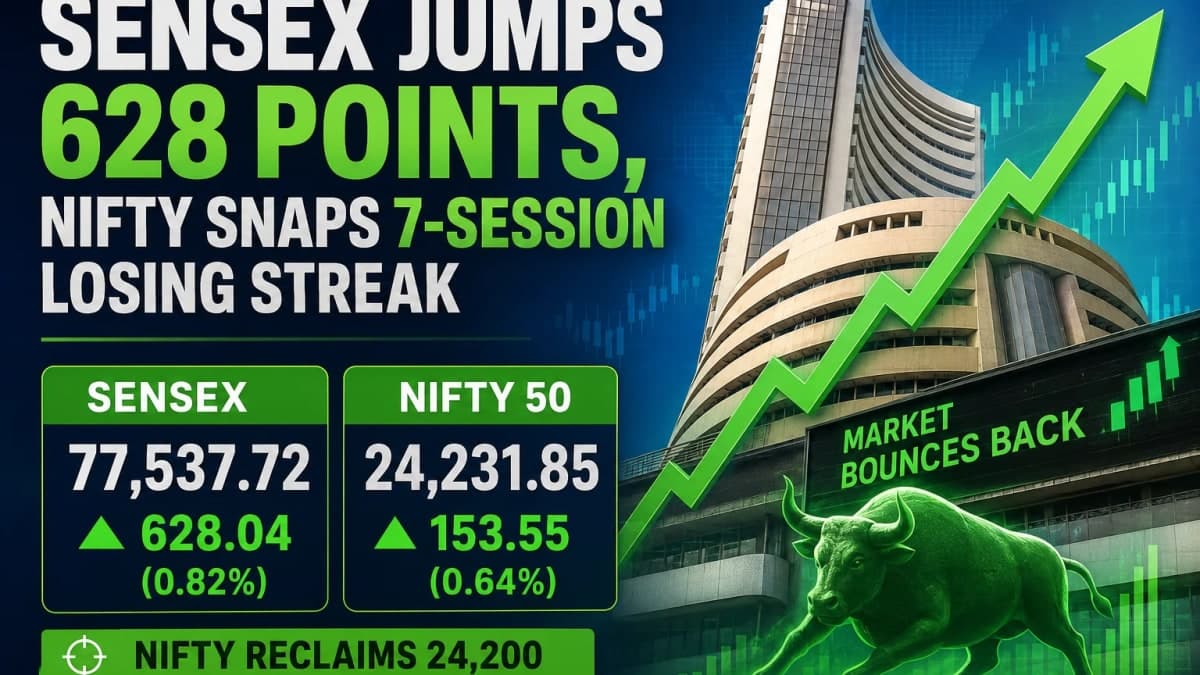
The BSE Sensex gained 628.04 points, or 0.82%, to close at 77,537.72, while the Nifty 50 advanced 153.55 points, or 0.64%, to finish at 24,231.85. The move took the Nifty back above the psychologically important 24,200 level and ended its seven-session losing run.
The Sensex, meanwhile, recovered after four consecutive sessions of declines. The rebound offered investors some relief following a period in which concerns over global bond yields, crude oil prices and geopolitical uncertainty had weighed heavily on sentiment.
What Drove the Sensex and Nifty Higher?
One of the major catalysts came from overseas bond markets. Investor concerns eased after the U.S. Treasury announced plans to increase buybacks of longer-duration government debt, helping stabilise bond markets and reduce some of the pressure from elevated yields.
Higher government bond yields can make fixed-income assets relatively more attractive and can put pressure on equity valuations, particularly in emerging markets. Therefore, an easing in yield-related concerns helped improve global risk appetite and supported Indian stocks.
Domestic buying also became more broad-based as investors returned to sectors that had come under pressure during the recent decline.
IT and Financial Stocks Support Recovery
Technology and financial shares played an important role in Thursday's advance. Fourteen of the 16 major sectoral indices ended higher, while the Nifty IT index gained around 0.8% and financial stocks advanced about 0.7%.
Heavyweights including Bharti Airtel, ICICI Bank and HDFC Bank also contributed positively to the Nifty's performance.
Realty stocks were another strong pocket of the market, with the Nifty Realty index rising nearly 2%. The participation of several sectors suggests that Thursday's gains were not restricted to only a small group of heavyweight companies.
Broader Markets Join the Rally
The recovery extended beyond the headline indices.
Small-cap stocks gained around 0.7%, while mid-cap shares advanced approximately 0.4%, reflecting an improvement in sentiment across a wider portion of the market.
The rupee also recovered, snapping a three-session losing streak and closing around ₹95.71 against the U.S. dollar, adding another supportive signal for domestic market sentiment.
Why the Seven-Day Losing Streak Matters
The Nifty's seven-session slide had been its longest losing streak in roughly 11 months. During that period, the index lost about 2.1%, as rising crude oil prices and elevated global bond yields increased pressure on Indian equities.
India is particularly sensitive to sharp increases in crude prices because the country imports a large share of its energy requirements. Higher oil prices can raise inflation risks, increase corporate input costs and put pressure on the rupee.
At the same time, rising yields in major developed markets can reduce the relative appeal of emerging-market assets.
Thursday's rebound therefore represents an important interruption of that negative momentum, although one positive session alone does not necessarily establish a sustained upward trend.
Is This the Beginning of a Bigger Market Recovery?
The return of broad-based buying is encouraging for investors, especially after several consecutive sessions of weakness. Stabilisation in global bond markets could provide additional support if yields remain under control.
However, several risks remain.
Crude oil prices and geopolitical developments continue to be important variables for Indian markets. Foreign investor flows, currency movements and global interest-rate expectations could also influence whether the recovery extends into coming sessions.
From a technical perspective, the Nifty is approaching resistance around the 24,290–24,320 region, while the 24,100–24,130 area is being watched as an important near-term support zone.
A sustained move above resistance could strengthen confidence in the rebound, while renewed selling below support could indicate that volatility is not yet over.
Balanced Analysis
Thursday's rally is significant because it interrupted a prolonged sequence of losses and brought participation from IT, financials, realty and broader-market stocks.
Still, investors may need more evidence before interpreting the move as the start of a durable market reversal.
Much of the recovery was connected to improving global cues and easing bond-market pressure. If those conditions reverse—or crude oil and geopolitical risks intensify—Indian equities could again face volatility.
For now, the session has shifted short-term sentiment away from persistent selling and demonstrated that investors remain willing to buy after meaningful market corrections.