हिंदी में पढ़ें —JantaScope हिंदी
Finance

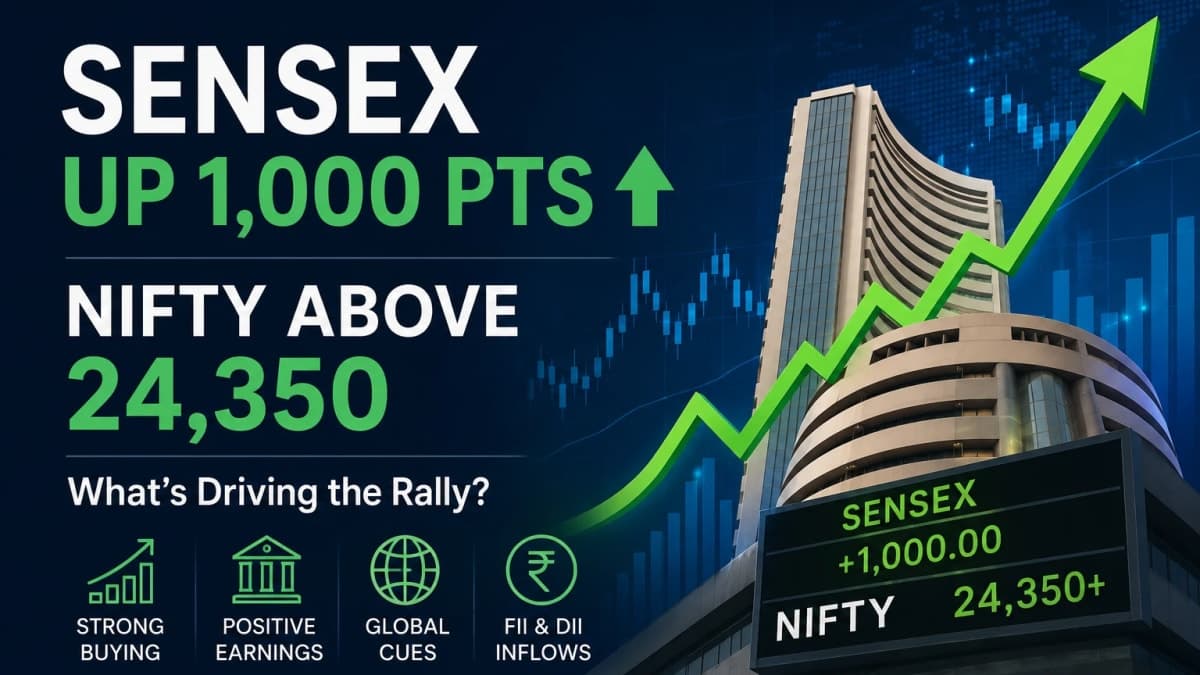
Sensex Surges Over 1,000 Points Intraday as Nifty Crosses 24,350: Factors Behind the Market Rally

Indian benchmark equity indices witnessed strong buying during the trading session, with the BSE Sensex climbing more than 1,000 points intraday while the NSE Nifty moved above the 24,350 mark. The rally reflected broad-based investor optimism supported by positive corporate earnings, buying across key sectors, and encouraging domestic and global market cues. Analysts note that market movements continue to be influenced by multiple economic and financial factors.

Sensex Surges Over 1,000 Points Intraday as Nifty Crosses 24,350: Factors Behind the Market Rally

By Jeet Nirmal

Source: Janta Scope

Indian benchmark indices staged a strong rally during intraday trading, with the BSE Sensex advancing by more than 1,000 points while the NSE Nifty climbed above the 24,350 mark. The gains reflected improved investor sentiment as buying emerged across several heavyweight sectors, helping the broader market trade firmly in positive territory.

One of the key drivers of the rally was sustained buying in information technology, banking, financial services, and select large-cap companies. Positive quarterly earnings announcements from several listed firms encouraged investors to increase exposure to equities, supporting momentum throughout the trading session.

Market participants also remained optimistic due to favourable global cues, improving risk appetite, and expectations of steady economic growth. International market performance, easing concerns in some overseas markets, and stable macroeconomic indicators contributed to positive sentiment among domestic investors.

Institutional investors continued to play an important role in supporting the rally. Buying activity by Domestic Institutional Investors (DIIs), along with improving participation from Foreign Institutional Investors (FIIs), helped strengthen liquidity and boosted confidence in the market.

Another factor supporting equities was continued optimism around India's long-term economic outlook. Infrastructure spending, digital transformation, healthy corporate balance sheets, and resilient domestic demand have continued to provide confidence to investors despite periodic market volatility.

Analysts believe that strong corporate earnings remain one of the most significant catalysts for market performance. Companies delivering better-than-expected financial results often improve investor confidence and encourage fresh investments across related sectors.

Despite the impressive rally, market experts caution that short-term fluctuations remain a normal part of equity investing. Factors such as global interest-rate decisions, inflation trends, crude oil prices, geopolitical developments, currency movements, and future earnings announcements could continue influencing market direction in the coming weeks.

Financial advisors generally recommend that investors focus on long-term wealth creation, diversified portfolios, and fundamentally strong companies instead of reacting to daily market swings. While sharp gains often improve sentiment, disciplined investment strategies remain important during both rising and volatile markets.

As trading progresses, investors will continue monitoring additional earnings releases, economic indicators, and global developments, all of which are expected to influence the direction of the Sensex and Nifty in upcoming sessions.

Related

More stories

India’s Q2 Economic Indicators Signal Strong Momentum Ahead of Festive Season

India ended the July-September quarter with encouraging signals across manufacturing, industrial production, tax collections, digital payments and parts of the automobile market. The data point to resilient economic activity ahead of the festive season, although inflation, energy costs and uneven rural-facing demand remain important risks.

Finance

India’s Q2 Economic Indicators Signal Strong Momentum Ahead of Festive Season

India-US Trade Deal Not Imminent, USTR Says as Negotiations Enter Final Stretch

India and the United States are continuing negotiations on a bilateral trade agreement, but an immediate breakthrough should not be expected, US Trade Representative Jamieson Greer said. His comments came after discussions with Indian Commerce and Industry Minister Piyush Goyal at the G20 Trade Ministers’ Meeting in Milwaukee. Both sides say negotiations are progressing, although unresolved issues remain.

Finance

India-US Trade Deal Not Imminent, USTR Says as Negotiations Enter Final Stretch

Finance Ministry Sees India’s Q2 FY27 GDP Growth at 7.3%, but Global Risks Cloud Outlook

India’s Finance Ministry expects real GDP to grow around 7.3% in the July–September quarter of FY27, extending the economy’s strong start to the fiscal year. The estimate is notably above the Reserve Bank of India’s 6.4% projection for the quarter, although the ministry has warned that oil prices, trade uncertainty and tighter global financial conditions remain important risks

Finance

Finance Ministry Sees India’s Q2 FY27 GDP Growth at 7.3%, but Global Risks Cloud Outlook

FPI Outflows Cross ₹1 Trillion in H1 FY27 as Global Pressures Weigh on Indian Markets

Foreign portfolio investors remained cautious toward Indian markets during the first half of FY27, with net selling reaching ₹1.29 trillion. Financial services, oil and gas, automobiles and telecom faced significant withdrawals, while selected consumer and services sectors continued to attract overseas capital.

Finance

FPI Outflows Cross ₹1 Trillion in H1 FY27 as Global Pressures Weigh on Indian Markets

RBI FX Swaps Open Cheaper Dollar Funding Route for Some Indian Companies

The Reserve Bank of India’s large-scale dollar-rupee swap operations are reshaping currency-market pricing and creating an unusual funding opportunity for some Indian companies. Higher forward premiums mean eligible corporates may be able to borrow in rupees and convert that liability into dollars through currency swaps at a lower effective cost than borrowing directly overseas.

Finance

RBI FX Swaps Open Cheaper Dollar Funding Route for Some Indian Companies

Finance Ministry Estimates India’s Q2 GDP Growth at 7.3% as Momentum Moderates

India’s Finance Ministry expects the economy to grow by 7.3% in the July–September quarter of FY2026-27, according to its nowcasting model. The estimate points to continued economic expansion after 7.8% real GDP growth in April–June, although the ministry has also highlighted risks from geopolitical tensions, trade uncertainty, rising oil prices and tighter global financial conditions.

Finance

Finance Ministry Estimates India’s Q2 GDP Growth at 7.3% as Momentum Moderates