South Indian Doctor Goes Viral for Speaking Awadhi With UP Patients
A South Indian doctor working in Uttar Pradesh has captured attention online for something beyond medicine: her enthusiasm for Awadhi, the language she regularly hears from patients in Gonda.
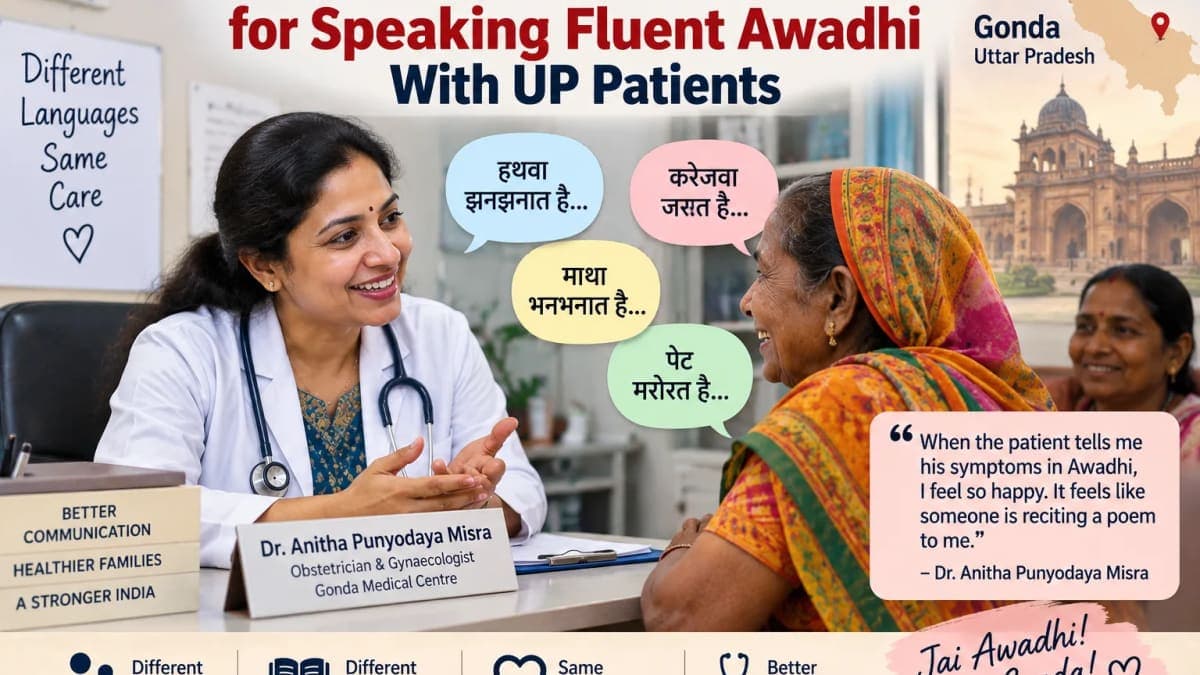
Dr Anitha Punyodaya Misra, an obstetrician and gynaecologist originally from Mangaluru, shared a video describing how she gradually developed an affection for Awadhi after settling in Uttar Pradesh. She practises and operates at Gonda Medical Centre.
In the video, Dr Misra explains that she learned to speak Hindi after marriage but eventually found herself particularly drawn to Awadhi.
“My favourite language is Awadhi. When someone talks to me in Awadhi, I feel very good,” she says.
Her lively imitation of the expressions patients use while explaining their symptoms has helped the video gain widespread attention on social media.
Why Awadhi Became Her Favourite
For Dr Misra, learning the local language appears to have been driven by everyday interaction rather than formal lessons.
Working with patients means repeatedly hearing the vocabulary, rhythms and expressions used in Awadhi. She says she especially enjoys the way patients describe what they are experiencing.
“When the patient tells me his symptoms in Awadhi, I feel so happy. It feels like someone is reciting a poem to me,” she says.
The remark became one of the most widely reported moments from the video, capturing why she finds the language so appealing.
From ‘Karejwa Jarat Hai’ to ‘Matha Bhanbhanat Hai’
Dr Misra's video becomes particularly entertaining when she demonstrates the colourful expressions she has heard from patients.
Among the examples she gives are phrases describing tingling hands, headaches, abdominal discomfort, burning sensations and other symptoms.
Expressions reported from the video include:
“Hathwa jhanjhanat hai,” “pet marorat hai,” “karejwa jarat hai,” “kamariya tootat hai” and “matha bhanbhanat hai.”
Rather than presenting them as medical terminology, Dr Misra highlights how vividly patients communicate discomfort through their everyday language.
Her familiarity with these expressions initially made her think she was becoming proficient in Awadhi. Then, another patient gave her a reminder of how much more there was to learn.
The Patient Who Left the Doctor Confused
Dr Misra recounts an encounter in which a patient used unfamiliar Awadhi expressions to describe her condition.
The doctor admits humorously that despite believing she could understand the language reasonably well, she once again found herself unable to follow everything the patient was saying.
The experience led her to conclude that mastering Awadhi is not something that happens quickly.
“Awadhi is not a course that you can finish in a day. Learning Awadhi is a journey of a lifetime,” she says.
She concludes her message enthusiastically with “Jai Awadhi! Jai Gonda!”
A South Indian Doctor Finding a Connection in Gonda
Dr Misra's background adds another dimension to the video's popularity.
She grew up in South India and is originally from Mangaluru. Reports say she spoke Kannada and English growing up and learned Hindi after marriage before becoming increasingly familiar with Awadhi through her life and medical practice in Gonda.
What makes the story resonate is therefore not simply that a doctor can reproduce local expressions. It is the way she talks about a language different from those she grew up speaking.
Instead of treating the linguistic difference as an inconvenience, she presents it as something she enjoys about interacting with patients.
Why Speaking a Patient's Language Can Matter
Behind the humorous viral video is a more practical issue: communication between doctors and patients.
Patients need to explain symptoms accurately, while doctors need to understand what they mean and communicate diagnoses, instructions and precautions clearly.
This becomes particularly relevant in areas where patients may naturally describe their health problems in a regional language rather than in standard Hindi or English.
A Hindustan report on Dr Misra's viral video said patients appreciate explanations delivered in familiar, everyday language. Such accounts, however, should be understood as reported patient reactions rather than evidence of measured clinical outcomes.
Dr Misra's story illustrates how familiarity with local speech can potentially make a clinical conversation feel more accessible—even when the doctor is still learning the finer nuances of the language.
Awadhi Has a Rich Literary Heritage
Awadhi is widely associated with the Awadh region of Uttar Pradesh and carries a significant literary tradition.
Its cultural history includes major works such as Goswami Tulsidas' Ramcharitmanas and Malik Muhammad Jayasi's Padmavat.
That history provides an interesting backdrop to Dr Misra's description of Awadhi as sounding poetic. For her, however, the connection with the language has developed not through classical literature but through ordinary conversations with patients.
More Than Just Another Viral Video
The popularity of Dr Misra's video reflects something broader about India's linguistic diversity.
A doctor from Mangaluru learning Hindi after marriage and then embracing Awadhi while practising in Gonda is a small example of how migration, work and everyday interaction can bring different linguistic cultures together.
Her story has attracted attention because the language itself becomes part of the doctor-patient relationship.
And despite becoming comfortable enough with Awadhi to recreate several local expressions, Dr Misra readily acknowledges that she still has more to learn.
For her, that appears to be part of the appeal.
As she puts it, learning Awadhi is a “journey of a lifetime.”