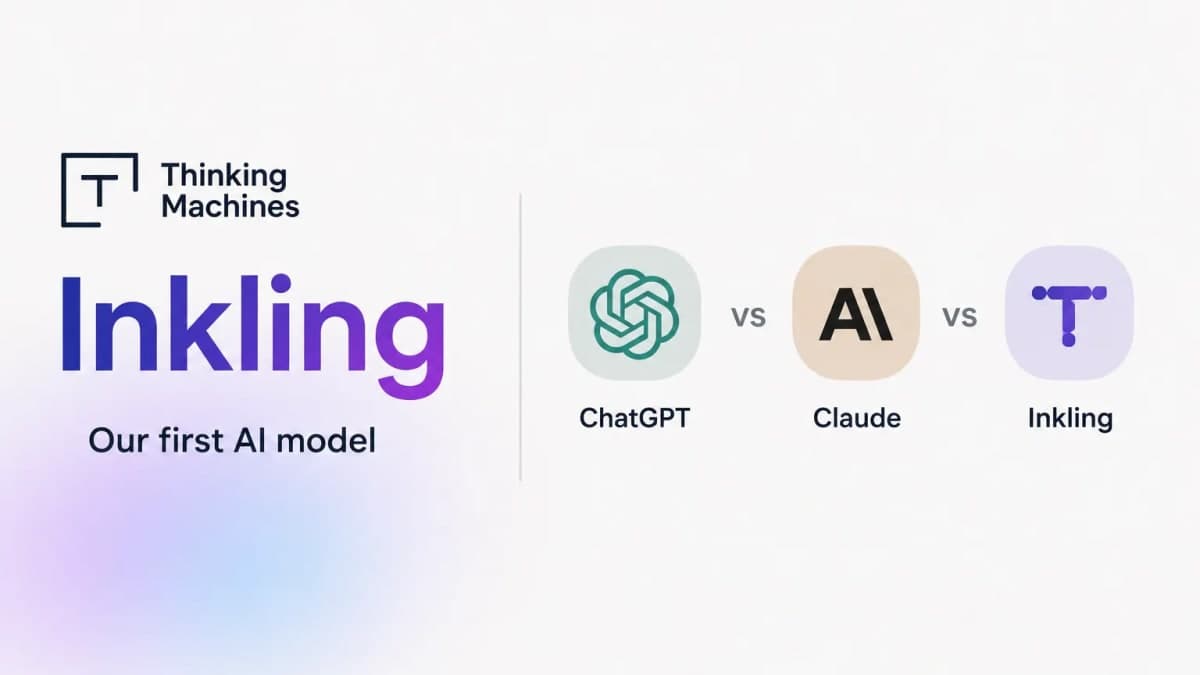
Thinking Machines has introduced its inaugural AI model, called Inkling, becoming the latest technology company to enter the rapidly evolving generative artificial intelligence market. The launch has generated interest among developers, businesses, and AI researchers eager to understand how the new system compares with well-known conversational AI platforms.
Inkling enters a market already populated by advanced large language models that assist users with writing, coding, research, reasoning, and content generation. Rather than assuming one model is superior to another, industry analysts emphasize that each AI platform is typically designed with different priorities, capabilities, and intended use cases.
Early information released about Inkling suggests that the model focuses on helping users perform complex reasoning and knowledge-based tasks. However, the complete range of its capabilities, benchmark performance, and long-term effectiveness will become clearer as more technical documentation and independent testing become available.
ChatGPT, developed by OpenAI, and Claude, developed by Anthropic, have each evolved through multiple model generations and support a wide variety of applications, including conversation, document analysis, coding assistance, brainstorming, research support, and enterprise productivity. Both platforms also include safety mechanisms, although their approaches to model behavior and system design differ.
Inkling's launch highlights the growing competition in artificial intelligence, where new companies are introducing specialized models to address different business and consumer needs. Some AI systems prioritize reasoning, while others emphasize speed, multimodal capabilities, enterprise integration, or software development assistance.
Experts note that comparing AI models involves several factors beyond conversational quality, including reasoning ability, factual accuracy, coding performance, multilingual support, context window size, response speed, pricing, privacy controls, and ecosystem integration.
At this stage, publicly available information about Inkling remains limited compared with more mature AI platforms. As developers and enterprise customers begin testing the model, additional insights are expected regarding its strengths, limitations, and practical applications across industries.
The introduction of Inkling also reflects the broader trend of increasing investment in artificial intelligence. Technology companies worldwide continue to develop foundation models capable of supporting education, healthcare, software engineering, scientific research, financial services, and business automation.
While comparisons between Inkling, ChatGPT, and Claude are attracting significant interest, industry experts caution that objective evaluations should rely on transparent benchmarks, independent testing, and real-world usage rather than early impressions alone. As the AI landscape continues to evolve, users are likely to benefit from greater competition, innovation, and choice.