DUSU Election 2026: Rebel Candidates Complicate ABVP-NSUI Contest
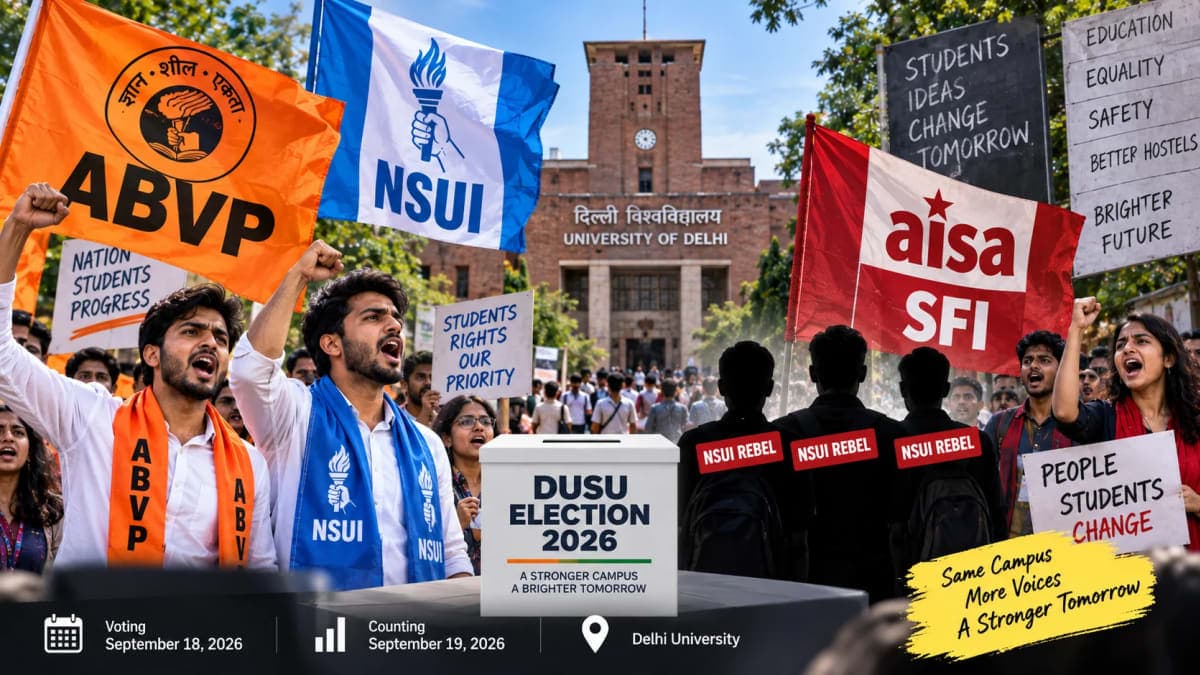
Voting is scheduled for September 18, with counting on September 19. The contest is led by the RSS-affiliated Akhil Bharatiya Vidyarthi Parishad (ABVP) and the Congress-backed NSUI, but the presence of rebels and a joint AISA-SFI panel makes the electoral arithmetic less straightforward.
For NSUI, the immediate concern is whether candidates with previous links to the organisation can draw support away from its official panel. For ABVP, a divided opposition could offer an opening, though there is not yet enough evidence to conclude that the rebels will draw exclusively from NSUI voters.
Three rebels add uncertainty to the contest
Samarth Beniwal is contesting for president, Himanshu Shokeen for vice-president and Vishesh Yadav for joint secretary. Current reports identify all three as NSUI rebels.
Their candidacies matter because DUSU contests can turn on relatively narrow margins and depend heavily on mobilisation across individual colleges.
But the effect should not be overstated before votes are cast. A rebel candidate does not automatically take votes only from a former organisation. Personal networks, college affiliations and local campaigning can produce a more complicated distribution of support.
The rebel factor is therefore a problem for NSUI, but not yet proof of an advantage for ABVP.
Yash Dabas leads ABVP’s panel
ABVP has fielded Yash Dabas for president, with Ishu Maurya contesting for vice-president, Riya Chhabri for secretary and Lakshyaraj Singh for joint secretary.
Dabas, who has a background in competitive tennis, leads a panel seeking to maintain ABVP’s position in one of the country’s most closely followed student elections.
The organisation’s campaign is built around bread-and-butter campus issues, including accommodation, women’s safety, academic facilities, employment opportunities, mental-health support and digital skills.
Housing has acquired particular urgency this year.
NSUI turns to Vijay Shankar Meena
NSUI has chosen Vijay Shankar Meena as its presidential candidate. Veer Chatrath is running for vice-president, Namrata Chaudhary for secretary and Gopal Chaudhary for joint secretary.
Meena, a Rajasthan native studying Buddhist Studies at Delhi University, comes from a tribal community. NSUI has presented his nomination as part of a wider argument for representation and social justice in student politics.
That gives the organisation a distinct political pitch, but it also faces the practical task of keeping its support consolidated while three rebels contest important positions.
The presidential contest between Dabas and Meena is likely to attract the most attention, although the fragmented field means the other three central posts could develop differently.
AISA-SFI offers a third organised choice
Reducing the election to ABVP versus NSUI would leave out another significant part of the field.
The Left-backed AISA-SFI alliance is contesting jointly. It has fielded Ananya Raturi for president, Akshat Shikhar for vice-president and Stanzin DeskYong for secretary.
The alliance is campaigning on issues including affordable accommodation, campus facilities and student welfare, offering voters an organised alternative to the two dominant student groups.
Its presence also complicates predictions about where dissatisfied or undecided voters might go. Combined with independent and rebel candidates, it makes a simple two-party calculation unreliable.
Satya Niketan tragedy puts student housing at centre of campaign
Beyond organisational rivalries, one issue has acquired unusual weight in this election: where Delhi University students live and whether those accommodations are safe.
The Satya Niketan building collapse, which killed seven people, including five students, has brought the shortage and safety of student accommodation into the campaign.
A large number of DU students depend on paying-guest facilities and private rentals because university and college hostels cannot accommodate everyone. That has made questions about building safety, fire compliance, rents and hostel availability immediate rather than abstract campaign promises.
ABVP has proposed measures including separate hostels for women, a Student Housing Cell, safety helplines and regular fire audits.
The organisation has also said a 1,340-bed hostel is under construction in North Campus as a result of efforts it supported. That assertion comes from ABVP and should be treated as a campaign claim rather than an independently established achievement.
AISA-SFI has similarly pushed accommodation higher on its agenda, calling for more college hostels and stronger safeguards for students living in private housing.
Campaign also draws controversy over university neutrality
The election has not been free of institutional controversy.
Social-media posts involving a senior Delhi University official and a college principal alongside, or appearing supportive of, ABVP candidates drew objections from NSUI and sections of the university community.
NSUI accused university authorities of bias and sought action.
No such allegation should be treated as proof that the university administration improperly backed ABVP. What the episode does show is how closely the conduct of university officials is being scrutinised during a highly competitive campaign.
The election will be decided college by college
National political affiliations give DUSU elections much of their visibility, but their mechanics remain intensely local.
Candidates need organisation across colleges, volunteers capable of bringing students to polling stations and networks that extend beyond headline campaign events. Turnout can therefore matter as much as the broader political mood.
That makes NSUI’s rebel problem particularly relevant. If the rebels retain strong networks in specific colleges, even modest shifts could affect close contests. If they fail to convert their personal support into votes, their impact may prove smaller than the campaign speculation suggests.
ABVP, meanwhile, will try to consolidate its existing base rather than depend on divisions among opponents. NSUI needs both a persuasive campaign for its official candidates and enough organisational discipline to prevent fragmentation.
AISA-SFI faces a different challenge: converting dissatisfaction with the two larger organisations into votes across a university spread over numerous colleges and campuses.
What is at stake on September 18
DUSU elections routinely draw attention beyond Delhi University because student organisations associated with national political movements treat the union as an important arena for recruitment and leadership development.
Yet the 2026 campaign has also been shaped by distinctly local concerns.
Housing safety has moved up the agenda after a deadly building collapse. Representation is part of NSUI’s pitch. ABVP is campaigning on a broader package of student services and campus infrastructure, while the Left alliance is attempting to build support around welfare and accommodation.
Running through all of this is the rebel factor.
It may damage NSUI, alter individual races or ultimately have less influence than expected. The available evidence does not justify a stronger prediction before polling.
What is clear is that the presence of three rebel candidates has made an already competitive DUSU election more difficult to read ahead of the September 18 vote.