Five Top Companies Lose Over ₹1 Lakh Crore in Market Value
The weakness in Indian equities during the week ending August 14, 2026, translated into a sharp reduction in the market value of several corporate heavyweights.
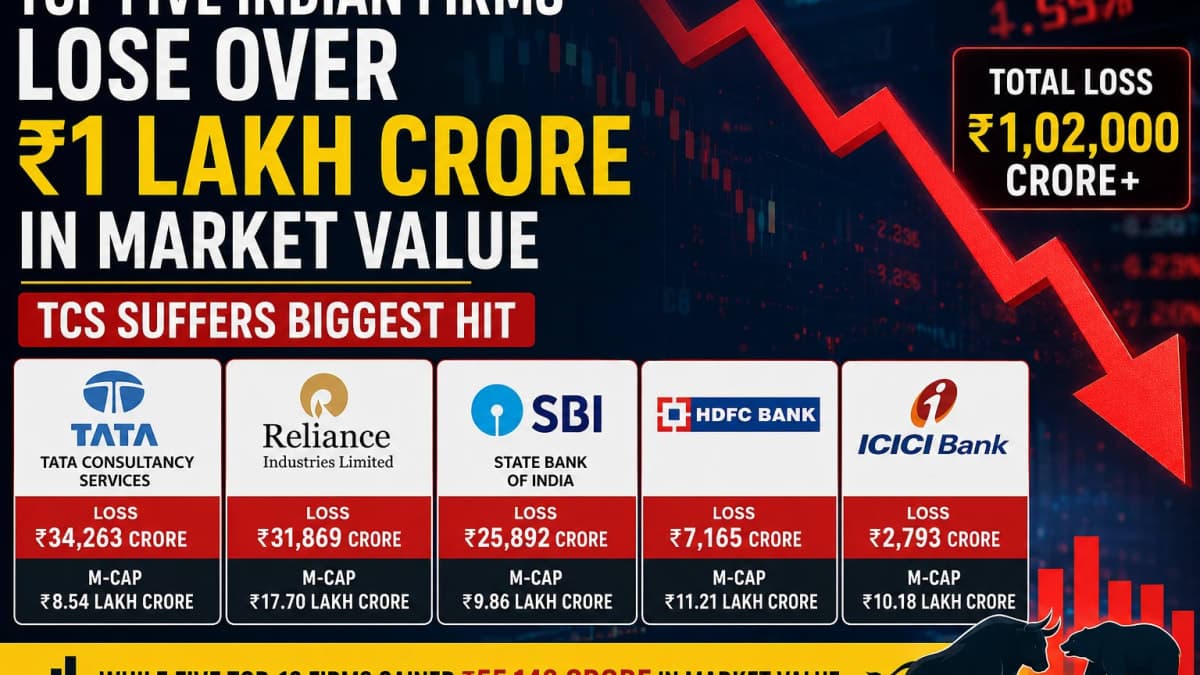
The combined market capitalisation of TCS, Reliance Industries, State Bank of India (SBI), HDFC Bank and ICICI Bank declined by roughly ₹1.02 lakh crore during the week. The losses came as the broader market remained under pressure, with the BSE Sensex declining 489.92 points, or 0.62%, while the NSE Nifty fell 204.65 points, or 0.83%.
Market capitalisation represents the total stock-market value of a listed company's outstanding shares. As a result, changes in share prices can quickly add or erase thousands of crores from the valuation of India's biggest companies.
TCS Records the Biggest Valuation Loss
Tata Consultancy Services emerged as the biggest loser among the top-10 companies.
The IT major's market capitalisation declined by ₹34,263.28 crore, bringing its total valuation down to approximately ₹8.54 lakh crore. The fall highlights the pressure on the technology heavyweight during a generally weak week for domestic equities.
Reliance Industries registered the second-largest erosion. Its market value fell by ₹31,869.13 crore to about ₹17.70 lakh crore.
SBI's valuation declined by ₹25,891.88 crore to around ₹9.86 lakh crore, while HDFC Bank lost ₹7,165.37 crore, leaving it valued at approximately ₹11.21 lakh crore.
ICICI Bank recorded a comparatively smaller decline of ₹2,792.65 crore, taking its market capitalisation to roughly ₹10.18 lakh crore.
Five Top-10 Companies Buck the Negative Trend
The weakness was not uniform across India's largest companies. Five members of the top-10 group — Bharti Airtel, Bajaj Finance, Larsen & Toubro, Life Insurance Corporation of India (LIC) and Hindustan Unilever — recorded valuation gains.
Together, these five companies added ₹55,149.45 crore in market capitalisation during the week.
LIC emerged as the largest gainer, adding ₹26,438.49 crore and taking its valuation to around ₹5.23 lakh crore.
Bharti Airtel followed with an increase of ₹20,592.13 crore, lifting its market value to approximately ₹12.43 lakh crore. Bajaj Finance gained ₹3,548.79 crore, Larsen & Toubro added ₹2,490.66 crore and Hindustan Unilever's valuation increased by ₹2,079.38 crore.
What Drove the Weakness in Indian Markets?
The valuation losses came against a broader bearish backdrop in domestic equities. Elevated crude oil prices, geopolitical uncertainty and mixed signals from global markets weighed on investor sentiment during the week, according to market commentary reported alongside the valuation data.
Large-cap companies have an outsized influence on benchmark indices because of their substantial market values. When heavyweight stocks such as TCS, Reliance and major private-sector banks decline simultaneously, their movements can contribute significantly to weakness in the broader indices.
At the same time, gains in companies such as LIC and Bharti Airtel demonstrate that investors were not selling across the market indiscriminately. Instead, the contrasting performance indicates a degree of sector- and company-specific positioning.
Reliance Remains India's Most Valuable Listed Company
Despite suffering a significant weekly decline, Reliance Industries retained its position as India's most valuable listed company.
The valuation ranking was led by Reliance Industries, followed by Bharti Airtel, HDFC Bank, ICICI Bank, SBI and TCS. Bajaj Finance, Larsen & Toubro, LIC and Hindustan Unilever completed the top-10 list.
Why the ₹1 Lakh Crore Erosion Matters
The decline illustrates how quickly market sentiment can affect even India's largest corporations. A company's market-cap loss does not mean an equivalent amount of cash has physically left the business; rather, it reflects a reduction in the market value investors collectively assign to its shares.
The split performance among the top 10 is equally significant. While five companies lost more than ₹1 lakh crore together, the five gainers recovered more than ₹55,000 crore in combined valuation. This suggests that the week's weakness was substantial but selective rather than a uniform collapse among large-cap stocks.
Investors will now be watching whether pressure on heavyweight technology, banking and energy stocks continues or whether improving domestic and global cues allow valuations to recover in subsequent sessions.