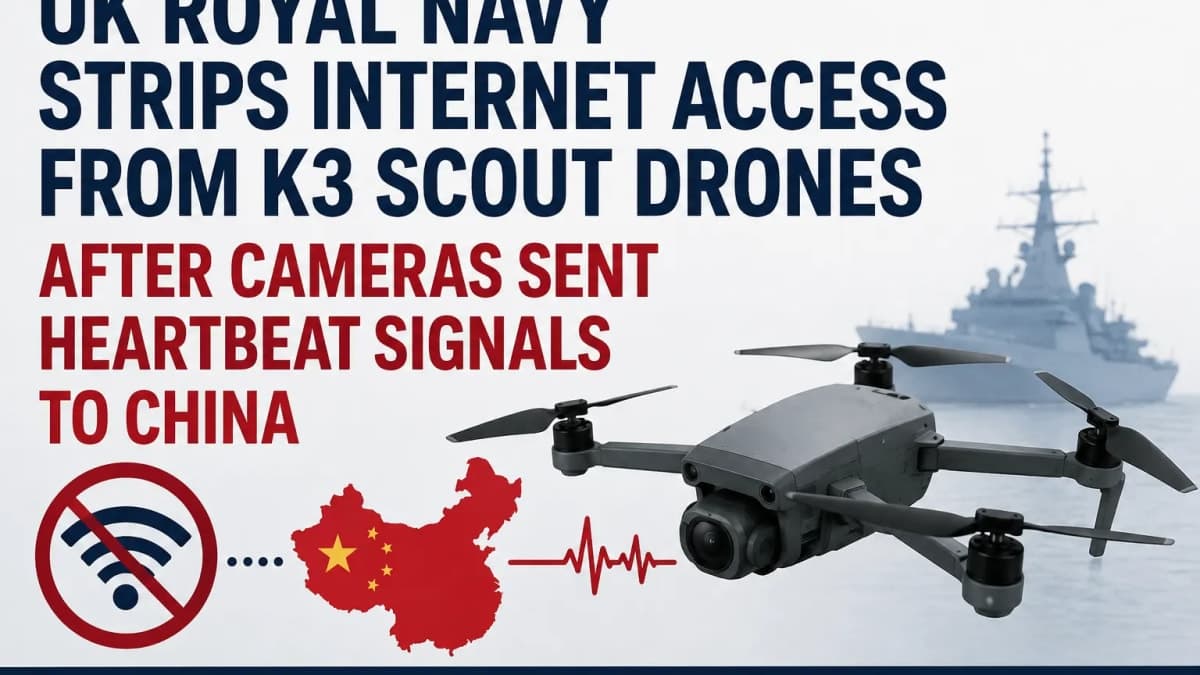
Royal Navy Disconnects K3 Scout Drones From Internet
The UK Royal Navy has stripped internet access from K3 Scout drones after cameras associated with the systems were found transmitting heartbeat signals to China, raising questions about cybersecurity and the use of connected components in sensitive military equipment.
Disconnecting the systems represents a precautionary approach to reducing the possibility of unwanted external communications from equipment operating in a defence environment.
The episode also highlights a broader challenge facing modern armed forces: even relatively small connected components can introduce cybersecurity and supply-chain considerations into platforms that increasingly depend on commercial digital technology.
Camera Heartbeat Signals Trigger Security Concern
At the centre of the issue are heartbeat signals associated with cameras on the K3 Scout drones.
In computing and connected-device systems, heartbeat communications are generally used to indicate that a device or service remains active and connected. Such communications do not, by themselves, establish that sensitive operational information has been transferred.
However, an unexpected external connection can become a significant concern when the hardware is being used in a military environment.
The reported destination of the communications — China — makes the issue particularly sensitive given the importance governments place on controlling the flow of information from defence-related networks and equipment.
Why Removing Internet Access Matters
Preventing the drones from accessing the internet can substantially restrict the ability of connected components to communicate with outside servers.
For military organizations, isolating equipment can be an effective security measure when external connectivity is unnecessary for its primary function. It can reduce the number of potential pathways through which information could leave a system or through which external services could interact with it.
The Royal Navy's response therefore demonstrates how connectivity itself can be treated as a potential security exposure when equipment is operating in a sensitive environment.
Commercial Technology Creates New Defence Challenges
Modern military organizations increasingly operate alongside a rapidly expanding commercial technology sector producing drones, cameras, sensors and other network-connected hardware.
Such products can offer advantages including faster development and easier access to advanced capabilities. At the same time, connected commercial components may depend on cloud infrastructure, remote servers or routine network communications that were designed for ordinary civilian environments.
Those features require additional scrutiny when the same technology is introduced into defence applications.
The K3 Scout case illustrates why cybersecurity assessments increasingly need to examine not only the primary platform but also individual cameras, sensors, software and other components attached to it.
Supply-Chain Security Becomes Increasingly Important
The incident also draws attention to technology supply chains.
A sophisticated system can contain hardware and software from numerous suppliers. Each component may have its own firmware, network behavior and external dependencies.
For defence organizations, understanding those connections can be essential. A seemingly routine communication generated by one component can create concern if its destination is unexpected or outside the organization's security boundaries.
As drones become more widely used for reconnaissance, training and other military purposes, assessing the digital behavior of their components is likely to become increasingly important.
Heartbeat Traffic Does Not Automatically Mean Espionage
The reported discovery should also be interpreted carefully.
A device sending a heartbeat signal to an overseas server does not automatically demonstrate surveillance, espionage or the transmission of classified information. Heartbeat traffic can serve ordinary technical purposes such as connectivity checks, device management or service monitoring.
Based solely on the reported facts, the existence of the signals does not establish what information, beyond those communications, may have been transmitted or why the cameras were contacting servers in China.
That distinction is important when evaluating the security implications of the case.
Why the K3 Scout Drone Case Matters
The broader significance extends beyond a single drone system.
Military platforms are becoming increasingly software-driven and connected, meaning cybersecurity can depend on everything from the main operating system to individual cameras and sensors.
The Royal Navy's decision to remove internet access demonstrates one method of managing that risk: limiting connectivity when it is not considered essential.
The episode may also encourage closer examination of network behavior across other connected defence equipment, particularly where commercial components are integrated into sensitive systems.
Balanced Analysis
The decision to disconnect the K3 Scout drones can be viewed as a straightforward risk-reduction measure. When unexpected external communications are identified in military equipment, restricting connectivity can reduce exposure while allowing security implications to be assessed.
At the same time, the discovery of heartbeat signals should not be treated on its own as proof that sensitive British military information was deliberately sent to China. Establishing that would require additional technical evidence about the content, purpose and destination of the communications.
The larger lesson concerns visibility and control. As military organizations adopt increasingly sophisticated connected hardware, knowing exactly when, where and why every component communicates externally is becoming an important part of operational cybersecurity.
This article is based on reporting published by TELEGRAPH CO UK.