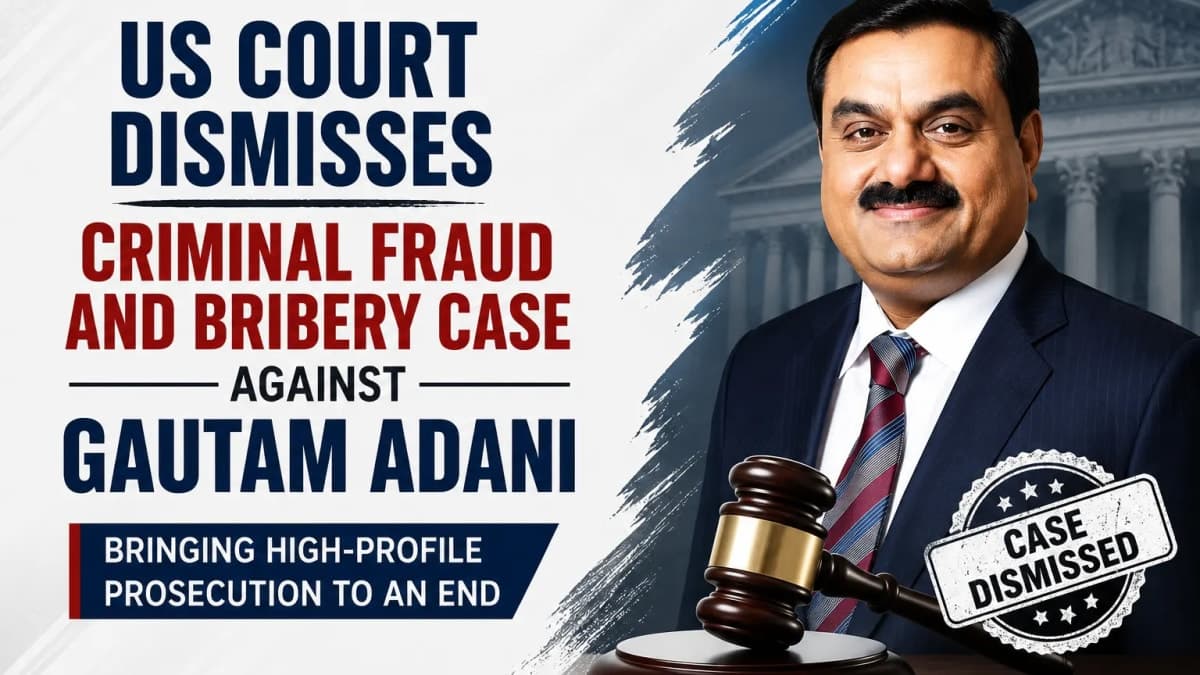
US Court Dismisses Criminal Case Against Gautam Adani
A US federal judge has dismissed criminal charges against billionaire Gautam Adani, formally bringing an end to a high-profile case involving allegations of bribery and misleading investors.
US District Judge Nicholas Garaufis approved the dismissal after the US Department of Justice decided that it would no longer pursue the prosecution. The case had accused Adani and other defendants of involvement in an alleged scheme connected with solar-energy contracts in India and representations made to investors in the United States.
Adani and the Adani Group had consistently denied wrongdoing and rejected the allegations against them.
The dismissal represents a significant legal development because prosecutors had originally presented the case as a major international corporate-fraud investigation.
What Was the Case About?
The criminal proceedings originated from allegations that hundreds of millions of dollars in bribes were promised or paid to Indian officials in connection with agreements involving solar power.
US authorities had also alleged that investors were misled while money was being raised from international financial markets.
The allegations resulted in charges that included securities fraud, wire fraud and conspiracy. The case attracted global attention because of Gautam Adani's position as one of India's most prominent business figures and the international reach of companies belonging to the Adani Group.
The defendants disputed the accusations throughout the proceedings.
Why Did the US Justice Department Stop Pursuing the Case?
The US Department of Justice moved in May 2026 to abandon the criminal prosecution.
In subsequent court proceedings, the department defended that decision on legal and practical grounds. Among the issues raised were the predominantly foreign nature of the alleged conduct, challenges associated with proving the case and changing enforcement priorities.
The decision, however, received unusual scrutiny from Judge Garaufis.
Before granting the dismissal, the judge sought additional information about the government's reasoning and examined whether anything had been offered or promised in connection with the decision to end the prosecution.
The court ultimately concluded that Gautam Adani's previously announced plans for major investment in the United States did not provide a basis to reject the government's request for dismissal.
Judge Raises Questions Over DOJ's Handling
Although the criminal case was dismissed, the ruling was not an unqualified endorsement of the way the Justice Department handled its withdrawal.
Judge Garaufis expressed concerns about the process followed by senior Justice Department official Trent McCotter. According to the court's assessment, the decision-making process appeared to have bypassed input from some of the investigators and prosecutors who had worked on the matter.
The criticism is important because it separates two questions: whether the prosecution should continue and whether the government's process for deciding to abandon it was appropriate.
Ultimately, courts generally have limited ability to force federal prosecutors to continue pursuing a criminal prosecution that the government itself no longer wishes to pursue.
What the Dismissal Means for Gautam Adani
The decision removes one of the most significant criminal legal challenges facing Gautam Adani in the United States.
The dismissal is particularly important because it was granted with prejudice, meaning the dismissed criminal charges cannot simply be brought again in the same case.
For Adani and his business group, removing this legal uncertainty could have implications beyond the courtroom. International investigations involving senior executives can affect investor confidence, financing arrangements, relationships with global institutions and perceptions of corporate governance.
Adani welcomed the development and reiterated his confidence in fairness and the rule of law.
Separate Civil Proceedings
The dismissal of the criminal prosecution should not be confused with the resolution of separate civil regulatory proceedings.
Gautam Adani and his nephew Sagar Adani separately agreed to payments of $6 million and $12 million respectively to resolve related US Securities and Exchange Commission civil charges.
Civil settlements and criminal prosecutions operate under different legal standards, so the outcomes should be viewed separately rather than treated as interchangeable findings.
Why the Decision Matters for Adani Group
The US prosecution had represented a potentially significant risk for the conglomerate because of its access to global capital markets and its operations across infrastructure, ports, energy and other industries.
Ending the criminal proceedings removes an important source of uncertainty that had followed the group since the charges emerged in 2024.
The immediate market reaction reflected that significance. Shares of several Adani Group companies gained ground following news of the court decision, suggesting investors viewed the dismissal as reducing a major legal overhang.
However, a criminal case being dismissed does not by itself resolve every broader debate surrounding corporate governance or regulatory oversight. Investors are likely to continue assessing the group's financial performance, debt position, expansion plans and governance practices independently.
Balanced Analysis
For Gautam Adani, the dismissal is clearly a major legal victory: the US criminal prosecution is ending without a trial or criminal conviction, eliminating a potentially serious threat to both the businessman and his corporate empire.
At the same time, the circumstances surrounding the Justice Department's decision attracted judicial scrutiny. Judge Garaufis' criticism of aspects of the government's handling means the ruling also raises broader questions about prosecutorial decision-making in politically and economically sensitive international cases.
It is therefore important to distinguish between the original allegations, which Adani denied, and facts established through a criminal trial. Because the prosecution was discontinued, the disputed allegations were not ultimately tested through a full criminal trial and verdict.
For investors, the most immediate consequence is greater legal certainty. For legal observers, the case may remain notable for the debate it generated over prosecutorial discretion, international enforcement and judicial oversight.
This article is based on reporting published by Business Standard.